


Key points
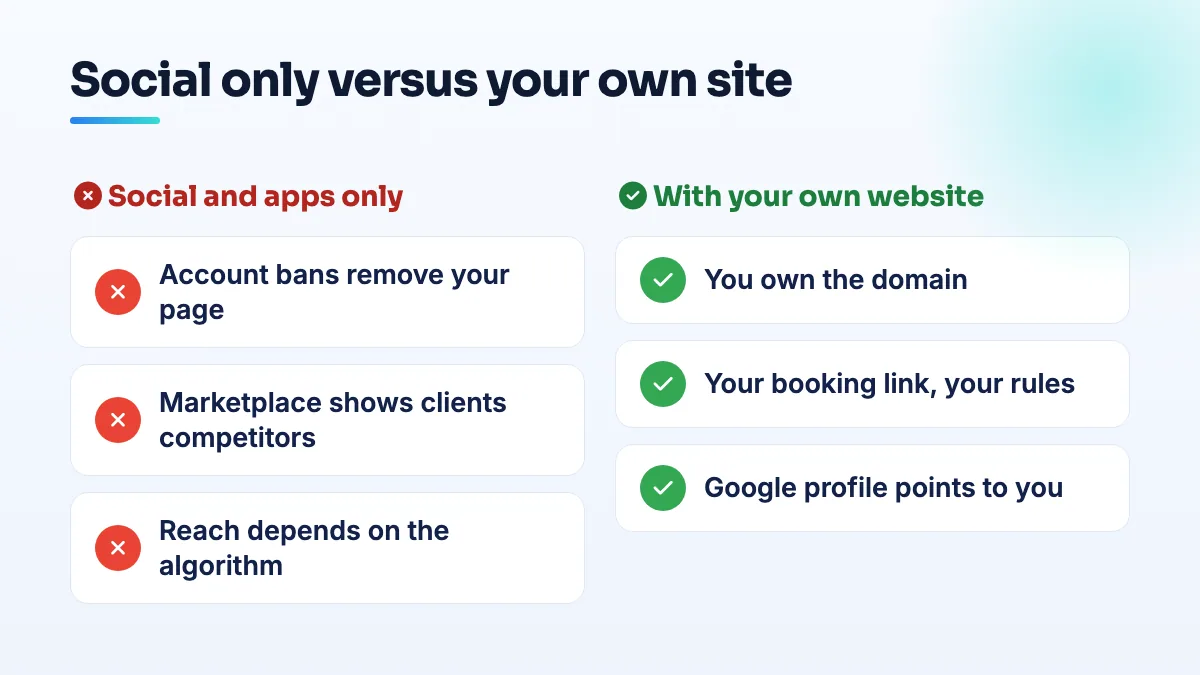
- A social account can be banned for life
- Booking marketplaces show your clients competitors
- A small site beats no site
- Your Google profile needs somewhere to point
- Keep social and booking; add the site underneath
"Do I need a website if I have Instagram?" is a fair question when every client already books through DMs or an app. The honest answer is that you can run without one, right up until the platform changes the rules, and then you have nothing.
Barbers ask this about Booksy, nail techs and tattoo artists ask it about Instagram, and sign shops ask it about Facebook. The risk is the same for all of them.
Why relying on one platform is the real risk
The clearest warning I found came from a sign shop. In a Signs101 thread about marketing a sign shop with no money, an owner whose shop relied on Facebook described getting a lifetime ban and losing the business page. The page went, and with it the one place customers knew to look.
Booking marketplaces carry a quieter version of the same risk. Barbers on Reddit point out that Booksy mostly feeds you Booksy's own clientele, and that those clients are shown other shops too. On Google, barbershop owners in the Help Community describe Booksy "Book online" buttons appearing on their profiles that they can't remove. When the platform owns the booking button, it owns the moment the client decides.
Instagram's problem is reach. Tattoo artists describe engagement collapsing after years of posting, and clients in a Reddit thread from people trying to find tattoo artists say they can't find anyone without Instagram because many studios don't take walk-ins and keep the door locked. If the only way to find you is an app you don't control, you're only as visible as the app lets you be.
Do I need a website if I have Instagram and a booking app?
You don't need a big one. Business owners in a Reddit thread asking whether Booksy and Instagram are enough were mostly worried about cost and effort. A useful site for a barbershop, salon, studio or sign shop is five pages or fewer. Here's what I'd put on it:
- Register a domain in your business name, in your own name. Not the web designer's account and not the booking platform's subdomain. This is the one thing no platform can take away, and it's where every small business website I build starts.
- Build a home page that says who you are, where you are and how to book. Your address or service area, hours, phone, and your booking link as the main button. Keep the booking app. The site just stops it being the only door.
- Add a services and prices page. Fades, gel sets, sleeves, vehicle lettering: whatever you sell, with starting prices. That's what people search for, and a booking app's listing rarely ranks for it under your name.
- Add a work page with your own photos. Pull your best posts in with captions that say what the work is. For a multi-chair shop, give each barber, tech or artist a short section with their own booking link.
- Point your Google Business Profile at the site. Put your domain in the website field, not your Instagram. You can still add Instagram as a social link; a tattoo studio owner asked about this in a Help Community thread about linking Instagram to a Google profile. Link your Instagram bio back to the site too.
- Collect client contacts you own. A simple sign-up for cancellations or a monthly offer. If an account is ever banned, this list is how you tell clients where you went.
I explain the Google side of this in more depth in the answer on whether you need a website with a Google Business Profile.
When a social-only setup is fine, and what changes by business
If you're a solo artist booked out months ahead from a loyal following, a site is insurance rather than growth. I'd still get the domain and a one-page site, because the ban or the algorithm change never comes with notice.
- Barbershops: the risk is the marketplace. Weigh what the app costs you against what it brings, which I cover in is Booksy worth it for barbers, and check which booking buttons your Google profile shows, because owners often find ones they never added. It's the first fix in most barbershop SEO work I do.
- Nail salons and tattoo studios: the risk is reach. Your site and Google profile are how clients find you when they search by style and area rather than by handle.
- Sign shops: the risk is a ban. Commercial buyers also expect a real site with installed work before they'll ask for a quote.
People also ask
Can a booth renter get their own Google Business Profile?
Usually not at the salon's address. Google only lets a business in a shared space list that address if it has its own dedicated space with permanent signage, where customers deal with its own staff during business hours. An open-floor chair doesn't pass that test. A private suite with your name on the door can, and a renter who also travels to clients can list as a service-area business with the home address hidden.
Read the full answer: Can a booth renter get their own Google Business Profile? →
Is Booksy worth it for barbers?
It can be, as booking software and as a short-term way to fill an empty chair. As your main source of new clients, it's weaker than it looks: barbers report that Booksy's marketplace sends its own clientele, shared with every other barber nearby, and some accuse it of taking referrals and fees. Use it for scheduling, and build your Google profile and website as the client channel you own.
Can a print shop publish trade-only pricing without undercutting resellers?
Yes, as long as the trade prices sit behind a login and your public prices never undercut them. Put retail pricing or a quote form on the public site, and give approved resellers, sign shops and designers a separate trade account with their own price list and blind shipping. Sign shop owners describe trade-only pricing as the main defense against competing with your own customers, so the rule is simple: never quote a reseller's client below what the reseller would charge.
Read the full answer: Can a print shop publish trade-only pricing without undercutting resellers? →
Can you appeal a Google review decision more than once?
No. You get one appeal on each review Google decides not to remove, and once the appeal is denied, that decision is final for that review. Wait for the first decision before appealing, and only appeal with new evidence tied to a specific policy clause. After that, your options are a calm public reply, reporting new reviews from the same accounts, and outnumbering the review with genuine ones.
Read the full answer: Can you appeal a Google review decision more than once? →
How do you ask a B2B buyer for a Google review?
Ask one named person who saw the job go well, such as the engineer whose first article passed or the manager who watched your sign go up, within a day or two of the job. Ask in person first, then send a short email with your direct review link. Tell them they don't need to mention part numbers or their company, and never offer anything in return.
Read the full answer: How do you ask a B2B buyer for a Google review? →