


Key points
- Ask the person who saw the result, not only purchasing
- Ask right after a win: approval, delivery, install, reorder
- Buyers under NDA can skip part and company names
- Never ask suppliers, distributors or partners to review you
- No gift cards or discounts in exchange for reviews
Most machine shops, fabricators and sign shops sit on four or five Google reviews because nobody asks the people who buy from them, and asking a purchasing manager feels strange. The way to ask a B2B customer for a Google review is the same way you'd ask for a reference: one named person, right after a job went well, with a direct link and no script.
Below is why it matters even when your buyers find you through referrals, who to ask inside a customer's company, the message I'd send, and where Google's rules draw the line for businesses that sell to other businesses.
Why a shop that sells to businesses still needs reviews
Your buyers read reviews too. In a Signs101 thread where sign shop owners traded tips on asking for Google reviews, one owner said of suppliers: "I pass up quite a few because of bad reviews." That's a business owner describing how he picks vendors. Your customers do the same thing when they check you out after a quote lands on their desk.
The fear runs the other way as well. In a Practical Machinist thread on whether a job shop should start taking work from the public, public Google reviews were one of the reasons owners gave for staying B2B only. I understand it. But you don't need retail customers to build a review profile, and staying invisible doesn't protect you: a buyer who searches your name and finds three reviews from years ago learns nothing.
It matters more now because the middlemen are expensive. Owners in a long Practical Machinist thread about quoting through Xometry describe marketplace jobs paying barely above material cost. Every buyer who finds you directly, on Maps or by searching your name, is a buyer you don't split with a platform. A handful of specific, recent reviews is part of what makes that direct call happen.
Who to ask inside a customer's company
The purchasing manager signs the PO, but they're often not the person who felt the result. I'd ask whoever saw the job go well:
- The engineer or quality lead whose first article passed inspection, or who got a quick answer when a drawing had a problem.
- The plant or maintenance manager whose line kept running because a replacement part turned up on time.
- The facility or marketing manager who watched your crew install their sign on the day you promised.
- The owner, at a small customer, where the buyer and the decision maker are the same person.
Some people will tell you their company doesn't let staff publicly endorse suppliers. Take that at face value, thank them, and don't push. Plenty of others can review you personally.
A lot of B2B work is under NDA, which worries buyers. Tell them up front they don't need to name the part, the program or their company. Lead time, communication and how you handled a problem are what the next buyer wants to read anyway.
How to ask a B2B customer for a Google review, step by step
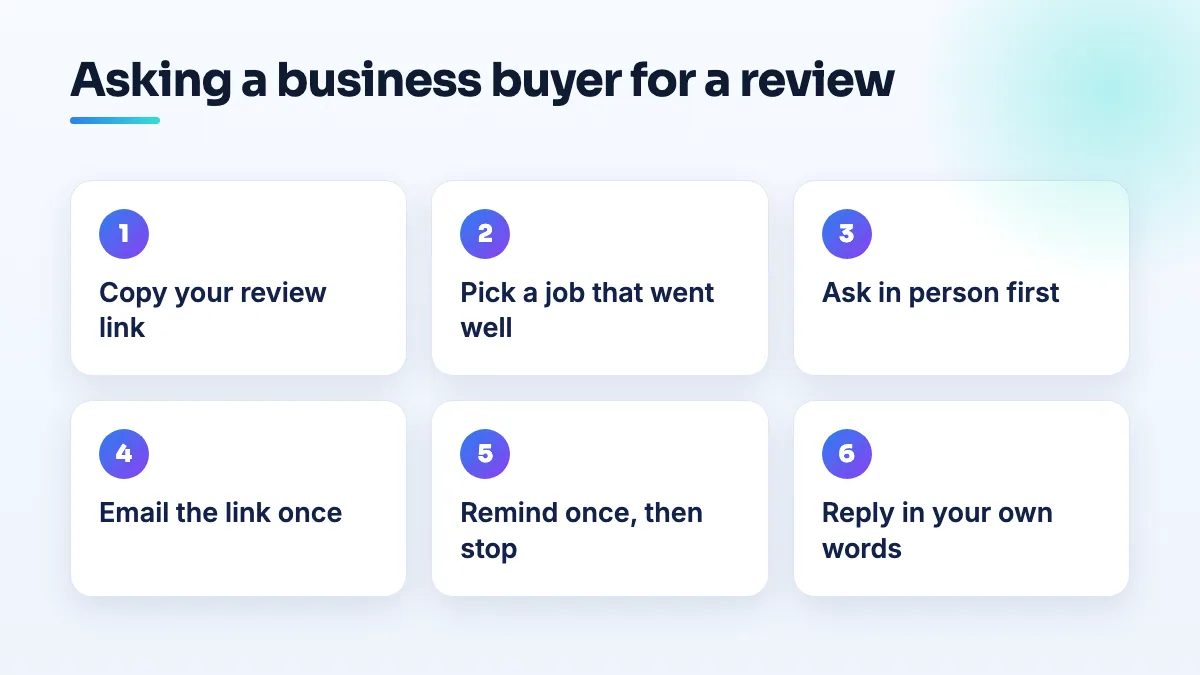
- Copy your review link first. Your Business Profile gives you a short link that opens the review box directly. Save it somewhere you can paste it in ten seconds.
- Pick a moment that went well. A first article approved, a rush job shipped on time, a sign installed and lit, a reorder placed. Ask within a day or two, while they still remember it.
- Ask out loud first. On the phone or at the dock: "We're trying to get a few honest Google reviews from customers. Would you be open to writing a couple of lines about working with us?" Most people say yes to a person before they'd say yes to an email.
- Send one short email with the link. Two or three sentences: thanks for the order, the link, and a note that they don't need to mention part numbers or their company name.
- Tell them what's useful, not what to write. "Other buyers usually want to know about lead time and communication" is fine. Drafting the review for them is not.
- Remind once, then drop it. One follow-up a week later. If it doesn't happen, it doesn't happen, and you still have the relationship.
- Reply to every review in your own words. Thank them for something specific. Don't name their company if they didn't.
What's different for machine shops, fabricators, sign and print shops
Machine shops have few customers and long relationships, so volume will always be low. A dozen honest reviews collected over a couple of years reads fine to a buyer. Ask the engineers you actually talk to, and ask at first-article approval, not at invoice time.
Fabricators and manufacturers often ship nationally, so reviews won't come from local people. That's fine. They show up when a buyer searches your company name after getting your quote, which is when they count.
Sign shops have the easiest moment in B2B: the install. Ask the business owner or manager standing next to the finished sign, then add your own photo of that install to your profile.
Print shops live on reorders. The reorder is the ask, because it proves the last job was good enough to repeat.
Where Google's rules draw the line for B2B
Google's policy on user contributions says a conflict of interest can include "a contractual or consultory relationship, or other professional or personal affiliations." In B2B, my reading is simple: a customer who paid you for work can review you. Your distributors, material suppliers, subcontractors, the shop you swap overflow work with and your own staff should not.
- No gift cards or discounts for reviews. Google doesn't allow incentives, and they don't even work well. A lawn care owner in a LawnSite thread about collecting Google reviews gave gift cards to all 21 clients, spent $500 and got none. Plain asking worked better.
- No review swaps with other businesses. "I'll review you if you review me" is exactly the affiliation the policy describes.
- Don't only ask the customers you're sure about. Ask after good jobs, but don't filter people out because they might give four stars.
- Don't email your whole contact list in one afternoon. Twenty reviews in a week from a shop that had four looks odd, and bursts are what review filters notice.
If you're unsure about the basics, I cover the general rules on asking for Google reviews separately. For industrial clients, reviews are one part of the profile work we do in machine shop SEO and SEO for manufacturers, along with sign shop SEO for installers. If you'd rather hand the whole profile over, that's our Google Business Profile management, and it sits alongside B2B SEO for the capability pages buyers read before they send a print.
People also ask
Is AS9100 certification worth it, and does it help a machine shop get found?
Only if buyers you want already ask for it. Owners report around $10,000 and eight months for AS9100, and it won't rank a shop by itself. It helps when aerospace, medical or defense buyers filter on it, and only if you publish it clearly: a certification page with scope and expiry, and a mention on every relevant capability page.
Read the full answer: Is AS9100 certification worth it, and does it help a machine shop get found? →
Does local SEO matter for a manufacturer that ships nationwide?
Yes, but for a narrower job than most shops expect. Your Google Business Profile ranks around your building, not across the country, so local search wins the buyers and engineers within driving distance of your plant. National work comes from website pages about your processes, materials and industries. Set up both, keep one profile at your real address, and don't stretch the service area to cover the country, because it won't change where you rank.
Read the full answer: Does local SEO matter for a manufacturer that ships nationwide? →
Can a print shop publish trade-only pricing without undercutting resellers?
Yes, as long as the trade prices sit behind a login and your public prices never undercut them. Put retail pricing or a quote form on the public site, and give approved resellers, sign shops and designers a separate trade account with their own price list and blind shipping. Sign shop owners describe trade-only pricing as the main defense against competing with your own customers, so the rule is simple: never quote a reseller's client below what the reseller would charge.
Read the full answer: Can a print shop publish trade-only pricing without undercutting resellers? →
How do you claim a Google listing that has no claim button?
Start from Business Profile Manager instead of the listing. Add a business, pick your existing listing from the suggestions, and Google will either let you verify it or route you to its ownership request, which emails the current owner. If neither appears, check every Google account you've used, then post the Maps link in the Help Community so a Product Expert can look.
Read the full answer: How do you claim a Google listing that has no claim button? →
Is that Google Business Profile email or call a scam?
Usually yes, if you didn't ask for it. Unsolicited emails and calls warning that your listing will be removed, your site isn't compliant or your ranking is at risk are mostly sales pitches or scams. Real Google requests do exist, so don't judge by how the message looks: close it, sign in to your profile yourself, and act only on requests that appear there.
Read the full answer: Is that Google Business Profile email or call a scam? →