

If nearly every new customer you've landed in years came through someone who already knew you, you don't have a sales channel. You have luck that hasn't run out yet. The answer to how to get new customers for a machine shop is to build one channel you own, a website and Google Maps listing that bring in RFQs from buyers who've never heard of you, and then measure it against the trade shows and referrals you already pay for in money or time.
The pattern is the same in machining, fabrication and commercial print. A metal fabrication shop owner on Reddit described going from ten major clients down to four with no idea how B2B manufacturers generate leads. On Practical Machinist, a long thread about finding and keeping customers keeps coming back to the same answer: referrals. That works until it doesn't, and there's no lever you can pull when it slows.
Below is why the usual channels stall, the steps I'd take to build one you control, how to measure it honestly, and what changes for a print shop.
Why referrals and trade shows stop being enough
Referrals are the best customers you'll ever get, and I'd never tell a shop to stop earning them. The problem is control. You can't decide to get three more next month. When one of your big accounts moves production or gets bought, the pipeline behind it is empty.
Trade shows feel like the active alternative. In a Practical Machinist thread asking whether Design-2-Part shows are worth it, one owner had done about a dozen of them without a single order he could trace back to a show. That doesn't mean shows never work. It means nobody was counting.
RFQ portals and marketplaces are the third option most shops try. Owners describe burning quoting hours on portals where overseas low bids win, and on marketplaces where the platform's cut keeps growing. I've written separately about whether Xometry is worth it for a job shop. The short version: it can fill a gap in the schedule, but the customer relationship belongs to the platform, not to you.
What's left is the complaint in a 2026 Practical Machinist thread saying getting leads is harder than doing the work. Every channel feels broken because none of them is yours.
Where new customers for a machine shop come from
This is how the channels compare from the owner's side. The middle column is what shop owners report in the forums, not my numbers.
| Channel | What owners report | Who controls it | What to count |
|---|---|---|---|
| Referrals | Most of the work, with no way to make more | Your existing customers | New accounts per quarter and who sent them |
| Trade shows | About a dozen shows, no traceable order | The show organizer | Conversations, then RFQs, then awarded jobs |
| RFQ portals and marketplaces | Quoting hours lost to overseas low bids | The platform | Quotes sent versus jobs won, and the margin |
| Cold calling | Welding and fab shops told digital is under a tenth of their marketing | You | Calls, meetings, first orders |
| Your website and Google Maps | Maps called genuinely useful by machinists | You | RFQs by source, then awards |
The cold-calling line comes from a Reddit thread from a welding and fabrication business told that digital should be a small slice of its marketing, and left with no plan for that slice. My view is that the slice matters more than its size suggests, because it's the only one that keeps working while you're on the shop floor.
How to build the one channel you own
This is the order I'd do it in for a job shop or fabricator starting from a thin website and no Maps listing. None of it needs a big budget. It needs someone to own it for a few hours a month.
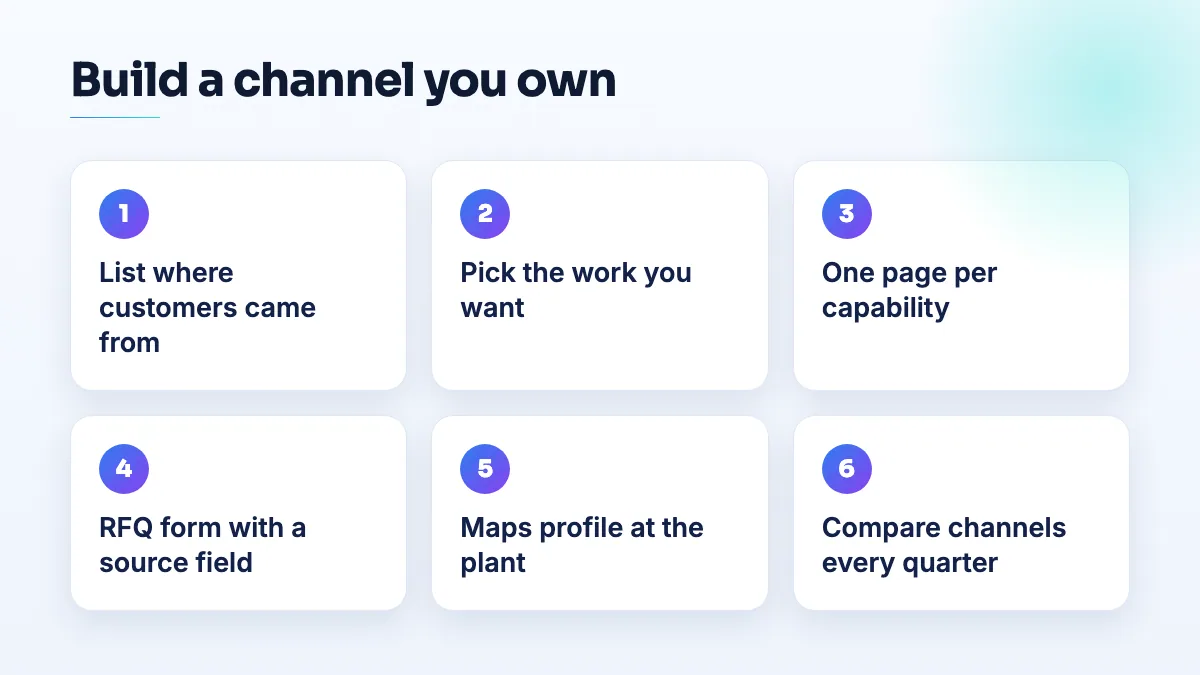
- Write down where your last twenty customers came from. Referral from whom, which show, which search, which cold call. Put it in a spreadsheet. If you can't answer for most of them, that's your first finding, and it's why step four exists.
- Pick two or three kinds of work you want more of. Not "anything we can quote". Choose by process, material, part size or industry: five-axis aluminum work, stainless weldments, short-run production of a particular part family. A custom metal shop in a Reddit thread about generating leads with no single industry to target had exactly this problem, and the fix is to market capabilities instead of industries.
- Write one page for each of those kinds of work. Each page lists the machines, the materials, the tolerances you'll commit to, part photos from your floor, certifications and typical lead times. These are the fabrication services pages buyers compare before they send a print, and they're what Google ranks for "5 axis machining" or "stainless fabrication" searches.
- Make the RFQ form ask the right questions. File upload for drawings and models, material, quantity, required date, and a required "How did you hear about us?" dropdown. The dropdown is the whole measurement system. Without it you'll be guessing again in a year.
- Set up a Google Business Profile at the plant. The same machinists who called search pointless said Maps was useful. Use the real address, the business name as it appears on your sign, a primary category that matches your main work, and photos of the floor and the parts. Buyers within driving distance use it.
- Write for the person who awards the work. Owners on Practical Machinist have asked which job titles actually award manufacturing contracts. In my experience a capability page is read by two people: an engineer checking whether you can hold the spec, and a buyer checking lead time, quality paperwork and whether you'll answer the phone. Give each of them a section.
- Ask your existing customers for a Google review. Some B2B shops avoid it because they fear public reviews, as one owner said in a thread about whether to take retail work. You don't need many. A handful from real buyers mentioning the job type is plenty for a shop.
- Compare every channel once a quarter. RFQs, quotes and awarded jobs by source, next to what each channel cost you. More on that below.
Before you hire anyone, one reply is worth knowing about. When a manufacturer asked for lead generation services in a Reddit thread about lead generation for manufacturers, he was pointed to his state's Manufacturing Extension Partnership center instead. It's a public program, and I'd make that call before signing any agency contract, including one with us.
How to measure it against trade shows and referrals
Count awarded jobs, not leads. A trade show that produces forty badge scans and no orders lost money. A website that produces six RFQs a quarter, two of which turn into repeat part numbers, is working.
- For each channel, add up what it cost: booth fees, travel and days off the floor for a show; portal subscriptions and quoting hours; whatever you pay for the website and your own time on it.
- Divide by the jobs it won, and note the margin on those jobs. Marketplace work and trade-show work often land at very different margins.
- Give the website time. Capability pages take months to rank, so judge them on the second and third quarter, not the first.
- Keep asking new customers where they heard of you, even when they came through the form. Buyers often see you in two places before they reach out.
After a year you'll know which channel deserves more money, and you'll be making that decision on your own numbers instead of a forum argument.
What's different for a print shop
Commercial printers have the same referral problem with a different shape. In an r/CommercialPrinting thread from a shop with one big client, the owner had bought a UV flatbed and had no second stream of work to keep it busy. The danger is the same as the fab shop down to four customers, only faster.
Print is also more local than machining. Most print buyers want to pick up, approve a proof in person or get a rush job the same week, so the Maps profile matters more for a print shop than for a job shop that ships everything.
The bigger difference is who the buyer is. A print shop's products map to specific trades. An owner in a thread asking which trades buy NCR forms couldn't work out who to target. My approach is to work backwards from the product: carbonless forms go to businesses that still write tickets, invoices or work orders on site; door hangers go to businesses that canvass neighborhoods; menus go to restaurants that change prices. Then write a page for each pairing, such as carbonless invoice books for contractors, with the sizes, part counts, numbering and reorder process that buyer cares about. That's how print shop SEO finds the second and third big client instead of waiting for them.
What not to do
- Don't book another trade show before you've measured the last one. If you can't name an order it produced, put that money into the pages first.
- Don't sign up for every RFQ portal at once. Pick one, track quotes against awards for a quarter, and drop it if the numbers don't hold.
- Don't pay for a directory listing on a promise. In a Practical Machinist thread about Thomasnet listings, an owner called about $6,000 on a paid listing a waste.
- Don't build a brochure site and stop. Owners in a thread on whether a job shop needs a website agree a missing site costs credibility even when it wins little directly. A site with capability pages and a proper RFQ form is a different thing.
- Don't hire whoever pitches you in the comments. Agencies selling in forum threads is a pattern manufacturers see often. Ask anyone, us included, how they'll measure awarded jobs, not traffic.
Where to start this week
Do step one today: the list of where your last twenty customers came from. It takes an hour and it tells you whether you have a referral business, a trade-show business or no pattern at all. Then build the first capability page for the work you want most.
If you want help, this is the work we do in B2B SEO, and in fabrication shop SEO and job shop SEO projects we start with the same spreadsheet.
Written by Saifur Rifat, Founder & SEO Lead at SERP Squad.