

Your Airbnb bookings dropped, your reviews are still good, and nothing on your side changed. You can't force Airbnb to show your listing again, so the answer has two parts: check the few things on the listing you do control, then build a second platform and a direct booking channel so one algorithm can never empty your calendar again.
This is not a rare story. A Superhost with a 4.9 rating and three years of hosting described in a Reddit thread from a Superhost down to one booking a quarter exactly what I hear from rental owners: the reviews held, the bookings didn't. The hosts who came through it best were the ones who had never relied on Airbnb alone.
Below is what I check first, the order I'd build the other channels in, and what I'd avoid while bookings are low.
Why your Airbnb bookings dropped when nothing changed
Airbnb doesn't publish how it ranks listings, and I won't pretend to know the formula. What I can do is tell you the patterns hosts keep reporting, because they point to causes you can actually check.
- More listings, same number of guests. Hosts in several markets describe saturation cutting occupancy hard, with some reporting around 80 percent fewer bookings as new listings flooded their area (see a Reddit thread about market saturation cutting Airbnb bookings). When supply doubles and demand doesn't, good listings lose bookings too.
- The listing stops appearing on the map. Hosts report their listing vanishing from the Airbnb map for their own dates and area, often with no message from Airbnb. A Reddit thread from hosts whose listings disappeared from the Airbnb map is typical: the listing was active, bookable and invisible.
- Your price moved away from the listings around you. If new places nearby charge less for similar space, the guest sees them first and books them first. Your reviews don't help if the guest never scrolls far enough to read them.
- A setting is quietly filtering you out. Minimum stays, advance notice, blocked dates and guest limits all decide whether you show up for a given search. A calendar sync that failed can block weeks without you noticing.
The first two you can't fix. The last two you can, so start there, but don't stop there.
Check whether your listing is still showing
Before you change anything, find out what a guest actually sees. This takes half an hour and tells you whether you have a listing problem or a market problem.
- Search as a guest, logged out. Use a private browser window, your town, dates two to six weeks out, and a normal group size for your place. Zoom the map to your street. Note whether your listing appears, and on which page of results.
- Repeat for three different date ranges. A weekend, a midweek stay and a week-long stay. If you only vanish for some of them, the cause is usually a setting, not the algorithm.
- Check your calendar and sync. Open the calendar and look for blocked dates you didn't block. If you sync with another platform, confirm the sync is still running. A broken import can close your calendar without telling you.
- Loosen one restriction at a time. If your minimum stay is longer than most places nearby, try shortening it for the next two months. If you need several days' notice, reduce it. Change one thing, wait a week, search again.
- Write down the five listings that do show up. Their nightly price after fees, their photos, what they offer that you don't. That's your real competition, and it tells you whether your price or your listing is the gap.
If your listing shows up fine and bookings are still low, the problem is the market. More listing tweaks won't fix that. More channels will.
Build the channels that held up: VRBO and direct bookings
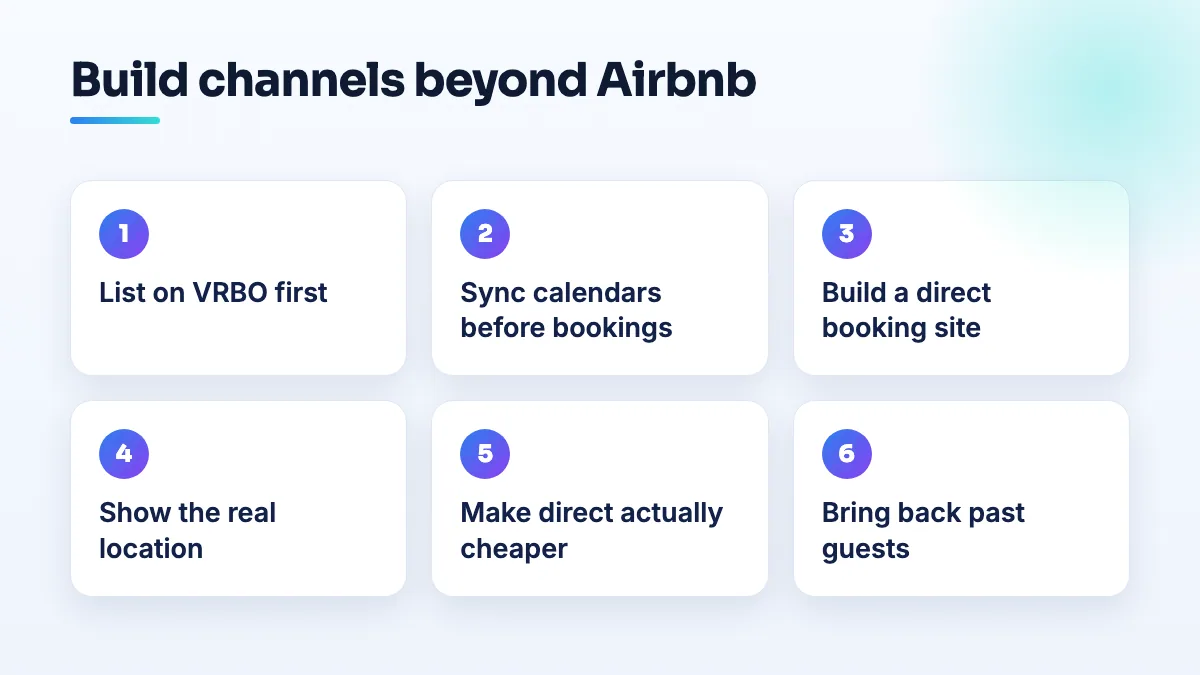
In a Reddit thread where hosts compared how their channels held up, the owners who were still doing fine were the ones taking bookings through VRBO and their own website as well as Airbnb. None of them had found a trick inside Airbnb. They had simply stopped depending on it. This is the order I'd build that in.
- List on VRBO first. It's the quickest second source of guests, and it reaches travelers who don't use Airbnb. Reuse your best photos, but write the description fresh rather than pasting the Airbnb text, and set your house rules and cancellation terms to match what you already offer.
- Connect the calendars before the first booking comes in. Use calendar sync or a channel manager so a booking on one platform blocks the dates on the other. A double booking in your first month on a new platform costs you more than a slow month.
- Build a direct booking website with its own domain. One page for the property with every photo, the real bed setup, house rules and the price, and a clear way to book or send an enquiry. Add a page about the area that answers what guests actually ask: parking, the nearest grocery store, how far the beach or trailhead really is.
- Show the location honestly. Travelers say in a Reddit thread where travelers explain why they cross-check booking pins on Google Maps that platform map pins are often moved, so they check the real location before paying. Give the neighborhood and the distances on your site. A guest who trusts where the place is books faster.
- Make the direct price actually cheaper. Hoteliers admit in a Reddit thread on whether book direct and save is true that direct rates are often 10 to 25 percent higher than the platforms. Guests notice. Price your direct booking below what the same stay costs on Airbnb after its guest fees, and say so on the page.
- Bring back the guests you already had. Repeat guests and their friends are where direct bookings come from first. A small welcome book in the property with your website name is the simplest way. Check each platform's current rules on off-platform contact before you add anything, and never ask a guest to cancel a platform booking to rebook with you.
Expect the direct site to start slowly. It won't rank for your town on day one, and I'd be wary of anyone who tells you it will. What it does from day one is give past guests, referrals and people who look you up by name somewhere to book that no algorithm can switch off.
How the three channels compare
| Channel | Who controls your visibility | What you own | Best use |
|---|---|---|---|
| Airbnb | Airbnb's search and map | Your reviews on that platform only | Volume, first-time guests |
| VRBO | VRBO's search | Your reviews on that platform only | A second audience, spreading the risk |
| Direct website | You, through your site and search | The guest relationship and the domain | Repeat guests, referrals, name searches |
The point of the table is the middle column. Two of the three can change overnight without warning. Only one of them keeps working if a platform decides to show someone else. The same logic is why I tell hotels to reduce OTA dependence before they need to.
Where Google fits for a vacation rental
Most owners' next idea is a Google Business Profile for the rental. Be careful. Google's guidelines for business listings list rental properties such as vacation homes as ineligible. A leasing or management office that guests or owners actually visit, staffed during its hours, can have a profile. The house itself can't, and a listing for it is the kind of profile Google removes.
So for a single rental, Google works through your website instead. Pages that answer what guests search for, such as the property type, the area and the things nearby, are how a direct site starts to be found. Hotels and staffed properties are different. They can have a profile, and travelers in a Reddit thread on investing in Google reviews for direct bookings point to those reviews as what wins a direct booking. I cover what hotels can do outside the high season in the guide to shoulder season hotel bookings.
What not to do while bookings are down
- Don't create a Google profile for the rental home. It's ineligible, and a removed or suspended profile tied to your name and phone makes a later, legitimate one harder.
- Don't slash your price in a panic. Compare yourself with the five listings that show up for your dates first. Cutting below them without knowing why they rank can lose you money on the bookings you would have had anyway.
- Don't paste your Airbnb description onto your website. Write the direct site for the guest who's already interested: exact beds, parking, arrival, the real distances.
- Don't delete your Airbnb listing out of frustration. It still brings in first-time guests. The goal is that it stops being your only source, not that it disappears.
- Don't trust every enquiry on a new channel. Bed and breakfast owners report scam enquiries arriving soon after they go live on a new booking system. Take payment through a proper booking tool, and never pay out a refund or overpayment to someone you haven't hosted.
Questions hosts ask
Will my Airbnb bookings come back on their own?
Sometimes they do, when a season turns or new listings drop out of the market. I wouldn't plan around it. Hosts who waited it out on one platform are the ones posting about one booking a quarter.
Do I need a channel manager?
With two platforms and a website, calendar sync is enough for most single properties. Once you have several properties or you're changing prices often, a channel manager saves you from double bookings.
How long before a direct site brings bookings?
From repeat guests and referrals, as soon as it's live. From Google searches, it takes months of real content about your property and area. That's why I'd start it now, while Airbnb is still bringing some guests.
Start with the channel you own
Your Airbnb listing is rented visibility. VRBO spreads the risk, and a direct site is the only part you keep whatever the platforms do. If you want the direct side built properly, it's the core of our vacation rental SEO work, and the site itself comes from our website design team.
Written by Saifur Rifat, Founder & SEO Lead at SERP Squad.