

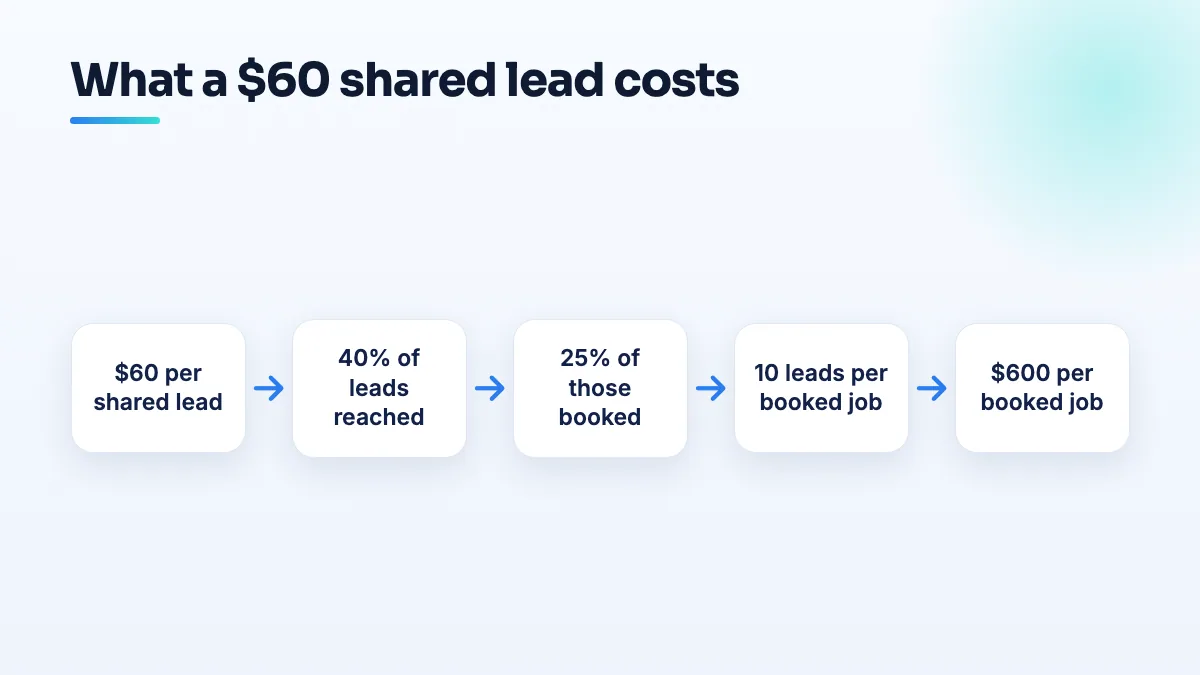
The price per lead on Angi, Thumbtack or HomeAdvisor tells you almost nothing, because the same lead is sold to several companies and you pay whether or not anyone hires. The number that matters is your Angi leads cost per job: everything you spent on the platform divided by the jobs it actually booked. Worked out honestly, a $60 lead can easily cost $600 per booked job.
Movers, cleaners, HVAC companies, remodelers, handymen, electricians, landscapers and event businesses all describe the same frustration: steady charges, few jobs. Below is how to calculate what a booked job really costs you, how to lower it, and how to decide when a lead platform has stopped paying. I run this calculation with every new client who buys platform leads, and the answer is rarely what the platform dashboard suggests.
Why a shared lead costs more than its price tag
Three things push the real cost far above the per-lead price.
- The lead goes to several companies at once. A Thumbtack reviewer on Thumbtack's Trustpilot page, rated 2.2 out of 5 across more than 6,600 reviews, wrote that the platform sells one lead to four professionals and charges each of them 80-plus dollars. A mover lead-cost breakdown puts shared moving leads at three to ten movers each. An HVAC owner on Reddit described the same thing with Angi: the lead went to four other companies too.
- You pay whether or not the job happens. A handyman described in a Reddit thread about a $40 TV-mount lead paying for the lead and getting no refund when the customer canceled. Thumbtack reviewers also report being charged for leads outside the service area they'd set.
- The first company to call wins most of the work. A guide to Angi leads for maid services says that if you're not the very first to call, your chances drop by up to 80%, and that Angi users are trained to collect several quotes and pick the lowest. So even a real lead is a race against three or four others, on price.
Put those together and most of what you pay for never had a chance of becoming your job. That's not a reason to never use the platforms. It's a reason to measure them on booked jobs, not leads.
How to work out your Angi leads cost per job
Do this for each platform separately, over the last 90 days. You need your platform invoices and a record of which leads you reached and booked.
- Add up everything you paid the platform. Lead charges, membership or subscription fees, and any advertising add-ons, minus credits or refunds you actually received. Use the invoices, not the dashboard summary. That way nothing gets left out.
- Count the leads you were charged for. Every one, including the ones that went nowhere.
- Count the ones you actually spoke to. A real two-way conversation, not a voicemail or an unanswered text. Divide by total leads: that's your contact rate.
- Count the ones that booked and paid. Not quotes sent, not "they'll think about it". Divide by the leads you spoke to: that's your close rate.
- Divide total spend by booked jobs. That's your real cost per booked job. If you prefer the formula: cost per lead divided by (contact rate times close rate).
- Compare it with the gross profit on an average job. Take the average job value from those bookings, subtract materials, labor and fuel, and see what's left. If the cost per booked job eats most of it, the platform isn't paying, however many leads it sends.
- Add the time you spent. Hours calling, quoting and chasing leads that went nowhere are real cost, even if they don't show on an invoice.
Here's the worked example from a moving lead provider comparison, which shows how much contact and close rates move the result on the same $60 lead:
| Lead price | Contact rate | Close rate | Leads per booked job | Cost per booked job |
|---|---|---|---|---|
| $60 | 40% | 25% | 10 | $600 |
| $60 | 65% | 35% | about 4.4 | $264 |
Real numbers from contractors land in the same range or higher. A marketing firm's review of whether Angi is worth it for contractors measured one remodeler at $100 per lead and $1,430 per acquired customer, about one job for every 14 leads, and another at $80 per lead and $2,500 per customer, roughly one in 31. On the service side, an HVAC owner in a Reddit thread on Angi results said they'd put $1,400 into Angi and got $250 back.
How to lower your cost per booked job
Before you quit a platform, make sure you're not paying the worst possible price for it. These are the fixes I'd make first, because they move contact and close rates:
- Answer within minutes. If the first caller wins most of the work, a lead you return the next morning is mostly wasted money. Route platform leads to a phone someone answers, or pause the platform during hours you can't respond.
- Tighten the job types and area. Switch off job types you rarely win or don't want, and set the service area to where you actually go. Check charges against those settings every month.
- Dispute bad leads the same week. Wrong area, wrong job, fake details. Keep a note of each and the outcome. Refund rules change and are often narrow, so don't count on credits in your math.
- Price the lead into small jobs, or skip them. A Thumbtack reviewer described paying $100 for a job they could charge at most $250. If a job type can't carry the lead cost, turn it off.
When to stay and when to leave
My rule: decide what a booked job is worth to you before you look at the platform's numbers. If your gross profit on an average job is, say, a few hundred dollars and your cost per booked job is close to it, the platform is buying you revenue, not profit. Work out your ceiling properly using the method in the post on your break-even cost per lead, then:
- Stay if your cost per booked job sits comfortably under that ceiling after the fixes above, and the customers are ones you'd want again.
- Cut back to the job types and areas that do pay, if some do and others don't.
- Leave if, after three months of fast response and tight settings, the cost per booked job is still above your ceiling.
What's different for movers
Moving leads have a wide spread of prices depending on where you buy them. The same comparison lists typical cost per lead of roughly $80 to $150 on Billy.com, $30 to $80 on Google Local Services Ads, $25 to $60 on Thumbtack, $20 to $50 on Angi, and $50 to $120 from regional brokers, with each shared lead going to three to ten movers.
The cheapest lead isn't the cheapest job. For a mover, the value of the booked job varies hugely by move size and distance, so work out cost per booked job separately for local moves and long-distance moves. A lead source that's too expensive for studio apartments can be well worth it for four-bedroom interstate moves. Record the move type against every lead, and the platform that looks worst on price may turn out to be the one sending your best jobs. It's the first analysis I do in any SEO for moving companies engagement, because it shows what organic leads need to beat.
What's different for cleaning companies
Cleaning leads are usually sold to four or five companies, according to a guide to Angi leads for maid and cleaning services, to customers who've been taught to compare quotes and take the lowest. That makes speed and price the whole contest, which is hard on a company that wants to be paid properly.
The thing that changes the math for cleaners is repeat work. A one-off deep clean has to pay for its own lead. A recurring weekly or biweekly client spreads the lead cost across months of visits. So I'd measure cleaning platforms on how many recurring clients they produce, not on one-off bookings, and I'd switch off one-off job types if they're what keeps the cost per booked job high. Building your own recurring demand is the focus of our cleaning company SEO work for exactly this reason.
What not to do
- Don't judge a platform by leads per month. Judge it by booked jobs per dollar.
- Don't sign a long contract before you've measured three months. Month-to-month or pay-per-lead first, then decide.
- Don't cut prices to win shared leads. If you only win when you're cheapest, the platform is setting your prices for you.
- Don't let the platform be your only source of work. If the leads dry up or the rules change, you have nothing underneath.
Building leads nobody else gets
The long-term fix is leads that come only to you: a Google Business Profile and website that rank in your area, and ads you control. Whether to start with SEO or Google Ads depends on how fast you need calls and how long you can wait. Our local SEO builds the leads that don't get shared, and Google Ads management covers the gap while it grows.
Written by Saifur Rifat, Founder & SEO Lead at SERP Squad.