


Key points
- Any reward for a review breaks Google's policy
- It applies even if you don't ask for five stars
- $500 of gift cards produced zero reviews
- Ask at the moment the customer sees the result
- Send the direct link the same day
You need more reviews, a competitor seems to be getting them easily, and a $10 gift card or 10% off the next visit feels like a harmless nudge. It isn't allowed. Incentives for Google reviews break Google's review policy whatever stars you ask for, and in the one real example I have, they didn't even work. A plain, consistent request does.
I see this question most from lawn care, cleaning and appliance repair companies, because their customers are happy but rarely think to write anything. Here's what the rule says and what I'd do instead.
What Google's policy says about incentives for Google reviews
Google's policy on prohibited and restricted review content treats reviews that don't reflect a genuine experience as fake engagement, and that includes reviews given in exchange for something. In practice that rules out:
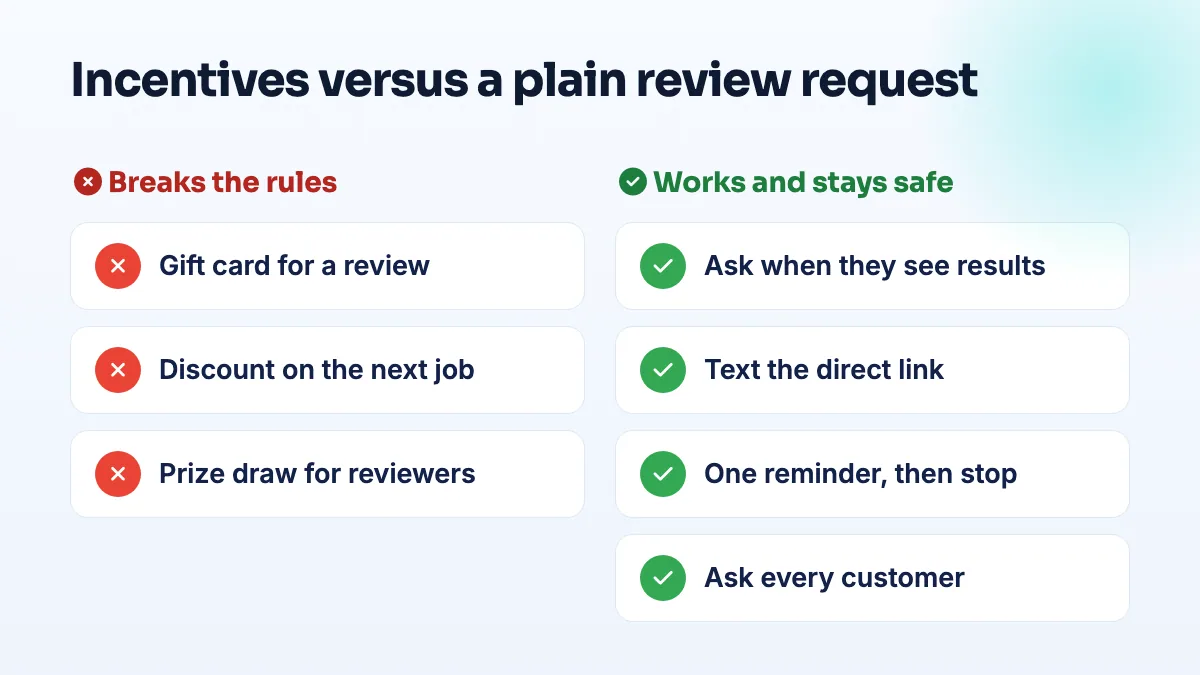
- Gift cards, cash or store credit for leaving a review
- A discount on the next service or on the current invoice
- A free add-on, like an extra cut or a free filter change
- Entry into a prize draw for everyone who reviews
It doesn't matter that you didn't ask for five stars. "Leave any review and get $10 off" is still an incentive. And asking only the customers you know are happy, often called review gating, is against Google's rules too.
Why the gift card approach backfires
The best evidence I've found is from a lawn care owner in a LawnSite thread about collecting Google reviews from mowing clients. They gave gift cards to all 21 clients, spent $500, and got zero reviews. Other operators in the same thread said plain asking worked better.
My explanation is simple: a gift card arrives as a thank-you, gets put in a drawer, and doesn't come with a moment or a link. The review request that works is the opposite: a direct ask at the right time, with nothing to think about.
There's also a risk to your reputation. Homeowners in a Minnesota Reddit thread about paid review offers documented "$100 off the quote" offers for a positive review while comparing notes on which repair companies' reviews they could trust. And any competitor who sees your offer can document it, the same way I explain how to report a competitor buying reviews.
What works instead
One landscaping company generated 75 reviews in four months once it had a plain process in place, according to a Landscape Leadership piece on getting Google reviews for lawn care. Nothing clever, just the same steps every time:
- Pick the moment the customer sees the result. The end of a first mow or spring cleanup, the walkthrough after a deep clean, or the minute the dryer runs again. That's when they're most likely to say yes.
- Ask in person, in one sentence. "Would you mind leaving us a quick Google review? It really helps a small business like ours." No script about what to write.
- Text the direct review link the same day. Get the short link from your Google Business Profile and send it while the job is fresh. A link that opens the review box does most of the work.
- Send one reminder a few days later, then stop. One nudge is helpful. Three is pestering.
- Ask everyone, and make it someone's job. Every customer, not only the happy ones, and one person checking each week that the requests went out.
- Reply to every review that comes in. It shows the next customer that you read them, and it tells the reviewer the effort was noticed.
How the timing differs by trade
Recurring lawn clients are the hardest, because the job never really ends. I'd ask after the first visit of the season or a visible one-off like a spring cleanup, not on the fourteenth routine mow. It's the first thing I set up in any lawn care SEO project.
Cleaning companies have a natural moment in the walkthrough after a first deep clean, when the difference is obvious. For recurring maids, ask once after the first month, when the customer has decided to keep you. That timing matters more in cleaning business SEO than any wording.
Appliance repair is a one-off visit, so the ask has to happen at the door, while the machine is running. There's no second chance next week.
What you can still offer customers
You can reward loyalty, as long as it isn't tied to a review. A discount every returning customer gets, or a thank-you card with no strings, is fine. The line is simple: if the reward depends on the review, it's an incentive. My fuller answer on whether it's OK to ask customers for Google reviews covers the rest of the rules around asking.
If you've already run an offer like this, stop it now and take it off your website, invoices and follow-up texts. Then build the plain process above. If you'd like it set up and running for you, that's part of our Google Business Profile management.
People also ask
Does adding keywords to your Google Business Profile name help?
It can lift you for a few searches, because Google matches the name against the query, but it breaks Google's rule that your profile name must be your real-world name. Stuffed names are a suspension risk, and one cleaning company lost its profile and ad campaign over a stuffed description. Put keywords in your categories, services, a plain description and your website, and remove existing stuffing one careful edit at a time.
Read the full answer: Does adding keywords to your Google Business Profile name help? →
Can you appeal a Google review decision more than once?
No. You get one appeal on each review Google decides not to remove, and once the appeal is denied, that decision is final for that review. Wait for the first decision before appealing, and only appeal with new evidence tied to a specific policy clause. After that, your options are a calm public reply, reporting new reviews from the same accounts, and outnumbering the review with genuine ones.
Read the full answer: Can you appeal a Google review decision more than once? →
Why are my customers' Google reviews not showing up?
Usually because Google is holding the review back, not because it was never written. A filtered review stays visible to the person who wrote it, so their screenshot doesn't prove it's public. New or empty accounts, sudden bursts of reviews and anything rewarded are the usual triggers. If nobody at all can leave a review, check your profile for a suspension, a verification request or a ratings restriction.
Read the full answer: Why are my customers' Google reviews not showing up? →
Is that Google Business Profile email or call a scam?
Usually yes, if you didn't ask for it. Unsolicited emails and calls warning that your listing will be removed, your site isn't compliant or your ranking is at risk are mostly sales pitches or scams. Real Google requests do exist, so don't judge by how the message looks: close it, sign in to your profile yourself, and act only on requests that appear there.
Read the full answer: Is that Google Business Profile email or call a scam? →
Why did Google change my business category or name without asking?
Google edits profiles on its own when its systems, or suggestions from the public, decide your details are wrong. It happens most to service-area businesses with hidden addresses: Joy Hawkins confirmed one wave of forced re-categorization hit only those listings. Put your category or name back with a single edit, then make your website, signs and other listings use the same words so the change doesn't return.
Read the full answer: Why did Google change my business category or name without asking? →