

A competitor that opened last year already has more five-star reviews than you've collected in a decade, or you've seen them offer customers money off for a good review. To report competitor fake reviews in a way Google actually acts on, you need a documented pattern rather than a suspicion: review dates, reviewer histories and proof of the incentive, sent through the right channels, while you keep building your own reviews the honest way.
This comes up in every trade I work with. Dentists, contractors, appliance repair companies, HVAC firms and landscapers all describe the same thing in forums and in the Google Business Profile Help Community, and the ones who get results all do the same unglamorous work first.
Here's what bought reviews look like, what Google's policy says, the exact order I document and report them in, and how to compete in the meantime without copying.
What bought and incentivized reviews look like
The pattern is usually speed. In a Reddit thread from dentists about a new office with 200 reviews in months, dentists compared notes on a practice that went from nothing to a wall of five-stars faster than any real patient base could produce them.
A contractor on the Local Search Forum laid out a sharper case in a Local Search Forum thread about a virtual-office competitor with 114 of 116 five-star reviews: a rival at a virtual office, using a name close to his own trademarked one, had collected 114 of its 116 five-star reviews in eight months. His complaint forms had been ignored for months.
Sometimes the incentive is out in the open. Homeowners in a Minnesota Reddit thread about appliance repair review offers described being offered "$100 off the quote if they leave a positive google review." An HVAC owner in a Help Community thread about a competitor discounting for reviews found a rival openly offering discounts for reviews and couldn't find anywhere to report it. And in a LawnSite thread about sudden review bursts at young lawn companies, landscapers described competitors one or two years old showing 30 to 40 reviews inside two months, from accounts with no other history.
These are the signs I check when a client sends me a competitor they suspect:
- Bursts. Dozens of reviews in a few weeks, then silence, then another burst.
- Empty reviewer accounts. Profiles with one or two reviews ever, no photos, no local history.
- Reviewers who review the same set of businesses. The same accounts praising a dentist in Ohio, a roofer in Texas and a locksmith in Florida.
- Review count far ahead of the business's age. Check the state business register for when the company was formed.
- An incentive you can see. A discount on a flyer, an invoice line, a text message, a social post or a sign at the counter.
- The business itself breaks listing rules. A virtual office address or a keyword-stuffed name often travels with bought reviews.
What Google's review policy says about incentives
Google's prohibited and restricted content policy for reviews treats reviews that don't reflect a genuine experience as fake engagement. Paying for reviews, offering discounts, freebies or other incentives in exchange for them, and reviewing a business you're connected to all fall under it. The discount doesn't need to be tied to five stars to break the rule. "$10 off for any review" is still an incentive.
Selectively asking only happy customers, often called review gating, is also against Google's rules. I mention it because it's the version many businesses do without realizing, and you want your own process clean before you point at anyone else's.
Why most reports go nowhere
Owners report the competitor once, in anger, with no evidence attached, and hear nothing. Or they report 40 reviews one at a time and each is judged on its own, where it looks like an ordinary happy customer. The contractor with the 114-review rival had filed forms for months without a result. The HVAC owner couldn't find a channel at all.
My view is that Google acts on patterns it can verify quickly. A single review that says "Great service, highly recommend" breaks no visible rule. Sixty of them in five weeks from accounts that also reviewed the same twelve out-of-state businesses is a pattern, and so is a photo of the discount offer. The work is turning what you know into something a reviewer can check in two minutes.
How to report competitor fake reviews, step by step
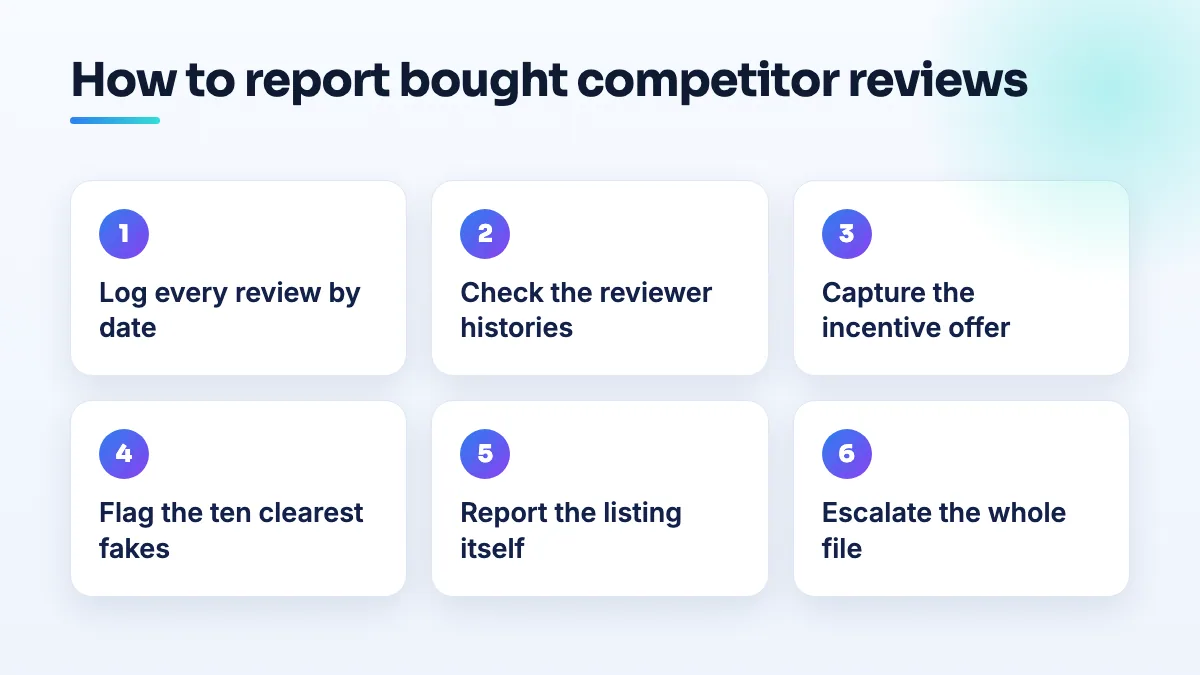
- Log every review in a spreadsheet. Sort the competitor's reviews by newest and record the date, star rating, reviewer name and how many reviews that account has left. Take dated screenshots as you go. Once the rows are in, the bursts show up on their own.
- Open the reviewer profiles. For the suspicious rows, note what else each account has reviewed. Accounts that review the same cluster of businesses in different states, or that have no history at all, are your strongest evidence. Mark the ten clearest examples.
- Capture the incentive itself. If the offer is public, screenshot the web page or social post with the date. If a customer received it, ask them to forward the text, email or invoice. Don't create fake accounts or pose as a customer to get it; you'd be breaking the rules you're reporting.
- Flag the clearest fake reviews individually. Report the ten worst from Google Maps, choosing the reason about fake or conflicted content. Ten strong flags beat 200 weak ones, and mass-flagging makes your own reports look like harassment.
- Report the listing if it breaks the listing rules too. A virtual office address, a name stuffed with search phrases or a network of look-alike profiles goes through Google's Business Redressal Complaint form. I cover that in detail in the guide on how to report fake Google Maps listings.
- Post the whole file in the Help Community. Summarize the pattern in five lines: review count, time window, what the reviewer accounts have in common, the incentive evidence and the dates you reported. Attach screenshots with customer names blurred. Product Experts can't remove reviews, but a clear, documented case is the kind they escalate.
- Recheck monthly and add to the file. Don't re-report every day. Once a month, update the spreadsheet. If the pattern continues, you now have a longer record, which is stronger, not weaker.
If Google still doesn't act
Be ready for a slow answer, or none. Reports on competitor reviews take weeks at best and months at worst, and some cases in the threads I read were still open when the owners stopped posting. Treat the report as something running in the background, not the plan.
What I'd do while it runs:
- Keep the file current. Every new burst is new evidence. An escalation with six months of data carries more weight than one with six weeks.
- Watch for the listing changing. Businesses built on bought reviews often change names, addresses or phone numbers. Screenshot every change; it strengthens the listing-level report.
- Don't let it take over your week. The hours spent refreshing their profile are hours not spent getting your own reviews.
How to compete without copying them
A dentist in one Reddit discussion asked whether to fight fake negatives with fake positives. My answer is no, and not only because of the policy. Bought reviews can be removed in bulk, and when that happens the profile that relied on them drops overnight. Yours shouldn't be the one that drops.
What works instead is dull and reliable:
- Ask every customer, every time. At the end of the job or appointment, in person, then a text with the direct review link the same day. Not only the happy ones.
- Aim for detail, not volume. A review that mentions the actual service and the town tells a searcher far more than twenty lines of "Great!" Customers can ask what to mention; they just can't be told what to say.
- Reply to every review. It shows a real business is paying attention, which a review farm rarely bothers with.
- Keep a realistic target. You don't need 200. Work out how many Google reviews you need to compete in your area, then keep a steady pace.
Customers notice more than owners think. In many trades I see people wary of profiles where every review is a perfect five and reads the same, and a mixed, detailed record looks more believable.
Where the evidence shows up in each trade
In the dental thread, nobody had seen an offer. What they had was timing: a new office with more reviews than an established practice builds in years. When there's no document to point at, the reviewer spreadsheet is your whole case, and it's the part I spend longest on in dental SEO cases.
In the contractor case, the reviews came bundled with a virtual office and a borrowed name. When that happens, the listing report is the stronger lever, because an ineligible address is easier to verify than a reviewer's motive. It's a regular part of the contractor SEO clean-ups I do.
In the appliance repair and HVAC examples, the incentive was out in the open: a discount on the quote, an offer customers could repeat word for word. Ask customers who received one to forward it. Those documents are the evidence Google's reviewers respond to best in appliance repair SEO work, and they apply just as well to heating, cooling and landscaping rivals.
What not to do
- Don't leave the competitor a fake one-star. It's the same policy breach, and it's traceable to you.
- Don't accuse them by name in a review reply or on social media. If you're wrong, or can't prove it, you've created a legal problem for yourself.
- Don't match their offer "just a little". A raffle entry, a free add-on or a small discount for a review is still an incentive.
- Don't pay anyone who promises to remove their reviews. Nobody outside Google can do that on request.
Getting help with the file and your own profile
Documenting and reporting competitor reviews is tedious, and it's easy to get angry and send a weak report too early. If you'd rather hand it over, it's part of our Google Business Profile management, along with building a genuine review pace that doesn't depend on what your competitor does next.
Written by Saifur Rifat, Founder & SEO Lead at SERP Squad.