
Case study · E-commerce
300% organic traffic in 4 months
A Shopify store went from page 3 to category leader with technical and content SEO.
300%organic traffic
4 motime to result
52+page-1 keywords
 For AgenciesWe run SEO fulfillment under your brand, clients stay yours, hassle stays ours.Explore White Label SEO →
Google's guidance is blunt: helpful, people-first content wins. We write exactly that, from briefs built on real search analysis, in your brand voice, with internal links planned into every piece. No filler, no padding, no thousand-word intros.
Why businesses buy this
The content graveyard is full of the same three mistakes:
Padding to hit 2,000 words buries the answer and bores the reader. We write to answer completely, then stop, which is what actually ranks now.
Guessing what a page should say loses to analyzing what ranks and what is missing. Every piece here starts from that analysis.
Generic agency prose erodes trust with customers who know your field. We learn your voice from your best material and keep it.
A production system, not a word mill:
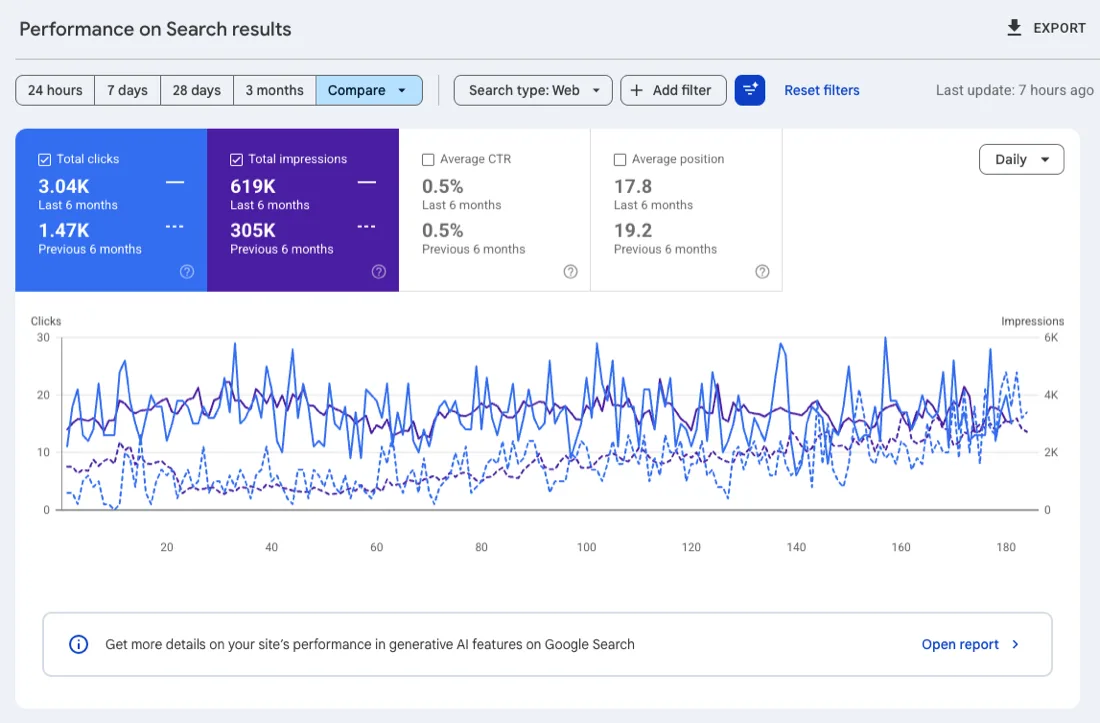
Content-led growth in Google's own data: clicks doubled from 1.47K to 3.04K in six months, impressions from 305K to 619K.
Proof, not promises
Every case study we publish runs on this content engine. More proof on our reviews page and YouTube channel.
A Shopify store went from page 3 to category leader with technical and content SEO.

A service business owner on what changed after SERP Squad took over.
★★★★★“Finally an SEO team that reports on leads, not just rankings.”
The first 90 days
Money pages first, calendar second, compounding third:
SERP-analyzed briefs for your highest-value pages, competitor content gaps mapped, voice learned from your best material.
Service, comparison and location pages live, internal links woven into each.
First pieces enter results, refresh candidates identified, calendar settles into rhythm.
Every new piece strengthens the ones before it as topical authority accumulates.
How the writing is planned
Pages rank when they answer a real query better than the pages already there. That starts with research, not with a writer opening a blank document.
Every target keyword gets one page and one page only, chosen on search volume against keyword difficulty. Mapping first is what prevents two of your own pages competing for the same search later.
A pillar page covers the subject broadly and the supporting pages go deep on each part, linked back with descriptive anchor text. That structure is what builds topical authority rather than a pile of unrelated posts.
Each piece starts from a brief: the query it answers, the entities it has to mention to be credible, the heading hierarchy, and the questions competitors leave unanswered. Writers get direction instead of guesswork.
Search engines read named entities and their relationships, not keyword density. Content that names the right products, places, standards and organisations earns semantic relevance the way a knowledge graph understands it, and reads naturally because those things belong in the sentence anyway.
Content decays. An editorial calendar schedules the content refresh work that keeps rankings alive, and content pruning removes pages that only dilute the site. Readability and what sits above the fold get checked on the way through.
Passage ranking means a single well-formed answer can rank without the whole page doing so, AI assistants quote the same passages, and the Google Discover feed surfaces the same pages to people who were not searching at all. Clear definitions near the top, and a direct answer under each question heading, is what makes a page quotable.
How search reads a page
Search engines stopped counting keywords a long time ago. What they build instead is a model of meaning, and content either fits it or it does not.
A topical map lists everything a subject involves before deciding what to publish. Gaps in that map are why a site with thirty posts can still lose to a competitor with eight.
Salience is how central a term is to the page rather than how often it appears. Co-occurrence, the words that reliably appear near it in good sources, is what makes writing read as expert to a machine as well as a person.
Half of business names and service terms are ambiguous. Naming the city, the industry and the adjacent services performs disambiguation, so you are filed under the right meaning instead of a similar-sounding one.
A semantic keyword is a related concept, not a reworded phrase. Covering the concepts a reader expects is what an ontology of the subject would predict, and what vector embeddings actually measure.
One question becomes several behind the scenes as engines and assistants expand it. Query fan-out is why pages that answer the obvious follow-up questions get surfaced far more often than pages that answer only the headline.
None of this matters if the page does not ask for the enquiry. Conversion copy, a clear next step and proof near the decision point is the last third of every brief.
Transparent reporting
Content reporting connects words to rankings, honestly:
Every published piece with its rankings, traffic and conversions, so winners and laggards are visible.
What shipped this month, what is in draft and what briefs come next, against the agreed calendar.
Older pieces losing ground flagged and scheduled, because content maintenance is half the game.
What works now
One well-written asset now works six jobs. These are the channels your content library feeds, and every brief we write targets them deliberately.

People-first pages answering real searches are still the core of organic rankings: content that earns positions and holds them for years.

The same content, properly indexed, ranks on Bing and surfaces in Copilot answers: extra distribution at zero extra writing cost.

Location content keeps your Apple Business Connect presence accurate and rich, supporting the map iPhone users open by default.


AI assistants quote citable, well-structured content. Writing with clear claims and clean structure decides whether they quote yours.


Strong content fragments into social posts that hold attention, reinforcing the authority your rankings claim.

Written content becomes video scripts: the same research ranking on Google ranks again on YouTube and feeds AI answers twice.
Every one of these channels is part of our SEO services; your audit shows which will move first for you.
Honest comparisons
Content budgets face three doors. The honest comparison:
Unedited AI volume is the defining content scam of this decade: hundreds of posts, zero leads, and sitewide quality signals dragged down. Human-edited, search-briefed content is what actually ranks and converts.
A social post lives a day; a ranked article works for years. Both have jobs, but only one compounds, and the ranked piece feeds the social calendar anyway.
GEO, being cited when AI answers quote sources, is not a rival discipline. Generative engines lean on the same authority, structure and entity signals strong SEO builds. Citable, structured writing is what gets quoted.
Service areas
Strategy tuned to how people search in each market. See every market on our service locations page.
Related services
Only pay for what it produces
Where there is genuine search demand and a site that converts, this work can be priced as pay for SEO rankings instead of a retainer, so what you pay follows what the campaign produced.
Buyer beware
Content is the easiest deliverable to fake, which is why the AI-dump scam lives here. The full pattern set:
Hundreds of auto-generated blog posts feel like activity, but unedited AI content nobody reads produces no leads and can drag the whole site down. Volume is not a strategy; content only counts when it answers real searches.
The most common scam is the simplest: a retainer collected every month with no work log and no report. If an agency cannot show you exactly what was done in the last 30 days, the honest answer is usually nothing.
Nobody controls Google's results, and Google itself says ranking guarantees are the mark of a scam. Real agencies show evidence and timelines; fake ones sell certainty they cannot deliver.
Ten 2,000-word posts a month, no keyword mapping, no briefs, no rankings attached. Words are the raw material; the strategy is which searches they answer. Buying tonnage buys nothing.
A 12-month contract exists so an agency gets paid whether it performs or not. If the results were real, the contract would not need to trap you, which is why we do not use one.
Thousand-link packages from link farms and PBNs look like progress until Google catches the network, and it is your site that takes the manual action. Recovering costs more than the links ever did.
Ask any agency, us included, for three things before you pay: a sample monthly report, written confirmation that you own your domain, website, hosting and Google Business Profile, and the work log from a current client's last 30 days. We show all three in your free audit call, plus reviews you can verify on Google and Trustpilot. An agency that hesitates on any of them has answered your question.
Writers briefed by SEO strategists, edited for your brand voice. Every piece starts from a brief built on real SERP analysis: what ranks, what searchers ask, what is missing. AI assists research; humans own the words and the facts.
Service pages that convert, location pages that rank, comparison pages that close, and guides that earn links and AI citations. Blogs only where they serve the strategy, never as filler.
Google's helpful content guidance is our editorial standard: first-hand specifics, honest comparisons, answers up front and no padding. If a page would not help a real customer, it does not ship.
Written and edited by people, with AI used the way a good writer uses any research tool: never for unreviewed drafting at scale. Every piece passes a human editor for accuracy, voice and originality, and we publish nothing we would not sign.
A consistent writer matched to your industry, briefed on your voice from your own materials, with the same editor reviewing every piece. You can meet them, and samples are available before you commit.
Fresh from the desk
What we publish between campaigns. Worth a read if you want to understand how this work actually gets done before you pay anyone to do it.
We map the pages your competitors rank with that you do not have, the pieces on your site worth refreshing, and the order that produces revenue fastest.