


Key points
- Low public bids are decided on price alone
- Invited and negotiated work is decided before pricing
- Owners and GCs search your name before inviting you
- Project pages and credentials matter more than rankings
- Shared lead sites rarely suit commercial work
Commercial contractor bid board marketing sounds like a contradiction. If the job goes to the lowest qualified bid, what's a website going to change? A civil engineer made exactly that argument in a Reddit thread on whether construction firms need marketing: construction is a bid-based industry, and a website or social campaign doesn't matter much if your bid is higher.
For a pure hard-bid public job, I agree with him. But very little commercial work is only that, and the part that isn't is decided before anyone opens a bid.
Where the bid is decided before the price
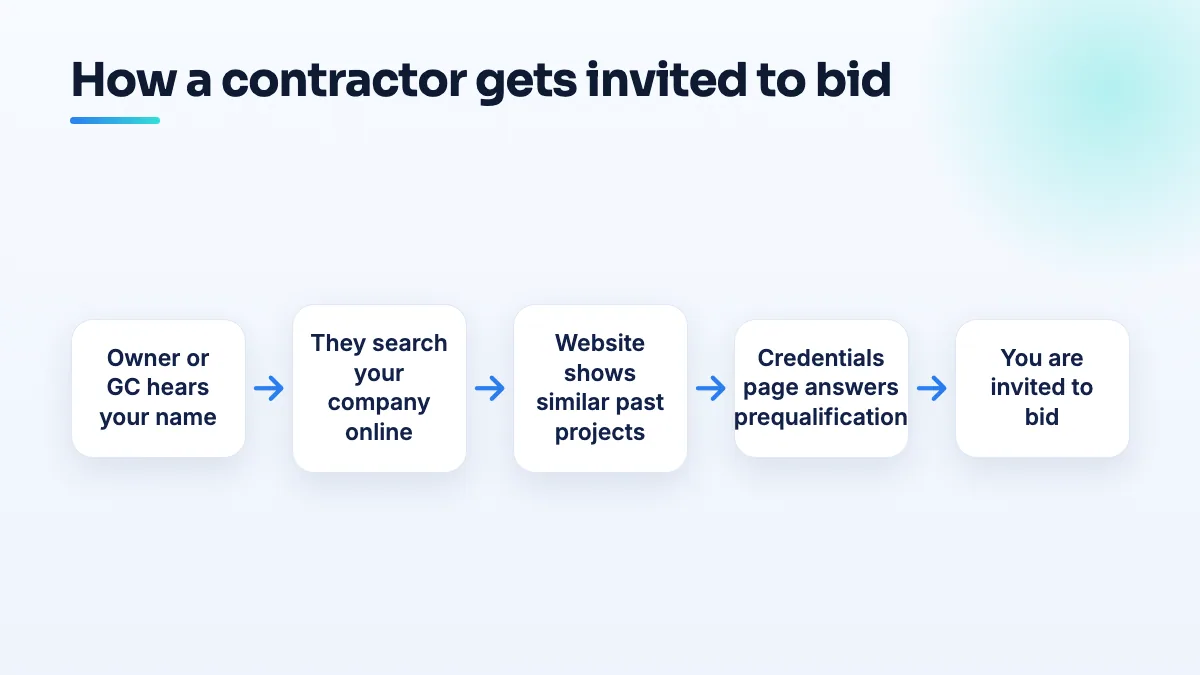
Think about how you got onto the last bid list you were invited to. Someone at a general contractor, an owner's rep or a developer had your name, then checked you. That check happens online now, and it happens in more places than people think:
- Invited bids. Private owners and GCs usually invite a short list of subs or contractors. Nobody invites a company they can't find or that looks inactive.
- Prequalification. Owners and GCs want your experience with similar projects, your safety program, your bonding and insurance and your licenses before you're allowed to price. Your site is where they first look for that.
- Negotiated and design-build work. The contractor is chosen on relationship and track record, and price is agreed afterwards.
- Owner-direct work. A business owner who needs a tenant improvement or a small building doesn't read bid boards. They search for a commercial contractor in their city.
- The tie-break. When two bids are close, the reviewer who can see three finished projects like theirs has a reason to pick you.
So the website isn't there to beat a lower number. It's there to get you in the room, and to make sure nothing online gives someone a reason to leave you off the list.
What commercial contractor bid board marketing should include
Not a blog every week and not fifty city pages. This is the short list I'd build for a commercial contractor who mostly bids:
- Put your credentials on one page a prequalification reviewer can find. License numbers, the states you work in, bonding capacity if you're comfortable stating it, insurance carried, safety program and certifications such as minority or woman-owned status where they apply. Label it plainly: "For owners and general contractors".
- Publish a project page for every notable job. Building type, square footage, contract value range if the client allows, your scope, the schedule and who the owner or architect was, with permission. Photos from the finished building, not renderings. I explain how to structure these in the guide to portfolio pages for contractors.
- Make your company name unambiguous. Use the same legal name, address and phone on your website, Google profile, state registration and license record. A contractor in a Help Community thread about a profile verified but never published was told by a Product Expert that, with no website, directory or registry footprint, Google couldn't tell his company apart from an older business with the same name. A GC searching your name hits the same confusion.
- Set up your Google Business Profile correctly, then leave it steady. The right primary category, your real office, hours when someone answers, and photos of finished work. If your license is active but Google still won't verify you, the reason is usually the address or name, which I cover in the answer on why a licensed contractor cannot verify with Google.
- Write one page for each kind of work you want to be invited to. "Tenant improvement contractor" or "medical office construction" in your region, with the projects that prove it. That's what owner-direct buyers search for, and it's the core of the B2B search marketing I do for contractors.
Where search matters less, and what to avoid
If nearly all your work is open public bidding where the lowest responsive bid wins by law, your estimating team matters far more than your website. I'd still keep the credentials page and project list current, because bonding companies, new GCs and future owners will look, but I wouldn't spend heavily on rankings.
What I'd avoid in any case is paying for shared leads. Contractors in a Reddit thread about Angi and HomeAdvisor lead costs describe money going out every week for leads sold to several companies at once, with no way to filter them. Those platforms are built for homeowners with small jobs, not for owners and GCs sourcing commercial work.
And don't let anyone sell you a page per town with the same text. Contractors have reported those location pages falling out of Google's index this year. One real project page in a town you've built in is worth more than any of them. If you want the whole setup done around how commercial work is actually won, that's the focus of our general contractor SEO work.
People also ask
Are service area pages still safe after the August 2026 spam update?
Service area pages that give each town real, specific information are still safe. Pages that only swap the city name into the same text match Google's description of doorway pages and were at risk long before August 2026. Reports of pages dropping after the update are anecdotal and inconsistent, so audit each page: keep the ones with local substance, merge the thin ones into one service-area page, and cut pages for towns you don't serve.
Read the full answer: Are service area pages still safe after the August 2026 spam update? →
Does a contractor license help you pass Google Business Profile verification?
Not much on its own. Google doesn't verify you because you're licensed; it checks that your records, profile and video all point to the same business at the same address. A license lookup or corporate filing showing a different address, or a mailbox, can make verification fail. Align every record first, then show the license in your video as supporting proof.
Is Houzz Pro worth it for remodelers?
Only if the contract and the lead numbers both hold up. Remodelers reviewing Houzz Pro describe a plan sold as monthly but invoiced around $4,000 a year up front, about two leads a month that were mostly low quality, and a 30% price rise at renewal they couldn't opt out of. Get the billing, renewal and notice terms in writing and work out how many signed jobs you need before you pay.
Read the full answer: Is Houzz Pro worth it for remodelers? →
What should you do when no Google Business Profile category fits your business?
Choose the closest category that describes the work customers hire you for, based on the categories the top three businesses use for your main search. Check it doesn't require a storefront you don't have. Then describe your exact specialism everywhere Google allows your own words: secondary categories, custom services, the description and a dedicated page on your website. Make the category change once, because category edits can send a profile back into review.
Why does my verified Google Business Profile not show up publicly?
Because verification and publication are separate. Verification proves the business is real; Google still has to be confident enough to show the listing to everyone. A new business with no website, directory listings or registry record can pass verification and stay "Only visible to you", especially if an older business shares its name. Search your name signed out to see which gate you're at, then build that footprint.
Read the full answer: Why does my verified Google Business Profile not show up publicly? →