

A competitor called something like "Plumber Near Me 24/7 Emergency Best Plumbing" sits above you on Maps, you've reported it, and it's still there or it came back. A keyword stuffed business name on Google Maps breaks Google's rules, but the report that sticks is not "this is spam": it's an edit that changes the name to the company's real name, backed by proof of what that real name is.
Plumbers, handymen, repair shops, limo companies and contractors all run into this, and most of them give up. I'll cover why these names rank, why most reports fail, the process that works best, and when to stop spending time on it.
Why keyword stuffed business names rank on Google Maps
The name is one of the strongest things Google matches against a search. When the name is the search, the listing gets a head start that has nothing to do with how good the business is. In a Help Community thread about 46 keyword-named mover listings, the poster showed how a listing titled with the search phrase triggered a name match instead of a category match. That's the whole trick.
It's against the rules. Google's guidelines for representing your business say the name on the profile should be your real-world name, the one you use consistently on your signage, website and stationery, without extra keywords or location details added to it.
The frustration is that enforcement is patchy. A Help Community thread about keyword-stuffed plumbing names that survive every report was locked without an answer. A handyman in a thread about a rival with emoji and keywords in its name watched it outrank him while his reports changed nothing. Another handyman, in a thread about reports that keep getting denied, wrote that "90% of my reports were denied" and said it had him reconsidering whether following the rules was worth it.
Why most name reports fail
From reading these threads, the failed reports have the same gaps:
- No evidence of the real name. "This name is keyword stuffed" asks Google to guess what the name should be. An edit that says "the real name is X, here's their logo, their website and their registration" doesn't.
- The owner changes it back. Members of a Local Search Forum thread on the correct process for stuffed competitor names describe names being corrected after a report and then reverted. A single fix isn't the end of it.
- The name is actually registered that way. Some businesses file a trading name full of keywords and put it on their van. If the stuffed name really is on their registration and their signage, Google will usually leave it. Check before you spend the time.
- It's reported as spam, not as a wrong name. A name problem needs a name fix. Save the spam and fake-location reports for listings that don't exist at all.
How to report a keyword-stuffed name so it sticks
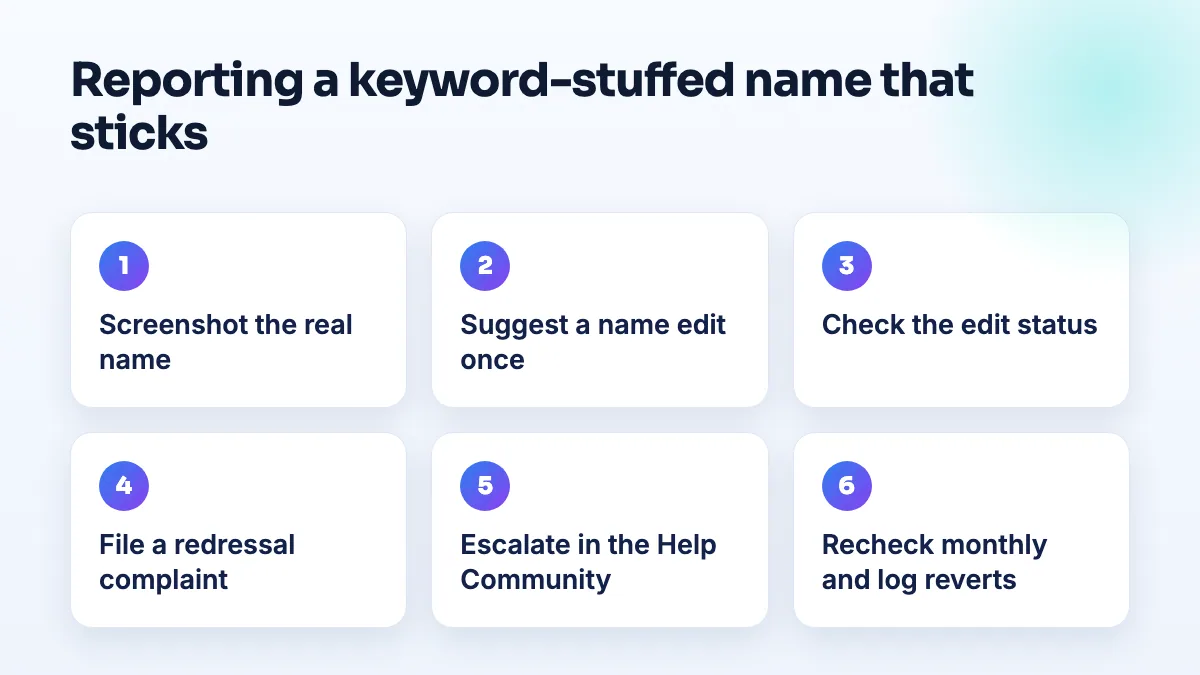
- Find the real name and screenshot it. The logo and footer on their website, the name on their vans or storefront in Street View, and the state business register or licensing lookup. Save each with the date. This is the evidence the whole report rests on.
- Suggest an edit to the name on Google Maps. Open the listing, choose to suggest an edit, and change the name to exactly the real name you found, nothing more. Do it once, from your own normal Google account.
- Check the status after a few days. Your contributions show whether the edit was applied, is pending or wasn't accepted. Screenshot whatever it says.
- If it's rejected or reverted, file the Business Redressal Complaint form. Give the listing link, the real name, and links or screenshots showing where that name is used. Keep it short and factual.
- Post the same evidence in the Help Community. Explain that the name was corrected and reverted, or that the edit was refused despite the evidence, and ask a Product Expert to take a look. Repeated reverts are the kind of pattern they can escalate.
- Log it and recheck monthly. If the stuffing comes back, add the new dates to the same record and reference your earlier report. A history of reverts is stronger than one complaint.
When to stop reporting
This is where I'd be honest with you: one stuffed name is rarely what's keeping you out of the map pack. My rule is two rounds of edits and one escalation per listing. After that, the hours go into your own profile, where they're guaranteed to count.
Before you start at all, check whether it matters. Search the way your customers do, from the neighborhoods you serve, and see where that listing actually sits against you. If it only outranks you on your doorstep, it's a nuisance, not a crisis.
The exception is a network. If the stuffed names come with mailbox addresses, shared phone numbers and matching websites, you're not dealing with one pushy competitor. You're dealing with spam, and the right move is to document every listing and get fake competitor listings removed as one case.
What's different by trade
Plumbers see "24/7", "emergency" and "near me" packed into names, because emergency searches are where the money is. The locked plumbing thread shows how long these can survive, which is exactly why I'd cap the effort and put it into plumbing SEO basics instead.
Handymen run into emoji and service lists in names, as in the thread above. Those are easy to evidence when the real business has a plain name on its invoices, vans or social pages. It's a common fix request in handyman SEO.
Phone and computer repair shops can't run Google Ads for third-party repair, so the map pack is where everything is decided, and names like "Cheap iPhone Screen Repair [City]" get verified and stay that way. Evidence of the real trading name matters most here.
Limo and chauffeur companies in big cities have fought stuffed names for years; a Local Search Forum thread about keyword-stuffed limo names in New York is a long-running example. Be careful with your own profile in this category: owners have reported a limo listing suspended within minutes of adding a secondary category, so don't make retaliatory edits to yours. I'd keep your own profile stable and let limo company SEO work on the website do the heavy lifting.
Contractors are where the revert problem is best documented. Expect to go round more than once, and keep your evidence file.
What not to do
- Don't stuff your own name to keep up. It can win a few searches and then cost you the profile. I explain the risks of adding keywords in your Google Business Profile name separately. Even legitimate name changes get reviewed: a licensed solar contractor in a thread about a name change that triggered a suspension renamed his profile to match his LLC and was suspended for deceptive content.
- Don't suggest edits from several accounts. Staff, family and friends all editing the same listing looks like an attack, and it can be treated as one.
- Don't report names that are simply descriptive. "Smith Plumbing" or "Downtown Phone Repair", if that's what's on the sign, is a real name.
- Don't call them out in reviews or posts. Keep it in the report, with evidence.
Put the time into your own profile
The listings that beat keyword-stuffed names over time are the ones with the right primary category, a real service area, steady reviews and a website that backs up every service. That's the work in our Google Maps SEO, and if you'd like help deciding which spam is worth fighting in your market, it's part of our local search optimization service.
Written by Saifur Rifat, Founder & SEO Lead at SERP Squad.