

You've flagged the fake listings in your map pack one by one for months, and they're still there, or they vanish and come back a week later. If you want to report fake Google Maps listings so they actually come down, stop reporting them individually: document the whole network in one spreadsheet, file it once through Google's Business Redressal Complaint form, and get a Product Expert in the Help Community to escalate it.
Movers, roofers, plumbers, HVAC companies, remodelers, solar installers and tow operators all describe the same thing in the Google Business Profile Help Community: dozens of listings at mailboxes, empty lots and residential addresses, with phones that forward to whoever buys the lead. I went through those threads. The reports that worked had one thing in common, and it wasn't persistence.
Why reporting fake listings one at a time fails
A single report shows Google one listing that might be wrong. It doesn't show the operation behind it, so even when that listing comes down, the network replaces it. Phil Rozek, a well-known local search consultant, put it bluntly in a Local Search Forum thread about fake-address competitors that keep reappearing: "There's no way to prevent a determined person from sneaking a new fake listing past the goalie." In that thread, removed listings were back within a week with their reviews intact.
Bulk reports without a clear case don't do much better. In a Help Community thread about 46 keyword-named mover listings in the Netherlands, the poster documented a network in detail and filed redressal complaints, and nothing changed. In another thread, a redressal case against brokers posing as movers had removed nothing a month later.
What worked was different. The advice from Product Experts in a Help Community thread about fake mover listings was to report the network, not the listings: one documented submission showing how the listings connect. And in a thread about 50 fake moving listings in one metro, a Product Expert escalated the case and Google removed all 50 about five weeks later. That's the model I follow.
What counts as a fake listing network
Before you report anything, be sure it's spam and not a competitor you just don't like. A real company from out of town that follows the rules isn't reportable, and reporting it wastes the credibility you need for the real case.
The networks in these threads share a recognizable set of fingerprints:
- Addresses that aren't offices. Virtual offices, mailbox suites, bare intersections, empty lots and people's homes. One documented moving network had more than 110 profiles on addresses like these.
- Phones in the same ranges. In the Dutch mover case, 44 of 45 numbers sat in the same forwarding ranges.
- Identical settings. In the same case, 36 of the 46 listings had identical opening hours, and review text was recycled from one city to the next.
- Names built from search phrases. "Movers [City]" or "Emergency Plumber [Town]" instead of a company name. None of the 46 Dutch names appeared in the national business register.
- Shared websites. The same template, the same domain with different city pages, or no website at all.
- Category tricks. Spam movers in one documented network listed themselves as a "logistics company" to avoid the stricter checks movers face.
Scale is normal. Owners have documented more than 100 fake HVAC listings in New York City, more than 100 fake siding listings across several states, and 84 fake locksmith listings in Kansas City, of which 53 were removed before others started coming back.
How to report fake Google Maps listings as a network
This takes an afternoon, and it's worth doing properly once rather than badly ten times.
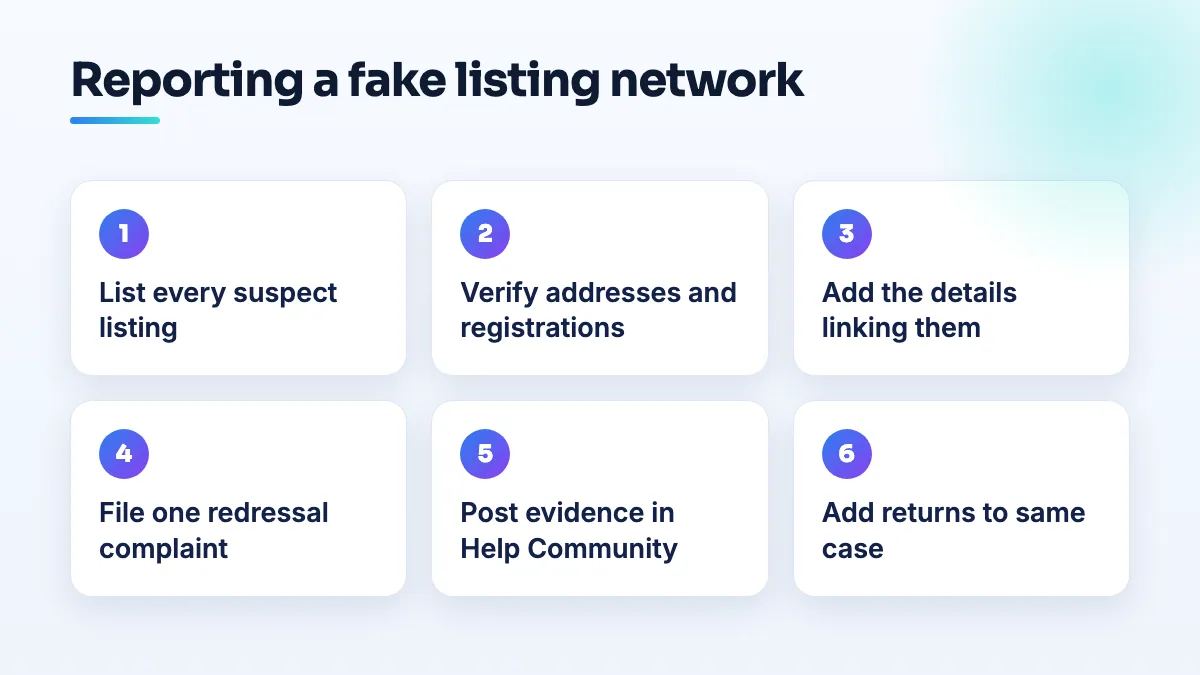
- Search from several places in your service area and list every suspect listing. One row per listing in a spreadsheet: business name, Maps link, address, phone, website, primary category, hours, review count and the date you first saw it. Screenshot each listing as it appears.
- Check each one against the real world. Drop the address into Street View. Look the name up in your state or provincial business register and, where the trade is licensed, the licensing lookup. Note what you find in its own column: "UPS Store", "vacant lot", "no registration found".
- Add the columns that connect them. Phone number range, website or domain, template, opening hours, repeated review wording, the date reviews started. This is the part most reports skip, and it's the part that turns forty complaints into one case.
- Write a short summary at the top. How many listings, what links them, and which rule each breaks. Google's eligibility guidelines say a rented mailing address the business doesn't operate from isn't eligible, and P.O. boxes and remote mailboxes aren't accepted. Quote the rule, don't paraphrase it.
- File it once through the Business Redressal Complaint form. Link the spreadsheet as a view-only shared file, paste the summary into the form, and keep the confirmation. Don't file forty separate complaints.
- Post the same evidence in the Help Community. Give the summary, a link to the spreadsheet, the date you filed and any case ID. Stick to facts, don't name people, and ask whether a Product Expert can escalate. This is the step that made the difference in the case where 50 listings came down.
- Log the dates and wait. Don't resubmit while it's open. If nothing happens, know when to stop waiting: Gold Product Expert Tony Gricar said in a thread about an unresolved redressal complaint that "81 days means Google has declined to take action on the profile."
- Add new evidence and go again, as the same case. If listings survive or come back, add them to the same sheet with new dates, reference your earlier submission, and ask for escalation again. A network that keeps rebuilding is stronger evidence each time.
What changes by trade
The method is the same everywhere. The evidence you'll find, and the risks of reporting, differ.
Movers face the most organized networks, with calls forwarded to call centers that resell the job. Look hard at the category: spam listings using "logistics company" instead of "moving company" is a pattern Google can act on. Brokers listed as if they were carriers belong in the report too, since brokers aren't eligible to list as movers under Google's rules. It's the most common spam we deal with in moving company SEO.
Tow operators have a harder time. A Tulsa tow company in a thread about a fake tow listing on a neighbor's body shop watched it sit there for two years. And in a thread from a verified tow company invisible for its own name, Tony Gricar said: "Google does put greater scrutiny on towing companies." That cuts both ways. Before you report, make sure your own profile would survive the same scrutiny, because edits and attention bring audits in this category. I cover the settings that matter in towing SEO.
Roofers, remodelers and general contractors mostly see virtual-office networks that reappear after removal, often with reviews that arrived far too fast. One contractor on the Local Search Forum documented a virtual-office competitor with 114 of its 116 five-star reviews posted in eight months. Include review dates in your sheet; they're strong evidence. For roofers, the week after a hail storm is when this spikes, so I'd build the sheet before storm season as part of any roofing SEO plan.
Plumbers, HVAC companies and solar installers see phone-verified listings in bulk. An owner in a Help Community thread about spam in trade categories described fake profiles in moving, plumbing, locksmith and carpet cleaning, and social media ads openly selling Google Maps profile creation for a fee. For solar, the redressal clock matters most, because the 81-day answer came from a solar thread.
What not to do
- Don't report real competitors. Out-of-town crews and legitimate new companies aren't spam. Mixing them in makes the whole report look like a grudge.
- Don't flood listings with edit suggestions from several accounts. It looks like manipulation, and it can draw attention to your own account.
- Don't leave reviews on the fake listings. Warning customers with a one-star review isn't evidence and can break the review rules yourself.
- Don't copy their tactics. Adding keywords to your own name or opening a virtual office to compete puts your real profile at risk. I explain what happens with keyword stuffed business names on Google Maps separately.
- Don't wait for an algorithm to fix it. Updates like the August 2026 spam update change things at the edges, but a documented report is the lever you actually control.
Questions people ask
How long does removal take when it works?
In the documented moving case, about five weeks after the Product Expert escalated it. I wouldn't promise anyone a timeline, but if you're past 81 days with nothing, treat it as a no and build a stronger case.
Should I report the listings or the website?
The listings, because that's what Google Maps controls. The websites are evidence: if the footer says it's a referral service, screenshot it. I cover how to spot lead reseller fake Google listings in more detail.
Will the listings come back?
Some will. Keep the spreadsheet open, check your map pack monthly and add returns to the same case. The goal is to make running spam in your market more trouble than it's worth.
Protect your own listing while you fight
Reporting spam doesn't rank you on its own. The profiles that win when the fake listings drop are the ones that are complete, compliant and collecting real reviews. That's the core of our Google Maps optimization, and if you'd like the whole market handled, including the spam reporting, it's part of our local SEO services.
Written by Saifur Rifat, Founder & SEO Lead at SERP Squad.