

The two businesses above you in the map pack might not be businesses at all. Lead reseller fake Google listings are profiles built to rank for "repair near me" or "movers" and forward every call to whoever pays for the lead, and you can usually prove it from their own websites, phone numbers and opening hours.
It shows up in auto and AC repair, moving, phone and computer repair, carpet cleaning and addiction treatment. I read through the Local Search Forum and Help Community threads where owners documented these networks, and the tells repeat almost exactly. Here's how to spot them and how to collect evidence that Google will act on.
What a lead-reseller listing is and why it ranks
There are three versions, and they often overlap:
- Lead resale. A company with no crew runs listings in many towns. Calls go to a call center, which sells the job to a local business, sometimes to several at once.
- Rank and rent. Someone builds a listing and website that rank, then rents the calls to one local company for a monthly fee.
- Mass-built listings. Dozens of profiles with copied websites, stock photos and reviews that read as if a tool wrote them.
The clearest documented case is in a Local Search Forum thread on lead resellers flooding the map pack. The top two results for AC repair in one town were resellers whose own website footers said they were "lead referral companies, and not an actual HVAC contractor." They had four to eight reviews each and phone numbers in one sequential run. One member said they "multiply like roaches."
They rank for a simple reason. When a listing's name is the search phrase, Google can match the name to the query directly. In a Help Community thread documenting 46 fake mover listings in the Netherlands, every name was "moving company" plus a city, which fired a name match instead of a category match. Add verification by phone, which an owner in a thread about spam profiles verified by phone said is how large numbers of fake profiles get created in moving, plumbing, locksmith and carpet cleaning, and you get a map pack full of them.
Signs of lead reseller fake Google listings
These are the checks I run when a client sends me a list of names they don't recognize. One sign on its own proves nothing. Three or four together usually do.
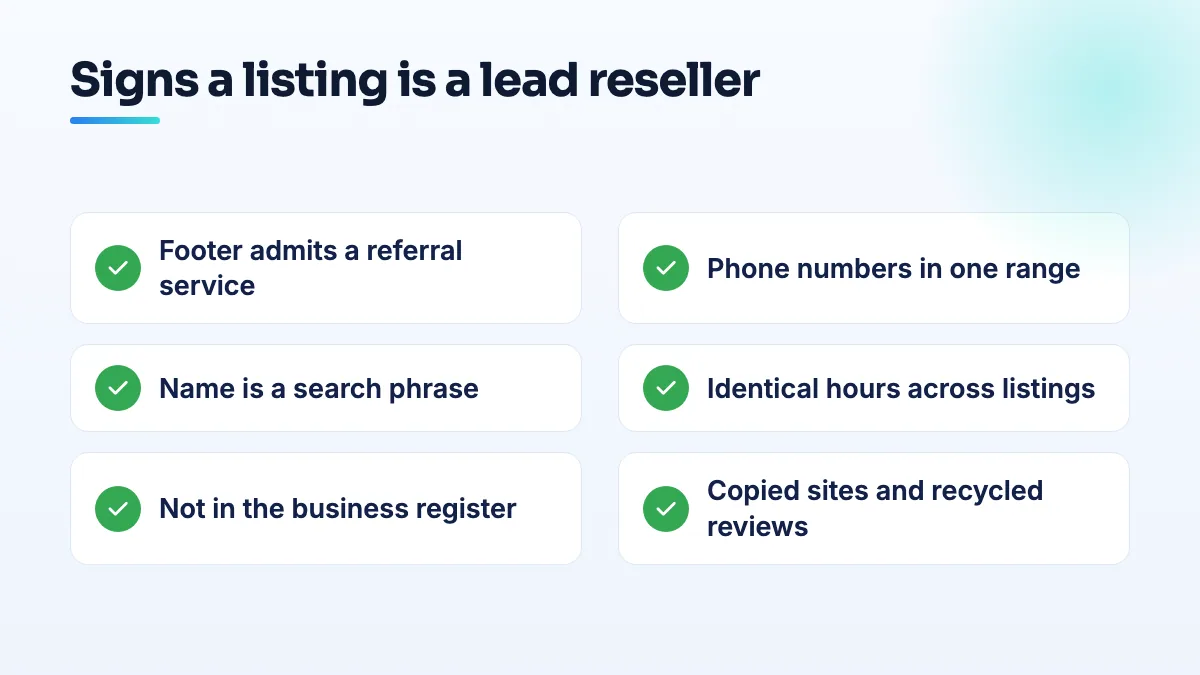
- The website admits it. Read the footer, the terms page and the privacy policy. Phrases like "referral service", "we connect you with local providers" or "not a contractor" are the reseller telling you exactly what it is.
- Phone numbers in one range. Sequential numbers across listings, or numbers from the same forwarding provider. In the Dutch case, 44 of 45 numbers sat in the same forwarding ranges.
- A name that's a search phrase. "AC Repair [Town]" or "Movers [City]" with no company name behind it. Look it up in the state or national business register. None of the 46 Dutch names was registered, and one listing title literally contained the word "leadgen".
- Identical opening hours. 36 of those 46 listings were open 07:00 to 22:00. Real companies rarely match each other to the minute.
- Copied websites and stock photos. The same template with the city name swapped. A reverse image search on the "team" photo often finds it on a stock site.
- Reviews that don't fit. Recycled wording across cities, a handful of reviews on a listing ranking above companies with hundreds, or reviewers with no other history.
- An address that isn't a workplace. A house, a virtual office, an intersection or a mailbox suite.
- A phone call that can't answer basic questions. Ask the company's legal name and where its shop is. A real business answers in one sentence. A call center asks for your ZIP code and promises a technician will call back.
How to collect evidence that proves the pattern
Spotting them is the easy part. Proving it in a way a Google reviewer can check in minutes is what gets listings removed.
- Screenshot the map pack with the date. Do the search from two or three places in your area, and save each result with the search phrase and date visible.
- Capture each suspect listing. Screenshot the profile, then the website's homepage and footer. If the terms page admits it's a referral service, screenshot that sentence.
- Look up every name. Business register, licensing lookup where the trade is licensed, and Street View for the address. Record what you find, including "not found".
- Put it all in one spreadsheet. One row per listing, with columns for phone, website, hours, category, review count and what you found. Sort by phone number; the ranges usually jump out.
- Mark what links them. Shared phone ranges, shared templates, identical hours, recycled reviews. This is the evidence of a network, not just of one bad listing.
- Report it as one network. File one complaint with the spreadsheet, then post the evidence in the Help Community. I walk through that process in detail in the guide to report fake Google Maps listings as a network.
What it looks like in your industry
Auto repair and transportation. Reseller listings take the top slots, and the network can be large and tied to one domain: one Local Search Forum member documented a competitor verifying 21 listings against a single website in one metro. For shops, the footer check is usually decisive. It's the first thing I check in auto repair SEO work when a client says the map pack changed overnight.
Moving. The most industrial version. Networks forward calls to call centers that resell the move, and some also run Local Services Ads pages with hundreds of reviews that have nothing to do with moving. Check both the map pack and the ads above it. I see this more than any other spam in SEO for movers.
Phone, computer and electronics repair. Google Ads doesn't allow third-party repair ads at all. In a Google Ads Help Community thread about computer repair ads, a Diamond Product Expert's whole answer was "No. You cannot advertise." With ads closed, the map pack is the main place left to get found, and that's why it fills with repair "shops" that have no workshop. Real repair shops should lean hard on photos of the bench, the storefront and named technicians, which is how we approach phone repair SEO.
Cleaning. Carpet cleaning is the classic rank-and-rent target. In a Local Search Forum thread about more than ten suspicious carpet cleaning listings in Sacramento, members found copy-pasted keyword websites, stock photos and reviews they believed were machine-written, and concluded it was rank-and-rent or lead resale.
Recovery centers. Here the stakes are legal, not just competitive. Members of a Local Search Forum thread about rehab categories described the rehab local pack as filled with spam. And the FTC has gone after the ad version of the same trick: in its 2025 case against Mercury Marketing and others, the FTC said ads showed real clinics' names and routed calls to a call center that posed as those clinics. If you run a treatment center, document calls that reach you after someone "found you" on a listing you don't own.
What not to do
- Don't prank or tie up their lines. It proves nothing and it's the kind of thing that ends up in a thread about you.
- Don't buy leads from a network you're trying to remove. You'd be paying to compete with your own map pack position.
- Don't copy the setup. Keyword names, extra listings and virtual offices put your real, verified profile at risk.
- Don't accuse anyone by name in public. Stick to evidence in the report and in the Help Community post.
Win the calls while the report is pending
Removal takes weeks at best. Meanwhile, the searcher is choosing between you and the reseller in the Google map pack, so give them what a reseller can't: your real company name, a license number where it applies, photos of your own people and vehicles, and reviews that mention your staff by name. That's what our GBP management focuses on, and it's part of our wider local SEO work for businesses in reseller-heavy markets.
Written by Saifur Rifat, Founder & SEO Lead at SERP Squad.