

Mail-in repair shops, limo and freight brokers, cloud real estate brokerages and kiosk networks all sit on the edge of Google's rules, and most of them find out the hard way through a rejected verification or a suspension. Google Business Profile eligibility with no in-person customers has a short answer: you qualify only for the part of your business that meets customers face to face, and if there isn't one, you don't qualify at all.
That sounds harsh, but it's also useful. Once you know which part of your business passes the test, you can set up one profile that survives instead of fighting verification for months.
I went through the Help Community and Local Search Forum threads from these business models. Here's how the rule applies to each, the setup I'd use, and where to put your effort if you don't qualify.
The one test: do you serve customers in person?
Google's eligibility rules for Business Profiles allow two kinds of business: one with a physical location customers can visit, or one that travels to customers in person. Online-only businesses aren't eligible, and neither is a rented mailing address you don't operate from.
A Diamond Product Expert put it bluntly to a limo broker in a Help Community thread from a limo broker with no office: he was eligible "ONLY in case you serve your customers face to face 'in-person'." That broker's story shows why it matters. A single edit to his description suspended the profile, and the video verification that followed asked him to film a license plate and the tools on his truck. The reviewer had no idea what a broker was, because there was nothing in person to show.
Google Business Profile eligibility when you have no in-person customers: five models
Limo and black car brokers
If you take bookings and farm the rides out to other operators, you don't serve anyone face to face, so you don't qualify. If you own or run vehicles and your chauffeurs pick customers up, you do: you're a service-area business, and the video shows your vehicles, your base and your control of them. Many limo companies are a mix. My advice is to list the part with your own cars and drivers, nothing else.
Mail-in and pick-up electronics repair
In a Local Search Forum thread from a pick-up and mail-in repair shop, the owner described the business as "a pick up/mail in electronics repair shop that is a SAB". That's the right instinct for the pick-up side: if you collect devices from customers' homes or offices, you're traveling to them. Pure mail-in repair, where everything arrives in a box, is an online service and isn't eligible. If customers can also drop devices at your workshop during set hours, that's a storefront, and the address shows.
Drop-off points and partner kiosks
Drop-off networks and kiosks were ruled ineligible in a Help Community thread about drop-off networks and kiosks, and the reason is simple. A kiosk inside someone else's store, or a drop-off counter run by partner staff, isn't your location. Customers deal with the host's people, not yours. Only locations staffed by your own employees during your listed hours can carry your name.
Cloud and virtual real estate brokerages
A brokerage with no traditional office couldn't get through verification in a Help Community thread about a cloud brokerage that couldn't verify. The brokerage itself has no place customers visit. The agents are a different story: they meet buyers and sellers in person, so an individual agent can usually list as a service-area business from a hidden home address. That's the setup I'd use for agents at a cloud brokerage.
Freight, transport and moving brokers
Brokers arrange the move; carriers do it. A broker listed as a moving company is ineligible under Google's rules, and owners in the moving threads report competitors doing exactly that. If you're a broker, the carrier side isn't yours to list, and I'd never set a brokerage up as a mover. More on transport below.
How to set it up the one way that survives
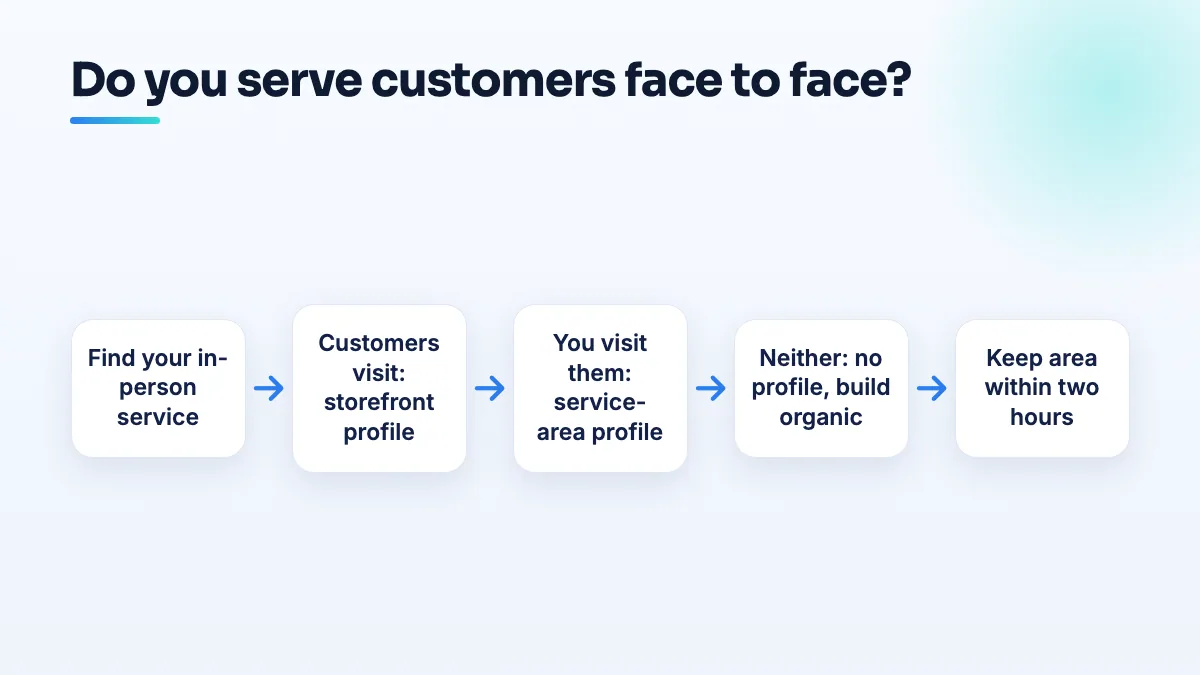
- Name the in-person part of your business in one sentence. "Our drivers pick customers up." "We collect laptops from offices in the metro." "Buyers visit our workshop counter weekdays 9 to 5." If you can't write that sentence truthfully, stop here and skip to the section on not qualifying.
- Pick the profile type that matches the sentence. Customers come to you: storefront, address visible, real hours. You go to them: service-area business, address hidden, service areas listed.
- Keep the service area to where you actually go. A Local Search Forum admin advised that a service area "should not stretch more than 2 hours from the address." Nationwide or continental areas read as a lead generator.
- Choose one primary category for the in-person service and leave it. In limo, category changes are unusually dangerous: a years-old listing in a Local Search Forum thread about a limo listing suspended over a category was suspended minutes after adding "Chauffeur service" as a secondary category.
- Make sure no other business shares your address without a suite number. A Product Expert explained to a limo firm that Google doesn't usually accept two businesses at one address in the same category unless each has its own suite or office designation.
- Film the in-person part for verification. The vehicles and the key, the collection van and the device intake bench, the workshop counter. Show what customers actually meet.
- Then stop editing. The limo broker lost his profile to one description change. Get the text right before you verify and leave it.
Transportation and trucking: when the model doesn't fit
Transport companies that cover huge distances hit a different wall. A horse transport company serving the whole of the USA and Canada asked for help in a Local Search Forum thread from a horse transport company. It was told to cut its service areas to 20 city and state combinations, split into separate US and Canadian profiles, and rebuild reviews from zero on the Canadian one.
The most useful line in that thread corrected what almost every transport owner believes: "the service area has zero impact on where you rank. Ranking is based on the physical address that you use to verify the listing." A trucking company listing 48 states gains nothing in the map pack for it. The admin's verdict was that the model doesn't fit the Google Business Profile well, and that Ads and organic search are the better channels.
My advice for transport and logistics companies:
- Carriers with a yard or terminal customers visit can have a profile there, and it will rank around that address. That's worth having for local searches near the yard.
- Freight brokers and dispatchers have no in-person service and shouldn't list. Your customers find you through your website, load boards and referrals.
- Long-distance movers and haulers should list only the base where the trucks and crews actually are, and win lanes and routes with pages on their own site. That's the core of the trucking SEO work we do.
If you don't qualify: where the effort goes instead
Not having a profile isn't the end of local visibility. It just moves the work to your own website.
- Build a page for each service and each region you genuinely serve, written for the way customers search: "mail-in MacBook logic board repair", "airport transfer from [city]", "horse transport [state] to [state]".
- Earn links and mentions from the places your customers already are: airports and venues for limo firms, equine associations for transporters, device forums for repair shops.
- Know which paid channels are closed to you. Phone and computer repair businesses can't advertise on Google Ads at all. In a Google Ads Help Community thread on computer repair advertising, Diamond Product Expert Rob Skelton's entire answer was "No. You cannot advertise." For mail-in repair, organic search is the whole game, which is why it's the center of our phone repair SEO work.
Startups hit a version of this too, and I've covered Google Business Profile eligibility for startups separately.
What not to do
- Don't rent an address to create a location. Setting up a virtual office on Google Business Profile fails the staffing rule and is one of the most common suspension stories in the forum.
- Don't list at a partner's store or kiosk. Their staff serve the customer, so it's their location, not yours.
- Don't describe yourself as the operator when you're the broker. A broker listed as a mover or a limo company invites the exact review that takes it down.
- Don't stuff city names into the business name to look local. Keyword-stuffed names are a known suspension trigger, and competitors report them.
- Don't create one profile per city you serve. Without a staffed base in each city, those profiles are the fake listings Google's checks exist to remove.
Get the setup right once
For businesses on the edge, most of the value is in deciding what to list before anything is created. That decision, and the verification that follows, is where our Google Business Profile management starts. For limo firms with their own fleet, it's also the first step in any limo company SEO project.
Written by Saifur Rifat, Founder & SEO Lead at SERP Squad.