


Key points
- Virtual offices and hot desks aren't eligible
- You need signage, customers and your own staff
- The operator's receptionist doesn't count as your staff
- Use your own suite number, phone and name plate
- Service-area businesses still need the office staffed
A virtual office, a hot desk or a day pass at a coworking space won't hold a Google Business Profile, and trying usually ends in a suspension. A coworking address on a Google Business Profile is allowed in one situation only: your own dedicated office there, with clear signage, customers received during business hours, and your own staff present to deal with them.
That's a much higher bar than most firms expect when they sign up for a Regus or WeWork membership, so here's the exact rule, why firms get suspended, and the setup I'd use if you want the address to survive review.
What Google says about a coworking address on a Google Business Profile
Google's guidelines for representing your business say a business can't list an office at a coworking space unless that office has clear signage, receives customers there during business hours, and is "staffed during business hours by your business staff." All three, not one of them.
A Diamond Product Expert's community guide on coworking rules makes the staffing part concrete: customers have to deal with your people at that address, not the operator's receptionist. A front desk that signs for your parcels and points visitors to a meeting room doesn't count. For service-area businesses only the staffing requirement applies, and the guide is blunt: "Service-area businesses can't list a 'virtual' office unless that office is staffed during business hours."
Why firms get suspended at coworking addresses
The Help Community is full of these cases, from a Help Community thread about a suspended coworking address to a thread from a business suspended at a virtual office address. The reasons repeat:
- Nobody from the business is there. A mail-handling plan or occasional desk use fails the staffing rule outright.
- The address is shared with dozens of companies. A Product Expert told a limo firm that Google doesn't usually accept two businesses at one address in the same category without separate suite or office designations. In a big coworking building, that's likely.
- Spammers use the same trick. One operator in the forum ran four profiles from coworking addresses in different provinces. In my view, that pattern is why a coworking address starts with less trust.
- Even a genuine office can be flagged. A law firm's satellite office was marked a duplicate despite a lease, a certificate of occupancy, insurance and permanent signage. If that happens with everything in place, a bare membership has no chance.
How to set it up so it survives
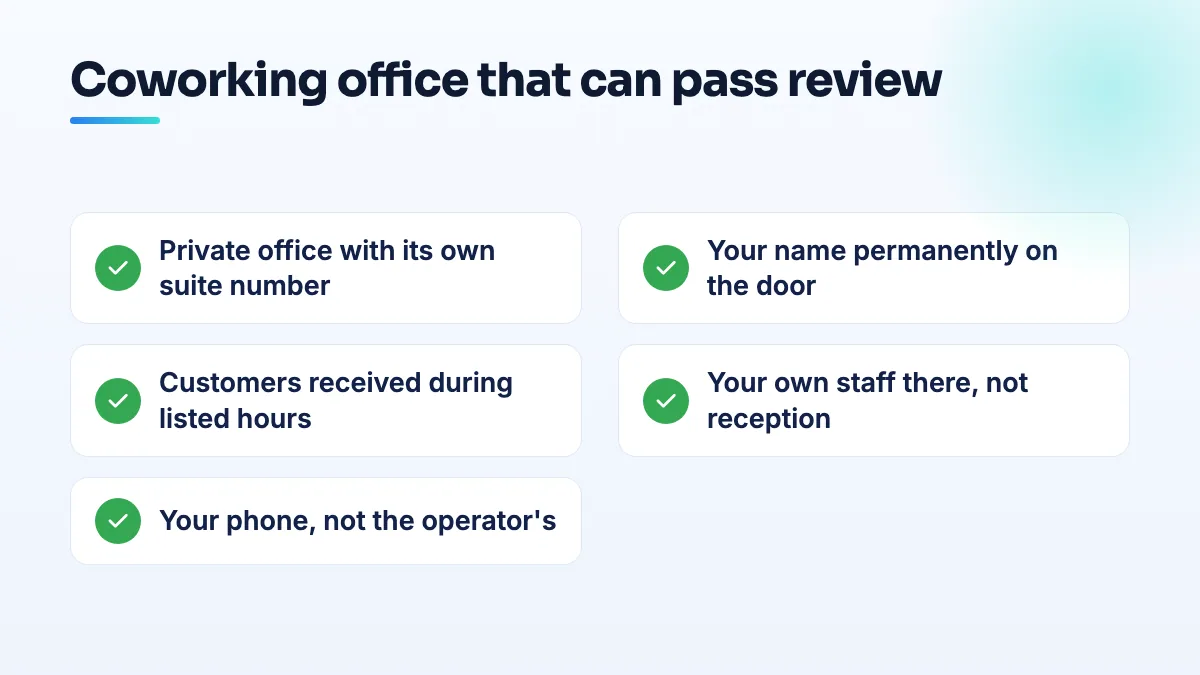
- Rent a private office, not a desk. It needs its own door and its own suite or office number in the building's addressing. Put that number in the profile address.
- Put your business name permanently on the door. A fixed plate or vinyl lettering, and your name on the building directory if there is one. Match the profile name exactly.
- Staff it with your own people during the hours you list. If someone from your firm is only there Tuesday and Thursday, those are your hours. I'd rather see short honest hours than a 9 to 5 nobody keeps.
- Make sure clients are greeted by your staff. Tell reception to send visitors straight to your office or call your people. The client's first conversation should be with you.
- Use your own phone number and website. Never the operator's main line.
- Plan the verification video before you apply. Film the building entrance and directory, walk to your office door with the name on it, open it with your own key, and show your staff and files inside.
Edge cases for startups, law firms and advisors
- Startups on a hot desk. Not eligible, however real the company. If you don't meet customers in person at all, read whether an online business can have a Google Business Profile before you pay for an address. Early startup SEO is usually better spent on your own website.
- Law firms with a satellite office. A shared suite used for occasional client meetings fails the staffing rule. A staffed satellite office with signage can qualify, but expect duplicate flags and keep the lease, signage photos and staff schedule ready. It's the first thing I check in any law firm SEO audit with more than one address.
- Financial advisors and other practitioners. Google names financial planners, lawyers and real estate agents as individual practitioners. A practitioner can have a profile only if they're public-facing and can be contacted directly at the verified location during stated hours, which rules out a coworking address you visit twice a month. It's a common trap in financial advisor SEO.
- Service-area businesses with a coworking base. You don't need signage, but the office still has to be staffed during business hours. If it isn't, use the address you actually work from and hide it.
If a coworking address has already cost you the listing, start with what triggers a GBP suspension and fix the address before you appeal. If you'd rather hand it over, that's part of our Google Business Profile management.
People also ask
Why does only one practitioner at our office show up on Google Maps?
Because Google's local filter usually shows only one of several listings that share an address and a category. It isn't a penalty, and the other listings still exist; they're hidden for that search. Agents, advisors, lawyers and instructors at one office trip it most. Different primary categories, direct phone numbers, genuine suite numbers and each listing's own reviews reduce it.
Read the full answer: Why does only one practitioner at our office show up on Google Maps? →
How should a doctor, lawyer or advisor name their Google Business Profile?
It depends on whether you're the only public-facing practitioner at that location. If you are, Google allows your brand followed by your name, as in its own example "Allstate: Joe Miller". If several practitioners share the office, the title should be only your name, without the firm's name. You can add a title or degree such as Dr., MD, JD, Esq. or CFA, and the name should match your license records.
Read the full answer: How should a doctor, lawyer or advisor name their Google Business Profile? →
Can an agency's restricted Google account get my profile suspended?
Yes. If an agency, freelancer or vendor with access to your listing has its Google account restricted, Google can suspend every profile connected to that account, and yours goes with it. The notice says a Google account associated with the profile was restricted. Proving your address won't fix it: remove the account, have the agency resolve its restriction, and appeal on that point.
Read the full answer: Can an agency's restricted Google account get my profile suspended? →
Should my Google Business Profile use my legal name or my trading name?
Use the name your customers actually see: the one on your signs, website, vehicles and invoices. For most businesses that is the trading name, not the LLC on the registration. Google asks for your real-world name, so a legal name nobody recognizes, or a sudden rename to match paperwork, can read as deceptive. If the two names differ, register the trading name as a DBA so a document ties them together.
Read the full answer: Should my Google Business Profile use my legal name or my trading name? →
Should each practitioner in a practice have their own Google Business Profile?
Only the practitioners people search for by name, and only if each is public-facing and reachable at the practice during set hours. Google allows individual profiles for doctors, dentists, lawyers, financial planners and agents, but listings at one address are often filtered, and each needs its own reviews. Give listings to key practitioners, make each distinct with its own category and phone, and keep everyone else on the practice listing.