


Key points
- Former employment and competitors are named conflicts of interest
- Report under conflict of interest, not just fake
- Prove the relationship with dated records
- A denied review gets one appeal, not two
- Reply once, calmly, and reveal nothing confidential
A former employee, or someone from the other side of a case, leaves you a one-star and Google tells you it doesn't break any rule. It often does. Google's own policy names former employment and competitors as conflicts of interest, but a Google review from a former employee or an opposing party only comes down when your report points at that rule and proves the relationship.
I went through the Help Community threads where owners report these reviews. The reports that fail tend to fail the same way: the owner explains why the review is unfair, while Google is checking something else entirely.
What Google's conflict of interest rule covers
Google's policy on prohibited and restricted review content says a conflict of interest may include "current or former employment, a contractual or consultory relationship, or other professional or personal affiliations." Its examples in the same sentence are industry competitors and family relationships.
That covers the people owners complain about most: an ex-employee, a competitor or someone promoting one, and relatives of either. It doesn't cover an unhappy customer, however unfair their review feels. An opposing party in a lawsuit isn't named directly, so the argument is that they have a personal affiliation to the dispute that conflicts with an honest review. If they also recommend a rival business in the same review, you have a second, stronger argument: the review promotes a competitor.
Why Google leaves conflicted reviews up
In a Help Community thread from a Utah family-law firm, the reviewer opened by saying they were the opposing party in a family law case and closed by recommending a named rival attorney. The firm reported it, appealed four days later, and got the reply that Google had "investigated and found that these reviews don't violate our policies." It was still live six days after that, and a Product Expert confirmed there's no second appeal for a single denied review.
A pet hotel near Kansas City described the same frustration in a Help Community thread from a pet hotel review-bombed by a former employee. Groomers, sitters and boarding kennels see this a lot, because staff turnover is high and a departing employee knows exactly which details sound believable.
My reading of why these fail: the person checking your report sees the review text and the account, not your payroll or your case file. A review that reads like a customer experience passes unless your report hands them the relationship in a form they can verify in a minute. "This is my ex-employee, they're bitter" isn't that. A named clause, dates and a document is.
How to report the review so the rule applies
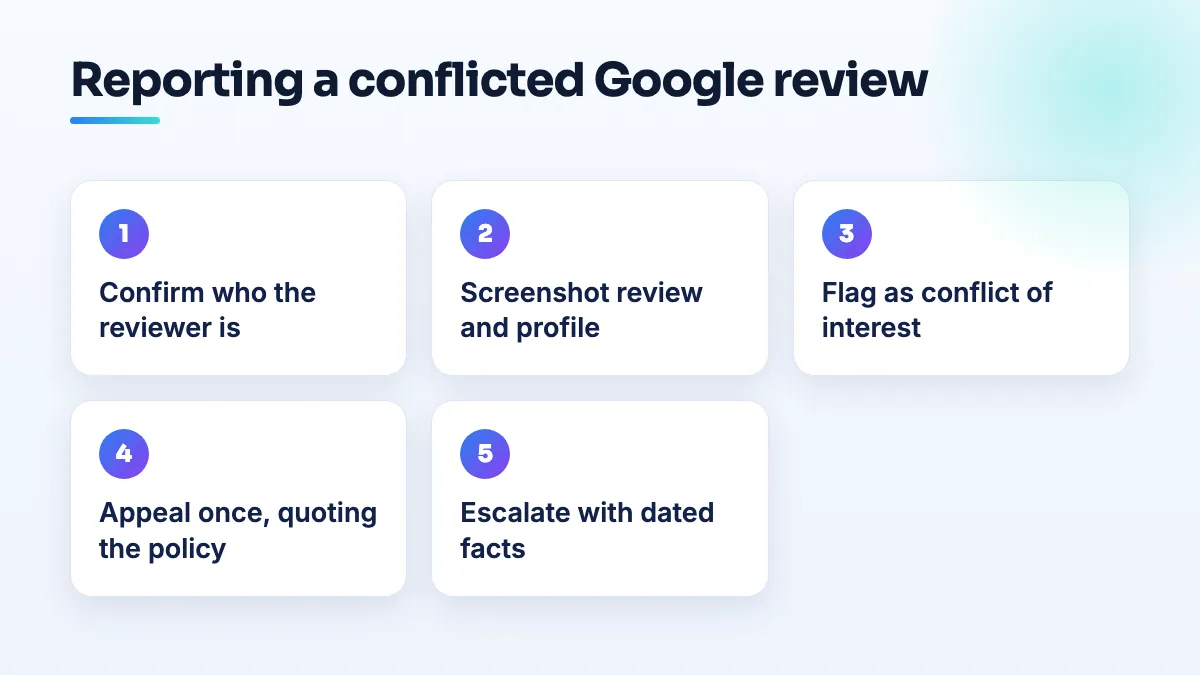
- Confirm who the reviewer is before you report. Match the account name, photo or details in the review to a real person: an employment record with start and end dates, or the reviewer's own words saying who they are. If you can't connect the account to anyone, this isn't your route. Treat it as a fake review and follow the steps to report a fake Google review instead.
- Screenshot everything with the date. The review, the reviewer's public profile and the other reviews they've left. A five-star for the competitor they recommended is the single most useful screenshot you can have.
- Flag the review under conflict of interest. When you report it, choose the reason that matches the policy rather than "offensive" or a general complaint. The reason you pick decides which rule the review is checked against.
- Appeal once, in three sentences. Quote the conflict of interest clause. State the relationship with dates, for example "The reviewer worked here from March 2024 to June 2025 and left on bad terms." Say you can supply documentation. Don't attach disciplinary records or anything confidential.
- If the appeal is denied, post the facts in the Help Community. Include the review link, the clause, the relationship, the dates you reported and appealed, and your screenshots with names blurred. Product Experts can't remove reviews themselves, but they can escalate a clear case that was decided wrongly.
What's different for law firms
Lawyers have a harder version of this problem, because the evidence that proves the relationship usually sits inside a client matter. Don't put client details in the report or the appeal. Point Google at the reviewer's own sentence instead: if they wrote that they were the opposing party, that's their admission, and you don't need your file to prove it.
The public reply is even more constrained. Confidentiality rules limit what you can say about any matter, and a review doesn't change that, so read how a lawyer can respond to a negative review before you type anything. Building enough genuine client reviews that one conflicted review is outweighed is part of any law firm SEO plan I run, for exactly this reason.
Replying to a Google review from a former employee
Keep the public reply short and about the business, not the person. Something like: "We take feedback seriously. We don't recognize this as a customer experience, and we've asked Google to review it under its conflict of interest policy." Never mention why someone left, what they did or what their records show. That turns a review problem into an employment problem.
For pet businesses with a rotating team, I'd also ask departing staff to hand back access to the business profile and social accounts on their last day. Most pet care SEO clean-ups I see include at least one former employee still listed as a manager.
What not to do
- Don't contact the reviewer demanding removal. It can become the next review, or evidence against you.
- Don't ask staff, friends or family to post reviews to bury it. The same conflict of interest rule applies to them.
- Don't file the same report again and again. One clear report and one appeal carry more weight than ten vague ones.
- Don't let one review stall everything else. A steady flow of real reviews protects you more than any removal. That's the everyday work in our Google Business Profile management.
People also ask
Can an agency's restricted Google account get my profile suspended?
Yes. If an agency, freelancer or vendor with access to your listing has its Google account restricted, Google can suspend every profile connected to that account, and yours goes with it. The notice says a Google account associated with the profile was restricted. Proving your address won't fix it: remove the account, have the agency resolve its restriction, and appeal on that point.
Read the full answer: Can an agency's restricted Google account get my profile suspended? →
Can you appeal a Google review decision more than once?
No. You get one appeal on each review Google decides not to remove, and once the appeal is denied, that decision is final for that review. Wait for the first decision before appealing, and only appeal with new evidence tied to a specific policy clause. After that, your options are a calm public reply, reporting new reviews from the same accounts, and outnumbering the review with genuine ones.
Read the full answer: Can you appeal a Google review decision more than once? →
Can you use a coworking space or virtual office for Google Business Profile?
Only with your own dedicated office there. Google allows a coworking address only if the office has clear signage, receives customers during business hours, and is staffed during those hours by your own staff, not the operator's reception. A virtual office, mailbox, hot desk or day pass doesn't qualify, and profiles listed at them are regularly suspended.
Read the full answer: Can you use a coworking space or virtual office for Google Business Profile? →
Why did Google change my business category or name without asking?
Google edits profiles on its own when its systems, or suggestions from the public, decide your details are wrong. It happens most to service-area businesses with hidden addresses: Joy Hawkins confirmed one wave of forced re-categorization hit only those listings. Put your category or name back with a single edit, then make your website, signs and other listings use the same words so the change doesn't return.
Read the full answer: Why did Google change my business category or name without asking? →
Can a lawyer respond to a negative Google review?
Only in a very limited way. ABA Formal Opinion 496 says a negative online review doesn't trigger the self-defense exception to Model Rule 1.6(a), the confidentiality rule. If the reviewer is a current or former client, the public reply can do little more than say your professional obligations don't allow you to respond. State rules can differ, so check yours before posting anything.
Read the full answer: Can a lawyer respond to a negative Google review? →