


Key points
- Report the rule it breaks, not that it's untrue
- A lawyer decides if it's defamatory, not Google's reviewers
- Reply once without repeating the accusation
- Never phone or threaten the reviewer
- Protect any staff member the review names
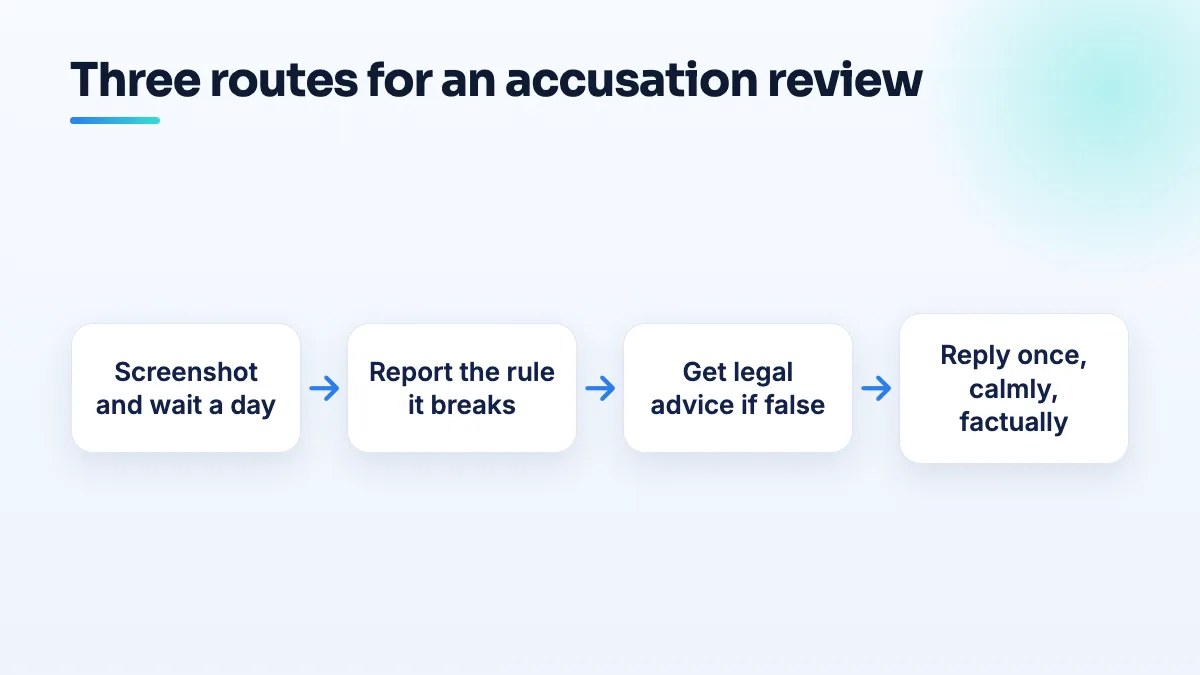
Someone has written a Google review accusing your business of illegal activity: unlicensed work, drugs, abuse, fraud. That's not a bad-experience review, and the fix is different. You report it under whichever Google rule it breaks, get legal advice if the claim is false and specific, and post one calm reply that doesn't repeat the accusation.
I went through the Help Community threads and forum posts from owners in this spot. The mistake I see most happens in the first 24 hours: arguing in public, or contacting the reviewer.
Why a Google review accusing your business of illegal activity is different
A normal one-star is an opinion. An accusation is a claim of fact, and customers read it that way. A tattoo studio in a Help Community thread about a review falsely accusing a shop of illegal activity was dealing with exactly that: a claim about the law, not about the tattoo.
The trouble is that Google's review reporting isn't built to decide whether an accusation is true. It checks whether the review breaks a content rule. So "this is a lie" rarely works as a report. A pet business in a Help Community thread about a review naming a staff member appealed on harassment grounds and was still denied. Schools and daycares get a version of this too: in a Reddit thread where childcare workers discuss a parent naming an educator in a review, the worry is how exposed the named educator is when the business can barely answer.
The three routes and when each one fits
| Route | Use it when | What it can realistically do |
|---|---|---|
| Report to Google | The review breaks a content rule: it harasses a named person, the reviewer was never a customer, or they're a competitor or ex-employee | Remove the review, sometimes after an appeal |
| Legal advice | The claim is specific, false, and you can show it's costing you business | Tell you whether it's defamatory where you are, and whether a legal request or letter is worth it |
| Public reply | Always, once you've calmed down | Show every future customer how you handle it |
What to do, step by step
- Wait a day before you reply. Screenshot the review, the reviewer's profile and the date first. Nothing you type in the first hour will help.
- Check whether the reviewer was ever a customer. Search your booking system, consent forms, enrollment records or invoices. If there's no trace of them, that's the strongest report you have, and the steps to get a fake Google review removed apply.
- Report it under the rule it breaks. A named employee attacked personally is harassment. A competitor or former staff member is a conflict of interest. Pick the reason that fits the content, and in the appeal say which sentence breaks which rule.
- Gather the facts that disprove the claim, but keep them private for now. Your license, a recent inspection, a permit, your insurance. You'll use them in a legal conversation and, briefly, in your reply.
- Talk to a lawyer if the claim is false, specific and damaging. I'm not a lawyer and whether a review is defamatory depends on where you are. A local lawyer can tell you in one call whether it's worth a formal request to Google or a letter to the reviewer, and whether doing so could backfire.
- Post one short reply. Don't repeat the accusation's words, because repeating them puts them in front of more readers. State one checkable fact and invite the person to talk offline.
A reply I'd be comfortable with looks like this: "We're fully licensed and inspected, and our license is on display in the studio. We don't recognize this account of events. If you'd like to talk about your visit, please call us and ask for the owner." Short, factual, no heat. My fuller reasoning on how to respond to negative reviews applies here too.
When the review names a member of staff
Never name the person in your reply, confirm their role or discuss anything they did. Talk to the employee privately first; they may be the one who's most upset. Report the review for harassment if it attacks them personally.
For schools and childcare, there's one more check. If the review describes a possible safety concern involving a child, follow your licensing and reporting obligations before you treat it as a reputation problem at all. That's the order I'd insist on in any daycare SEO work.
What not to do
- Don't phone or message the reviewer to demand removal. In a Reddit legal thread about daycares phoning parents over reviews, parents ask whether a business phoning them over a review is even allowed. That is not a conversation you want your business in.
- Don't threaten legal action in the public reply. It reads as intimidation to every customer who sees it, whoever is in the right.
- Don't pay anyone who offers to make it disappear. Owners describe one-stars posted and then money demanded to remove them in a Help Community thread about review extortion. Paying invites the next round.
- Don't bury it with fake five-stars. That breaks the same policy you're asking Google to enforce.
Tattoo studios, groomers and daycares get these reviews more than most, because trust is the whole sale. A profile with years of genuine, detailed reviews is what makes one accusation look like the outlier it is, which is where most of my tattoo shop SEO work starts. If you want help with the reports and the replies, that's part of our Google Business Profile management.
People also ask
Why did Google change my business category or name without asking?
Google edits profiles on its own when its systems, or suggestions from the public, decide your details are wrong. It happens most to service-area businesses with hidden addresses: Joy Hawkins confirmed one wave of forced re-categorization hit only those listings. Put your category or name back with a single edit, then make your website, signs and other listings use the same words so the change doesn't return.
Read the full answer: Why did Google change my business category or name without asking? →
Can a booth renter get their own Google Business Profile?
Usually not at the salon's address. Google only lets a business in a shared space list that address if it has its own dedicated space with permanent signage, where customers deal with its own staff during business hours. An open-floor chair doesn't pass that test. A private suite with your name on the door can, and a renter who also travels to clients can list as a service-area business with the home address hidden.
Read the full answer: Can a booth renter get their own Google Business Profile? →
How do you claim a Google listing that has no claim button?
Start from Business Profile Manager instead of the listing. Add a business, pick your existing listing from the suggestions, and Google will either let you verify it or route you to its ownership request, which emails the current owner. If neither appears, check every Google account you've used, then post the Maps link in the Help Community so a Product Expert can look.
Read the full answer: How do you claim a Google listing that has no claim button? →
Will Google remove a review from a former employee or opposing party?
Sometimes. Google's review policy lists current or former employment and industry competitors as conflicts of interest, so a review from an ex-employee or a rival can come down. In practice Google often leaves these reviews up, as a family-law firm found with a one-star from the opposing party. Your report has to name that clause and show the relationship with evidence Google can check.
Read the full answer: Will Google remove a review from a former employee or opposing party? →
Will Google remove a review from someone who was never a customer?
Usually not, if they dealt with your business at all. Google doesn't require reviewers to be customers, only to have interacted with you, so reviews from refused clients, couriers and towed drivers normally stay. Google does remove reviews with no real interaction, reviews about something other than your business, and reviews from someone with a personal conflict of interest. For the rest, a calm reply is your best tool.
Read the full answer: Will Google remove a review from someone who was never a customer? →