

You flagged a 1-star from someone who was never your customer, and Google came back saying it doesn't violate its policies. That's because "this person isn't in our records" isn't a reason Google removes reviews. If you want to know how to get a fake Google review removed, the answer is to name the specific policy the review breaks, show evidence for that clause, and say the same thing, calmly, in your public reply.
This hits every local business, but I see it most in dental and chiropractic practices, cleaning companies, nail salons, remodelers and tattoo studios. I went through the Google Business Profile Help Community threads where these reports failed, and they nearly all failed the same way.
Why "they're not a customer" gets rejected
A Product Expert put it plainly to a cleaning company in a Help Community thread about a fake review on a cleaning business: "The mere absence of a given person from your customer database is not a sufficient reason for Google to remove a review." The advice that followed was to name the specific policy clause, both in the report and in a public owner response.
Dentists reached the same conclusion on their own. In a Dentaltown discussion on removing fake Google reviews, practices reported that removal fails unless a specific policy is cited.
There's a good reason for this. Google can't see your customer list, and people review under nicknames, a partner's account or a name that isn't on the invoice. Nail salons post about 1-stars from names that match no customer all the time, and this is why those reports fail. From Google's side, a missing name proves nothing. A review that breaks a named rule, with something to show for it, is something a reviewer can act on.
The fake review policy clauses Google enforces
Google's prohibited and restricted content policy for Maps reviews is the document your report is judged against. These are the parts that fit most fake or unfair reviews, and what I'd attach for each:
| Policy | What the review looks like | Evidence that helps |
|---|---|---|
| Fake engagement | Not based on a real experience: no details, part of a burst, an account that reviews businesses in several countries | Reviewer's profile history, dates and times, other 1-stars posted the same day |
| Conflict of interest | Written by a competitor, a former employee or someone with a personal connection | Proof of the connection: a rival's business page with the same name or photo, an employment record, the reviewer promoting another company |
| Off-topic | About something other than an experience with your business: a landlord, a different company, politics | The detail that doesn't match you, such as a service you don't offer or a location you don't have |
| Harassment or personal information | Attacks a named staff member, or posts private details | The exact sentence, and who it names |
The conflict-of-interest clause is the one owners overlook most. Google's policy says a conflict of interest may include "current or former employment" and "industry competitors". A remodeler in a thread about a rival contractor's fake 1-star never got his removed. When I read threads like that, the report almost never showed Google how the reviewer was connected to the rival. The suspicion was there. The proof wasn't.
How to get a fake Google review removed, step by step
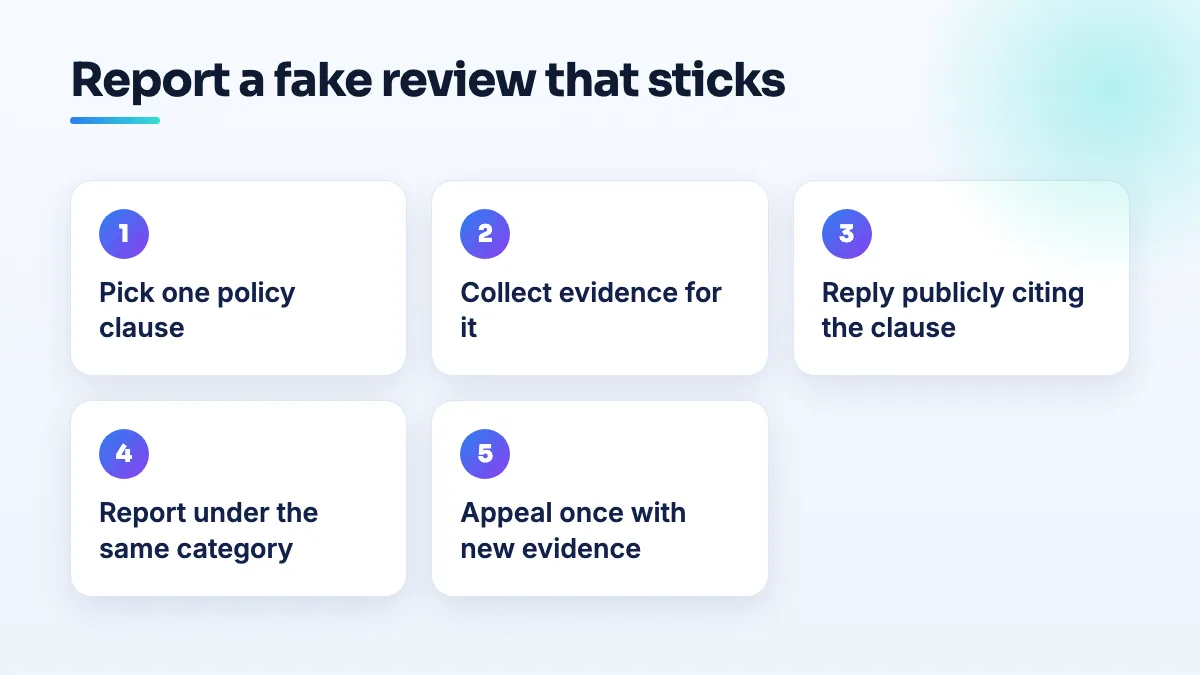
- Pick one clause. Read the review against the table above and choose the single clause it breaks most clearly. A report that says "fake, rude, competitor, off-topic" reads as a complaint, not a violation.
- Collect evidence for that clause. Screenshot the review with its date. Open the reviewer's profile and screenshot their other reviews. If you claim a competitor, capture the page that shows the connection. If you claim off-topic, capture what they describe that you don't do.
- Reply publicly, citing the clause. Keep it short and factual: "We can't find any record of this visit, and the review describes a service we don't offer. We've reported it to Google as off-topic under its content policy." No accusations, no names, nothing about the reviewer's life. My answer on how to respond to negative reviews has more on tone.
- Report the review under that same category. Flag it from your Business Profile, choose the category that matches your clause, and keep the report consistent with your reply. The reply and the report should tell the same story.
- Track the status and wait. Google's review management tool shows where each report stands. Don't report the same review again every day. It doesn't speed anything up.
- Spend your one appeal on new evidence. If the report is rejected, you can appeal, but Product Experts have confirmed there's no second appeal on the same review. Before you use it, read what happens once a Google review appeal is denied.
When the report a review tool errors out
Sometimes the problem isn't the decision but the form. A tattoo studio described the report tool failing outright in a Help Community thread about the report-a-review tool erroring. When that happens, this is the order I try things in:
- Report from a different place. If flagging from your Business Profile fails, open your listing on Google Maps and report the review from there as a normal user, still choosing the right category.
- Change browser or device. Try a private window, then your phone's Maps app. Sign in with the account that owns the profile.
- Screenshot the error with the date. If the tool keeps failing, that screenshot is what you post in the Help Community, along with the review link and your chosen clause.
What's different by industry
- Dentists and chiropractors can't confirm or deny that someone was a patient in a public reply. Health privacy law applies to review replies, and the U.S. health regulator has settled with a dental practice over its review replies. Cite the clause without saying anything about who the reviewer is. "This review doesn't reflect a visit to our practice" is already too much. "We've reported this review under Google's content policy" is safe. I cover the details in dental SEO work.
- Cleaning companies get reviews meant for a property, a landlord or a host, from people who never booked the cleaning. Those are off-topic cases, and the evidence is in the review text itself. It's the most common removal request I see in cleaning business SEO.
- Nail salons get reviews under names that don't match the booking book. Look at the account instead: if it has one other review, posted the same day in another country, that's a fake engagement case with evidence.
- Remodelers most often suspect a competitor. You need the connection on screen, not a feeling. A profile photo, a name or a company page that ties the reviewer to the rival is what turns suspicion into a conflict-of-interest report.
- Tattoo studios are where I've seen the reporting tool itself fail, so the workarounds above matter most for tattoo shop SEO clients.
What not to do
- Don't write a reply that attacks the reviewer. Other customers read it, and it can give Google's reviewer a reason to see you as the problem.
- Don't ask friends to flag the review. I've never seen a pile of flags from friends' accounts do more than one well-evidenced report, and it muddies your case.
- Don't post fake 5-stars to bury it. That's fake engagement on your side, and it puts your whole profile at risk.
- Don't pay anyone who promises removal. Nobody outside Google can remove a review, and some of those offers come from the people who posted it.
If several fake reviews arrived together, treat them as one case rather than one report at a time. I explain how in the guide to documenting a coordinated fake review attack.
When to get help
Most single fake reviews can be handled with the steps above in an afternoon. If you've already used your appeal, or the reviews keep coming, that's part of our Google Business Profile management: we build the evidence, write the report and the reply, and escalate through the Help Community when it's stuck.
Written by Saifur Rifat, Founder & SEO Lead at SERP Squad.