

You post every day, your follower count hasn't moved in months, and the model call you put out on Facebook ended with an empty chair. If you're wondering how to get tattoo clients or fill a new nail tech's book without living on Instagram, the answer is to be findable where people search when they're ready to book: Google, the shop's own profile and website, and a booking page that belongs to you.
Instagram is a good portfolio. It's a bad pipeline, because you don't control who sees it. Below is the setup I'd put in place for a new artist or tech, what changes between nails and tattoos, and what I'd stop doing straight away.
Why Instagram stopped filling the book
Artists describe this in their own words. A tattoo artist in a Reddit thread about Instagram no longer bringing tattoo clients had relied on Instagram since 2020, sat at about 1.8k followers for two years and watched engagement collapse with no plan B. Third-year artists in another thread describe being booked around two full days a week despite posting constantly.
Nail techs hit a different wall. Model calls on social media bring people who have nothing at stake. One tech in a Reddit thread from a nail tech with three no-shows in one day had all three come from Facebook. Newer techs in the same community say they don't know where clients are supposed to come from at all.
Meanwhile, the clients are looking. People in a Reddit thread from people trying to find a tattoo artist say it's hard to find anyone without Instagram, and one noted that more than half the studios they tried don't take walk-ins and keep the doors locked during open hours. The demand exists. It just can't find you.
Where ready-to-book clients actually look
Someone scrolling Instagram is browsing. Someone typing "fine line tattoo near me" or "gel x nails" plus their neighborhood into Google wants an appointment this week. Those searches show the map results first: the shop or salon's Google Business Profile, its reviews, its photos and its booking link.
That's the catch for a new artist working in someone else's shop. Nail techs in a Reddit thread about whose profile brings the clients are told their visibility depends on the salon owner's profile, not their own. For most techs and artists on the shop floor, that's accurate. So the first job isn't building your own following. It's making sure the shop's profile and website send people to you.
How to get tattoo clients and nail clients from search
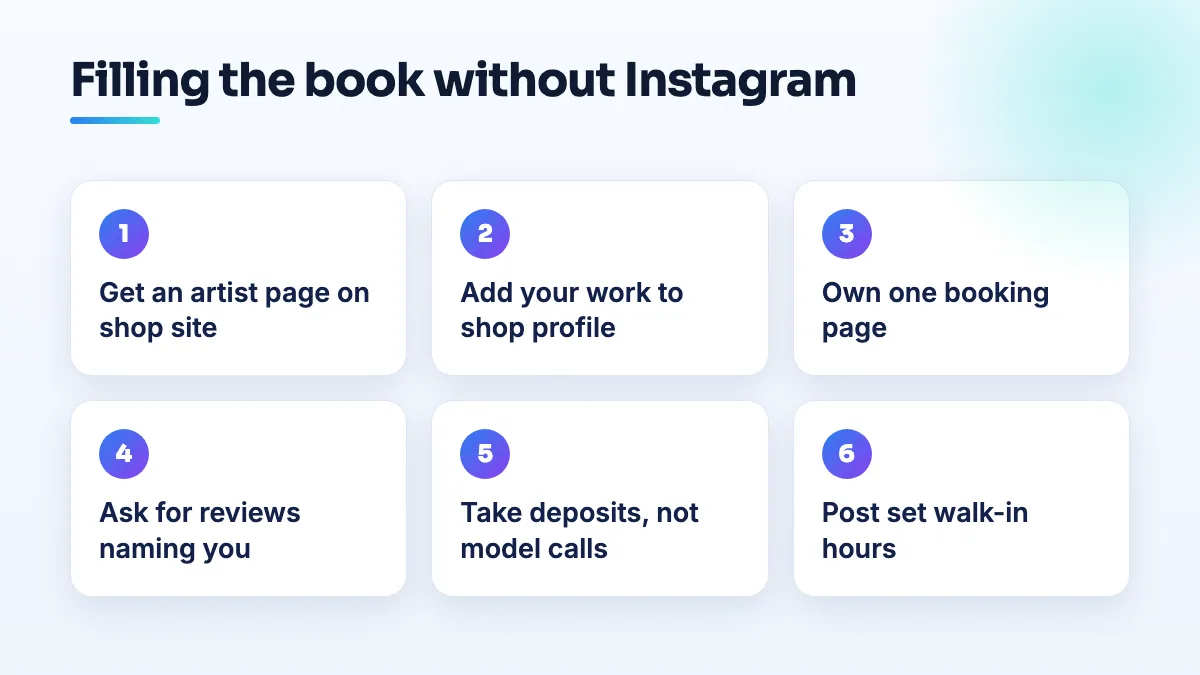
- Get yourself onto the shop's website with your own page. Your name, photo, the styles you do, ten of your best pieces with captions, and your booking link. Ask the owner this week. Shops benefit too, because every artist page is another page that can be found for a style.
- Get your work onto the shop's Google Business Profile. Ask the owner or manager to upload your healed tattoos or finished sets with your name in the post, and to add the services you do. If the profile lists "tattoo" but not "fine line" or "cover-ups", clients searching for those won't see it.
- Only make your own Google profile if you actually qualify. A chair on someone else's floor usually doesn't; a private suite with your name on the door can. I explain the rules for renters in the answer on booth renter Google Business Profile eligibility. Getting this wrong can split the shop's reviews and get both listings in trouble.
- Own one booking page. A simple page on a domain you control, with your services, starting prices, deposit policy and booking link. Put it in your Instagram bio and on the shop's site. I explain why in the answer on social media vs website for booking.
- Ask every client for a Google review that names you. On the shop's profile, a review saying "[your name] did my fine line script" helps the shop rank and tells the next client who to book. Ask at the end of the appointment, when they're looking at the result. Never offer anything in return.
- Replace free model calls with small deposits. A non-refundable deposit that comes off the price filters out people who were never coming. If you still need practice pieces, take them from people who've booked through the shop, not from open social posts.
- Offer set walk-in hours, and put them where Google can see them. A weekly flash day or walk-in afternoon, listed on the shop's profile and website. It answers the client who can't find an artist with an open door.
What's different for new nail techs
Nail clients rebook every few weeks, so one good client is worth a year of appointments. That changes where your effort goes.
- Rebook before they leave the chair. A client with the next date in their calendar doesn't need to find you again.
- Be the tech for a specific thing. "Structured gel", "short natural sets", "nail art for weddings". Clients search for these, and a salon can list you as its person for it on the site and profile.
- Fill gaps through the salon, not strangers. Ask the front desk to offer your open slots to walk-ins and cancellations. A client the salon already knows is far more likely to show than a model-call stranger.
- Keep your client list. If you move salons, a text list of your regulars is what goes with you. Reviews on the old salon's profile stay behind.
Salon owners who want their techs found this way are the kind of clients I work with in nail salon SEO.
What's different for tattoo artists
Tattoo clients decide slowly and spend more, and the locked door is the big problem.
- Think hard before leaving a street shop. Artists who moved to private studios in a Reddit thread about moving from a street shop to a private studio describe losing the walk-in trade. If you go private, your Google presence and booking page have to replace the door.
- Write about styles, not just show them. A short caption on each piece saying the style, placement and whether it's healed helps both the client and search. "Healed black and grey forearm piece" is findable. A photo alone isn't.
- Make consults easy to book. Big pieces start with a consult. Put a consult option with a clear deposit on your booking page so a client who found you on Google doesn't have to DM and wait.
- Keep the shop's reviews clean. Studios lose genuine reviews to Google's spam filter, and a sudden batch from one artist's followers can look like the pattern it catches. Ask each client once, after the session, and let reviews come in steadily.
Studios that want every artist on the roster to be found are exactly what our tattoo shop SEO work is built around.
What not to do
- Don't buy followers or engagement. It makes the account look bigger and the real reach smaller.
- Don't create a Google listing at the shop's address in your own name. It usually fails verification, and if it doesn't, it competes with the shop you work in.
- Don't run open model calls without a deposit. Three no-shows in a day is what that looks like.
- Don't ask friends or followers who never sat in your chair for reviews. Google filters them, and the shop's genuine reviews can go with them.
- Don't delete Instagram. Keep posting your best work there. Just stop treating it as the only way in.
Questions artists ask
How long before search brings me clients?
If the shop already has a decent profile, adding your page, your photos and reviews that name you can help within weeks, because the traffic already exists. Building a standalone presence from nothing takes longer, and I'd never promise a date.
What if the owner won't add me to the website or profile?
Explain that it helps the shop rank for more styles and fills chairs that are costing them money empty. If they still won't, that tells you something about whether it's the right shop to build a book in.
Where to start
This week: ask for your artist page, send the owner ten captioned photos for the profile, and set a deposit on your booking link. If you run the shop and want every artist found, that's part of our local SEO services.
Written by Saifur Rifat, Founder & SEO Lead at SERP Squad.