


Key points
- Open-floor chair renters rarely qualify at the salon's address
- A private suite needs your name permanently on the door
- Clients must deal with your staff, not the host's
- The hidden home address only fits renters who travel
- Never connect your booking link to the host's listing
Most booth renters find out the hard way: verification fails, or the profile goes live and then disappears. That happens because a booth renter Google Business Profile is judged by the same rules as any business in a shared space, and a chair on someone else's floor rarely meets them.
Barbers, nail techs, massage therapists and tattoo artists all run into this, so here's the rule, the setup I'd pick for each kind of rental, and the workaround I'd be careful with.
Why a booth renter's Google Business Profile fails at the salon address
A Platinum Product Expert put the rule plainly in a Help Community thread about a leased salon suite: "Businesses operating from a shared space are not eligible for a Google Business Profile unless they have a dedicated office with permanent signage." That renter had a real suite, and the rejection still came down to one detail: the business name wasn't on the suite door or window.
Google's guideline on shared offices says a business in a shared space needs clear signage, has to receive customers there during business hours, and has to be staffed by its own people. A Product Expert community guide on addresses spells out the part that catches renters: customers have to deal with your staff at that address, not the host's front desk.
A chair on an open floor fails nearly every part of that. There's no door to sign, the salon's reception often greets and books the client, and the address already belongs to the salon's own profile. When a self-employed stylist asked about this in a Help Community thread from a stylist renting inside a salon, a Gold Product Expert told her she didn't meet the criteria for a profile at that address and called it "a very common issue for hair stylists."
Which setup will actually verify
Work out which of these describes you, then follow the matching step. I'd do this before creating anything, because a failed or duplicate profile is harder to clean up than one that was never made.
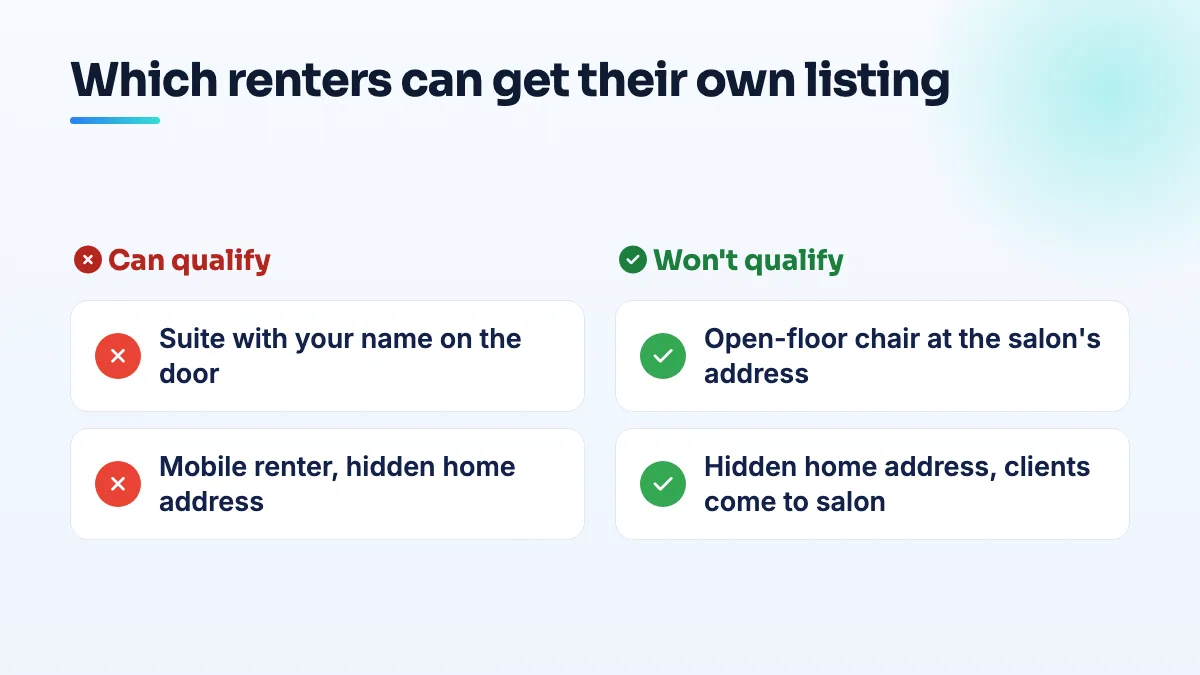
- If you rent a private suite with its own door, put your business name on it permanently. Vinyl lettering or a fixed sign on the door or window, not a paper note. Use your suite number in the address, set hours you're actually there to answer the door, and if Google asks for a video, film your key opening that door. If the building won't allow a sign, read about salon suite Google verification when the landlord bans signage before you apply.
- If you rent a chair or station on the open floor, don't create a profile at the salon's address. It will either fail verification or sit as a second listing on the shop's address, which hurts you both. I'd agree with the owner instead that your name, photo and booking link go on the salon's website and that clients can mention you by name in the salon's reviews.
- If you also travel to clients, list as a service-area business from home and hide the address. Bridal hair and makeup, house-call barbers, mobile nail techs and outcall massage therapists qualify this way because they serve customers at the customer's location. Keep the service area to where you really go. Product Experts have told mobile therapists to stay within roughly a two-hour drive of their base.
- Build a presence that doesn't depend on an address. Your own website with your name, services and booking link, connected to your Instagram. Clients who search your name need somewhere to land, whatever happens with Google.
- Never connect your booking platform to the host's address. A booth-renting barber in a thread from a barbershop that lost 124 reviews to a renter attached his Booksy profile to the shop's address. The shop's listing at one point showed the barber's business name, and the shop ended up split across two profiles, one holding about 124 reviews. That's exactly how a booth renter took Google reviews from the shop he worked in.
When the home-address workaround backfires
The fix most often suggested to stylists is to use your home address, hide it and list as a service-area business. The Gold Product Expert in the stylist thread suggested exactly that. It works for renters who genuinely go to clients. It backfires for renters who never leave the chair.
Google's eligibility rule is that a business either has a physical location customers can visit or travels to customers in person. If every one of your clients comes to the salon, your home is neither. A service-area profile for that business describes something that doesn't exist, and if Google asks for a verification video you'll be filming a home with none of your equipment in it. My advice: only use this setup if you'd be comfortable explaining your real service model to a Google reviewer.
What's different for barbers, nail techs, massage therapists and tattoo artists
- Barbers and stylists are the most common case, and an open-floor chair almost never qualifies. The bigger risk is to the host shop, as the Booksy case shows.
- Nail techs on a rented station are often told their visibility depends on the salon owner's profile. For open-floor stations that's accurate, so negotiate how you appear on it before you sign.
- Massage therapists renting a treatment room are closer to passing, because the room has a door. It still needs your name on it and clients who deal with you, not the wellness center's reception.
- Tattoo artists doing guest spots shouldn't list at the host studio at all. A private studio with a locked door and no signage has the suite problem: put the name on the door.
If you own the shop the renters work in
Keep one profile for the shop and don't let renters create listings at your address. List every renter on your website with their own booking link, and reply to reviews that name them so their clients see it. That keeps your review history in one place, and it's usually the first thing I set up in SEO for barbershops and in nail salon SEO projects where renters come and go. If your profile already has a second listing on it, Google Business Profile management is where we untangle it.
People also ask
Do you need a website if your clients book through Instagram or Booksy?
Yes, if you want to keep the clients you've built. Instagram, Facebook and Booksy are rented space: an account can be banned, reach can collapse and the marketplace shows your clients other shops. A simple website you own gives Google and new clients a stable place to find you, and it holds your booking link, services and prices whatever happens to the platforms.
Read the full answer: Do you need a website if your clients book through Instagram or Booksy? →
Can two businesses share the same address on Google Business Profile?
Yes, if they are genuinely separate businesses and Google can tell them apart. Each needs its own suite or unit number, its own permanent sign, its own staff on site during business hours, and its own phone number and website. Two businesses on the same street address with no suite number and the same category look like a duplicate, and one or both can be suspended.
Read the full answer: Can two businesses share the same address on Google Business Profile? →
Is Booksy worth it for barbers?
It can be, as booking software and as a short-term way to fill an empty chair. As your main source of new clients, it's weaker than it looks: barbers report that Booksy's marketplace sends its own clientele, shared with every other barber nearby, and some accuse it of taking referrals and fees. Use it for scheduling, and build your Google profile and website as the client channel you own.
Can you appeal a Google review decision more than once?
No. You get one appeal on each review Google decides not to remove, and once the appeal is denied, that decision is final for that review. Wait for the first decision before appealing, and only appeal with new evidence tied to a specific policy clause. After that, your options are a calm public reply, reporting new reviews from the same accounts, and outnumbering the review with genuine ones.
Read the full answer: Can you appeal a Google review decision more than once? →
How do you claim a Google listing that has no claim button?
Start from Business Profile Manager instead of the listing. Add a business, pick your existing listing from the suggestions, and Google will either let you verify it or route you to its ownership request, which emails the current owner. If neither appears, check every Google account you've used, then post the Maps link in the Help Community so a Product Expert can look.
Read the full answer: How do you claim a Google listing that has no claim button? →