


Key points
- Google requires interaction, not a purchase
- Refused clients and couriers can review you
- No-interaction reviews can be reported as fake
- Reviews about a landlord or building are off-topic
- Save your one appeal for real rule breaks
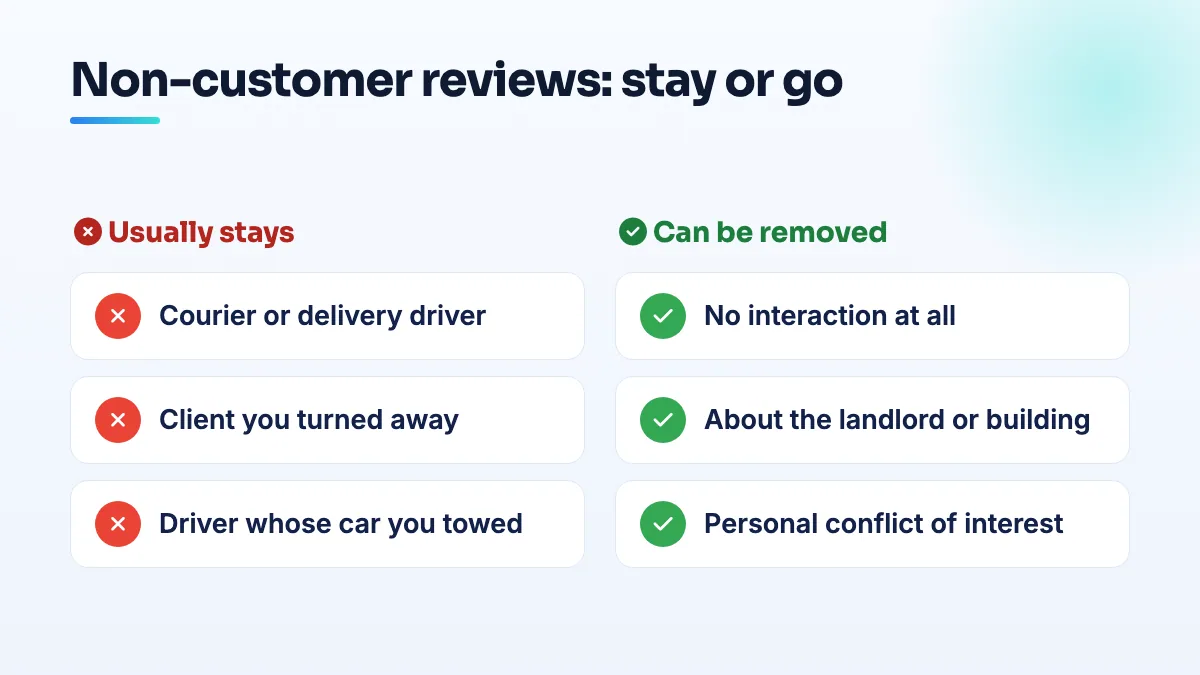
Usually not, if the person dealt with your business in any way. Google doesn't require a reviewer to be a paying customer, only to have interacted with you, so a Google review from a non customer stays up when it's about a real encounter: a client you turned away, a courier at your back door, a driver whose car you towed. It comes down when there was no interaction at all, or when the review breaks another rule.
I went through the Google Business Profile Help Community threads where owners asked for these removals. The ones who understood the interaction rule wasted far less time.
The interaction rule, in a Product Expert's words
The clearest statement came from Mike Blumenthal, a Diamond Product Expert, in a Help Community thread about a delivery driver's 1-star. The merchant had proved the reviewer was the courier assigned to its orders, with 7,472 completed deliveries on record and a review history full of the same complaint about other businesses. Blumenthal's answer: "They do not require that the reviewer is a customer, only that they have interacted with your business." The review stayed.
That one sentence explains most of the denials. A courier interacted with you. So did the person you refused to serve, the driver whose car you towed from a private lot, and the neighbor who walked past your sign every day. Google treats their experience of your business as reviewable, even if they never paid you.
Which non-customer reviews Google will remove
The rule has limits, and these are the cases where I'd report:
- No interaction at all. Someone who has never been near your business, and whose account has the marks of a fake. That's fake engagement.
- A review about something that isn't your business. A barbershop in a thread about a 1-star aimed at the landlord's property got a review from someone complaining about the building, who had never entered the shop. The appeal was denied, but off-topic is still the right clause, and the evidence has to show the review is about the building, not the barbers.
- A personal connection. A pet sitter in a thread about a review from a former tenant was reviewed by a former tenant who had never been a client. Google's policy lists personal affiliations under conflict of interest.
- Harassment or private details. A review that attacks a named person or publishes personal information breaks those rules whoever wrote it.
What to do with a Google review from a non customer
- Work out what the interaction was. Refused booking, delivery, tow, a dispute over a sign, a neighbor. Be honest with yourself: if there was one, the review will probably stay.
- If there was no interaction, report it with evidence. Screenshot the reviewer's profile and other reviews, and name the clause. My guide on how to report a fake Google review covers the wording.
- If there was one, write a reply for future customers. Explain the situation in one or two calm sentences without personal details: "We weren't able to take this booking because we were full that week. We're sorry for the disappointment." That reads well to anyone deciding whether to call you.
- Fix the cause if it's likely to repeat. If couriers are unhappy with your pickup process, or refused callers feel brushed off, a small process change stops the next review.
- Don't spend your one appeal on an interaction review. Keep it for reviews where you have real evidence of a rule being broken.
What's different for barbers, pet businesses, transport, towing and HVAC
- Barbershops in rented units get reviews about parking, the landlord or the building. Report those as off-topic, and put a line in your reply saying the shop doesn't manage the property. That's standard in barber shop SEO work.
- Pet sitters, groomers and vets turn clients away for good reasons: an aggressive dog, a full schedule, an animal they can't safely take. Those people interacted with you. Reply with the reason in general terms, and I cover more of this in pet care SEO.
- Transport and delivery businesses deal with couriers and drivers who aren't customers but clearly interacted with them. The Blumenthal answer applies exactly. Reply, and fix the handover if the complaint is fair.
- Towing companies get reviewed by drivers whose cars they removed from private property. Those are interactions, and they'll stay. A reply that states the lot was signed and the tow was authorized, without naming anyone, is what I'd write in towing SEO work.
- HVAC companies sometimes get reviewed by people angry about a yard sign or a van. A heating company in a thread about a reviewer mad about a company sign spent years filing threads about reviews like that. Seeing your sign or your van counts as an interaction by Google's standard, so I wouldn't spend the effort. Reply once, briefly, and let it go.
For tone in the replies, see my answer on responding to bad reviews. If non-customer reviews are dragging your rating down and you want them handled properly, that's part of our Google Business Profile management.
People also ask
Why doesn't my business show up when people search its exact name?
Usually because Google either can't tie your profile to your business as a clear entity, or it has confused you with another business with a similar name and sometimes merged the two. Open your profile's share link on a signed-out phone: if it opens your profile, strengthen your name, phone and website signals; if it opens another business, it's a data problem to escalate with proof.
Read the full answer: Why doesn't my business show up when people search its exact name? →
Does your service area affect where you rank on Google Maps?
Not in the way most owners expect. Adding towns to your service area doesn't make you rank in the map pack there. Map rankings are anchored to the address you verified with, even when it's hidden, and the service area mainly tells customers where you work. To reach nearby towns, use real town pages, reviews from customers there, ads, or a genuinely staffed second location.
Read the full answer: Does your service area affect where you rank on Google Maps? →
Why does my verified Google Business Profile not show up publicly?
Because verification and publication are separate. Verification proves the business is real; Google still has to be confident enough to show the listing to everyone. A new business with no website, directory listings or registry record can pass verification and stay "Only visible to you", especially if an older business shares its name. Search your name signed out to see which gate you're at, then build that footprint.
Read the full answer: Why does my verified Google Business Profile not show up publicly? →
Can a booth renter get their own Google Business Profile?
Usually not at the salon's address. Google only lets a business in a shared space list that address if it has its own dedicated space with permanent signage, where customers deal with its own staff during business hours. An open-floor chair doesn't pass that test. A private suite with your name on the door can, and a renter who also travels to clients can list as a service-area business with the home address hidden.
Read the full answer: Can a booth renter get their own Google Business Profile? →
Which Google Business Profile categories require a visible address?
Some Google Business Profile categories won't run as a hidden-address service area. Local Search Forum practitioners have confirmed Mechanic and Swimming Pool Contractor, and owners in other categories report being told theirs needs a location customers can visit. If your primary category is one of them, you either show a real address customers can come to during your hours, or choose a different category that fits your work and allows a service area.
Read the full answer: Which Google Business Profile categories require a visible address? →