


Key points
- Mechanic and Swimming Pool Contractor force a visible address
- A forced address sends customers to your door
- Check the category before hiding anything
- Choose a close category that allows service areas
- Never list a staff-only yard as a storefront
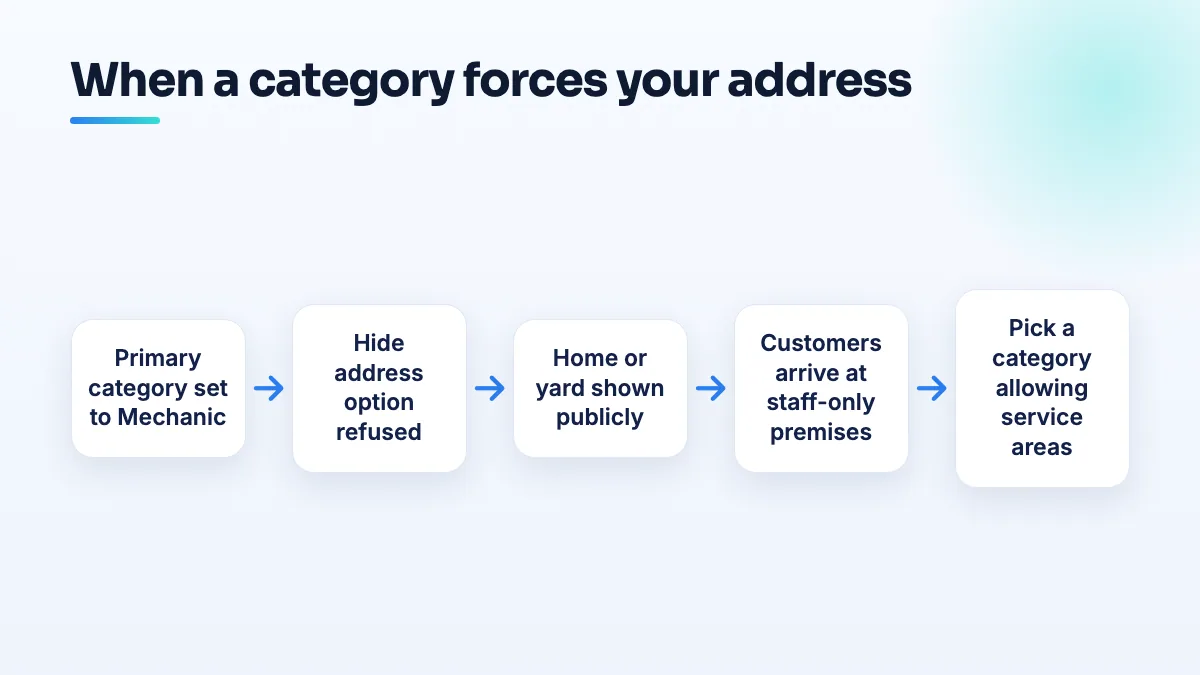
You work at the customer's location, you try to hide your address, and Google won't let you. The usual reason is the primary category. There are Google categories that require an address to be shown, and a mobile business that picks one ends up with its home or yard on the map and customers knocking on a door they were never meant to use.
Which Google categories require an address
The most useful reference I know is a Local Search Forum list of categories that require a business address, kept by practitioners who've hit the restriction. It confirms Mechanic and Swimming Pool Contractor. I haven't found a complete list published by Google, so I treat that thread as the starting point, not the final word.
Owners in other categories meet the same wall. In a Help Community thread about a category that requires a location customers can visit, the owner was told exactly that when trying to run as a service-area business. How it usually shows up: the option to hide the address is refused or the edit fails once that category is primary.
The logic is Google's. Some categories describe places people go to, like a garage, so Google expects a place you can go to.
Why it hurts mobile mechanics and fleets
A mobile mechanic with Mechanic as the primary category has to show an address. For most, that's their home. Customers then see a pin, drive to it, and turn up at a house. Fleet and transport businesses hit the same thing with a staff-only yard or depot: the category puts it on the map as if customers were welcome there.
Two related problems make it worse. Mobile mechanics already report ranking far too wide, with calls from 50 miles away. And for hidden-address auto businesses that choose a different category, Joy Hawkins confirmed in a Local Search Forum thread on auto glass listings being re-categorized that Google was quietly changing categories and that it only hit service-area businesses. So whichever way you go, check your category every few months.
What to do if your category forces an address
- Confirm the category is the cause. Check your primary category against the list, then screenshot the message or the refused edit. Don't keep retrying; repeated edits draw reviews of the profile.
- Decide honestly whether customers can visit you. If you have a real workshop with hours when someone is there to receive customers, show it. The category fits and the visible address is accurate.
- If you only work on site, choose a different primary category. Pick the closest one that describes your work and still lets you hide the address. My guide to Google Business Profile categories shows how to compare options against what ranks for your searches.
- Leave the restricted category off entirely. I haven't seen confirmation either way on whether a restricted category added as a secondary brings the same requirement, and it isn't worth a loop of edits to find out.
- Make your website match the category you chose. Page titles, headings and service pages should describe the same work in the same words, so the category and the site agree.
- Hide the address and set service areas you actually drive. The full setup, including how to make up for the visibility a hidden address can cost, is in my guide on how to hide your home address on Google Business Profile.
Edge cases: repair drop-offs, mail-in and depots
Electronics repair. Mail-in and pick-up repair businesses sit awkwardly between a storefront and a service area. If customers can drop devices off during set hours, you have a location and should show it. If everything arrives by courier and you never meet customers, you may not be eligible for a profile at all, because Google requires either a place customers visit or in-person service at theirs. It's one of the first questions in our electronics repair SEO onboarding.
Transport and fleets. A depot that customers never visit shouldn't be listed as if they can. For long-distance transport, the fit may be poor anyway: a Local Search Forum admin told one transport company that Google's model didn't suit a business covering a continent, and suggested ads and organic search instead. I'd weigh that before forcing a depot onto the map, and it's how we approach trucking SEO.
Mobile mechanics with a small workshop. If you do some jobs in your own bay by appointment, you can show the address with honest hours. Put "mobile service, appointments only at the workshop" on your website and in your profile description so people don't arrive unannounced. It's a setup we use often in mechanic SEO work, and getting it right is part of our Google Business Profile optimization.
People also ask
When does a department or second entrance get its own Google Business Profile?
Only when customers deal with it as its own place. A department that has its own entrance or counter, its own phone line, its own hours and a category different from the main business can have its own listing, named as the business plus the department. A second door, a delivery gate or an internal team can't, and listing them causes duplicate flags.
Why did Google change my business category or name without asking?
Google edits profiles on its own when its systems, or suggestions from the public, decide your details are wrong. It happens most to service-area businesses with hidden addresses: Joy Hawkins confirmed one wave of forced re-categorization hit only those listings. Put your category or name back with a single edit, then make your website, signs and other listings use the same words so the change doesn't return.
Read the full answer: Why did Google change my business category or name without asking? →
Should a local service business publish its prices online?
Yes, for most local service businesses. Publish fixed prices for fixed-scope jobs, a starting price or range for jobs that vary, and a quick estimator or quote form for custom work. Searchers who type "how much" want a number before they call, and pages that show one win the click. Add a date and a line that the final price is confirmed after inspection.
Read the full answer: Should a local service business publish its prices online? →
Why doesn't my business show up when people search its exact name?
Usually because Google either can't tie your profile to your business as a clear entity, or it has confused you with another business with a similar name and sometimes merged the two. Open your profile's share link on a signed-out phone: if it opens your profile, strengthen your name, phone and website signals; if it opens another business, it's a data problem to escalate with proof.
Read the full answer: Why doesn't my business show up when people search its exact name? →
Why does a dealership's service department show for the brand search?
It's a recurring Google-side problem: two listings carry the dealership's name, and Google sometimes picks the service department for the knowledge panel. You can't switch it off, but distinct names, categories, links and phone numbers on each listing, a stronger main listing and a well-documented report make it much less likely to happen and easier to get fixed.
Read the full answer: Why does a dealership's service department show for the brand search? →