


Key points
- Good booking software, weaker as a client source
- Marketplace clients are shared with other barbers
- Check your real fees in your own billing
- Send clients to your own booking link
- Chair renters: never link Booksy to the shop's address
Whether Booksy is worth it depends on what you're paying it to do. As booking software, plenty of barbers are happy with it. As a source of new clients, it's weaker than it looks, because the clients it sends are Booksy's marketplace users, and they're browsing other barbers on the same app.
My view: use it to manage bookings if you like it, but don't let it be the only way new clients find you. Build the channel you own alongside it.
What barbers say they actually get from Booksy
A barber put the core complaint plainly in a Reddit thread from barbers on Booksy's shared clientele: the marketplace feeds you Booksy's own clientele, and you share them with every other barber listed nearby. A client who found you by scrolling the app can find the next barber the same way.
In a barbers' Facebook group discussion about Booksy referrals and fees, barbers go further and accuse the platform of taking referrals and a third of the payment. Those are barbers' accounts, not figures I can verify, and pricing changes. Before you decide, open your own account's billing page and work out what you actually paid last month for marketplace clients versus your own regulars.
When Booksy is worth it and when it isn't
- Worth it: you're new, your chair is empty and you need bodies in it now. The marketplace can fill gaps while you build a following.
- Worth it: you just want solid scheduling, reminders and deposits, and you send your own clients to your own booking link.
- Not worth it as a strategy: you're established and most of your "new" clients come through the marketplace. You're renting a client list instead of building one.
- Risky: you rent a chair in someone else's shop and connect Booksy to the shop's address. That can tangle both of your Google listings.
How to check whether Booksy is paying for itself
Don't judge it on how busy the app feels. Look at three months of your own numbers:
- How many new clients came from the marketplace, as opposed to regulars who booked through your link.
- How many of those came back a second time. A marketplace client who never returns is a one-off sale, not a client.
- What you paid in total for the subscription, marketplace fees and any payment charges.
Divide what you paid by the marketplace clients who became regulars. That's what each kept client really cost you. If the number looks fine, keep going. If it doesn't, move your effort to channels where the client stays yours.
How to use Booksy without handing it your client base
- Treat it as software, not your storefront. Send clients to your own booking link from your Instagram, your website and your Google profile, so they come to you first and the app second.
- Control the booking button on Google. Make sure the "Book" link on your Google Business Profile goes where you want it to. If a Booksy link appears there that you didn't choose, or one from a provider you've left, read how to change the booking link on your Google Business Profile.
- Get a simple website of your own. Your name, your cuts, your prices, your hours and your booking link. Barbers ask whether they need one if they're already on Booksy and Instagram, and I answer it in a separate post on using Booksy instead of a website.
- Ask for Google reviews, not only app reviews. App reviews stay on the app. Google reviews show when someone searches "barber near me", which is where clients who don't use Booksy look.
- If you rent a chair, never attach Booksy to the shop's address. In a Help Community thread from a barbershop that lost reviews to a renter, a booth renter linked his Booksy to the shop's address and the shop ended up split across two Google profiles, one holding about 124 reviews.
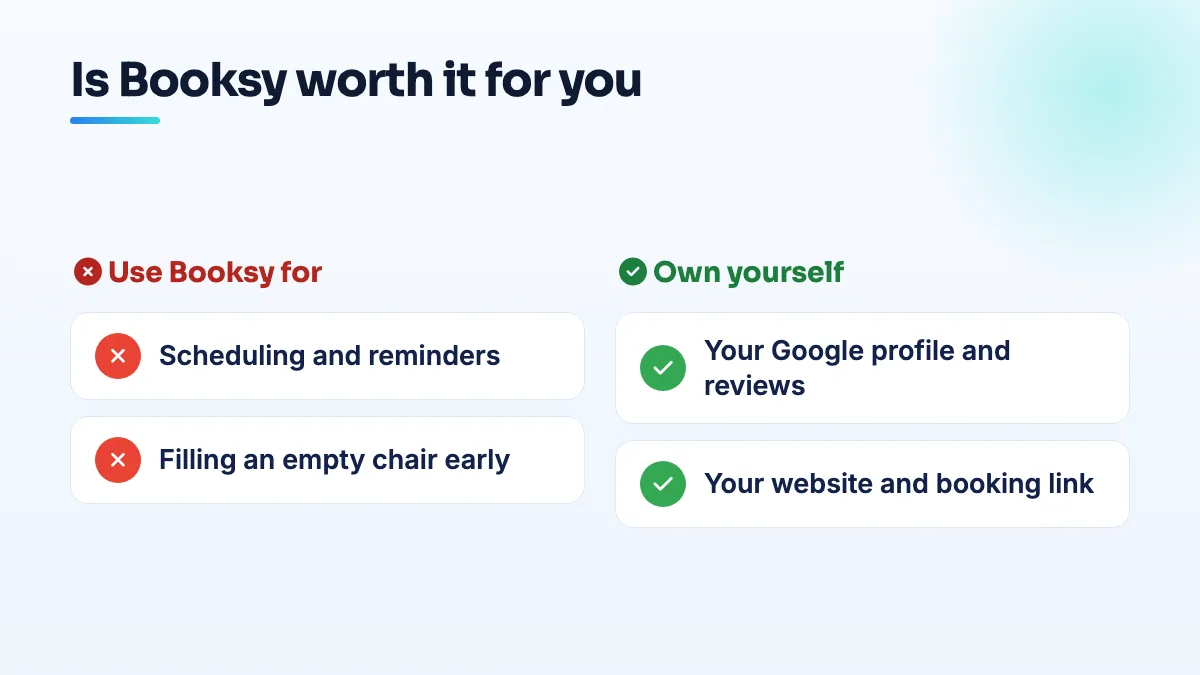
Booksy vs your own website and Google profile
Booksy is good at booking. Your own website and Google profile are good at being found by people who've never heard of you and aren't on any app. The difference is who owns the relationship. A client who found you on Google and booked through your link is yours, whatever software sits behind it.
For a shop, that's also where most of the search visibility sits. When I work on SEO for barbershops, the Google profile, the reviews and the website do far more for walk-ins and new bookings than any marketplace ranking.
Does the same apply to nail techs?
Mostly, yes. Nail techs on booking marketplaces face the same shared-client problem, and techs renting a station are often told their visibility depends on the salon owner's Google profile. If that's you, agree how you'll appear on the salon's website and profile before you sign, and build your own booking link and portfolio alongside it. It's the first thing I sort out in nail salon SEO work where renters are involved.
If you want the whole picture handled, from your Google profile to the pages that rank, that's what our local SEO services cover.
People also ask
Can a booth renter get their own Google Business Profile?
Usually not at the salon's address. Google only lets a business in a shared space list that address if it has its own dedicated space with permanent signage, where customers deal with its own staff during business hours. An open-floor chair doesn't pass that test. A private suite with your name on the door can, and a renter who also travels to clients can list as a service-area business with the home address hidden.
Read the full answer: Can a booth renter get their own Google Business Profile? →
Do you need a website if your clients book through Instagram or Booksy?
Yes, if you want to keep the clients you've built. Instagram, Facebook and Booksy are rented space: an account can be banned, reach can collapse and the marketplace shows your clients other shops. A simple website you own gives Google and new clients a stable place to find you, and it holds your booking link, services and prices whatever happens to the platforms.
Read the full answer: Do you need a website if your clients book through Instagram or Booksy? →
Can you appeal a Google review decision more than once?
No. You get one appeal on each review Google decides not to remove, and once the appeal is denied, that decision is final for that review. Wait for the first decision before appealing, and only appeal with new evidence tied to a specific policy clause. After that, your options are a calm public reply, reporting new reviews from the same accounts, and outnumbering the review with genuine ones.
Read the full answer: Can you appeal a Google review decision more than once? →
Why are my customers' Google reviews not showing up?
Usually because Google is holding the review back, not because it was never written. A filtered review stays visible to the person who wrote it, so their screenshot doesn't prove it's public. New or empty accounts, sudden bursts of reviews and anything rewarded are the usual triggers. If nobody at all can leave a review, check your profile for a suspension, a verification request or a ratings restriction.
Read the full answer: Why are my customers' Google reviews not showing up? →
What can you do when Google's AI shows wrong information about your business?
You usually can't get Google to delete an AI answer, and support has told owners it can't remove Gemini-generated information. What works is correcting what the answer is built from: record the wrong answer with dates, send feedback on it, update your Business Profile and website to state the truth plainly, fix directories and booking platforms that contradict you, then escalate in the Help Community with evidence.