


Key points
- Mismatched records make real businesses look hijacked
- Reinstatement won't stick while conflicts remain
- Fix website and registration before directories
- Keep one address format and one phone
- Appeal only once the main records agree
Yes, it can contribute, and it's one documented reason a profile gets reinstated and then suspended again. Google doesn't say that directory listings cause suspensions, but an inconsistent NAP (name, address and phone) gives any Google suspension review a reason to doubt you: when your profile says one thing and the rest of the web says another, a real business looks like a fake or a hijacked listing.
How inconsistent NAP leads to a Google suspension loop
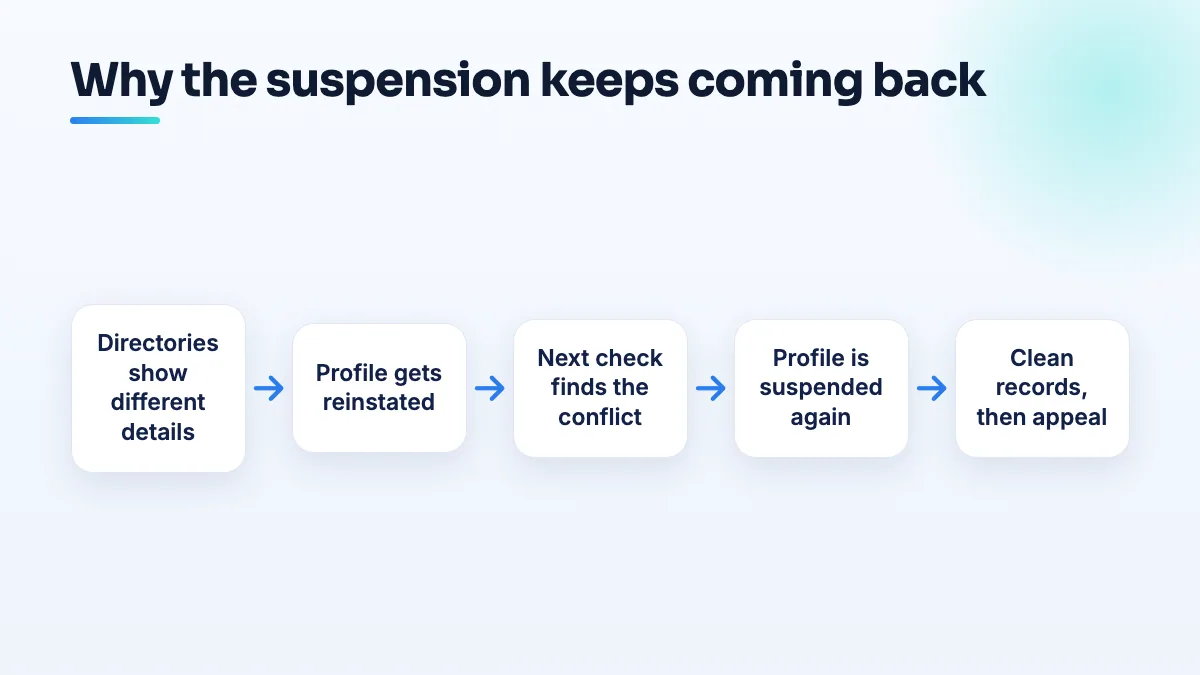
The clearest case is a moving company in Huntington Beach. In a Help Community thread from a mover re-suspended within 48 hours, the profile was suspended, reinstated, then suspended again within two days, losing reviews along the way. The cause identified in the thread was that the business details didn't match across Yellow Pages, Groupon, its own website and the BBB.
An appliance repair company in Toronto went through a longer version of the loop, although its thread doesn't name a cause. A Help Community thread from an appliance repair firm disabled, restored, disabled and suspended in three weeks describes a misrepresentation suspension, a denied appeal, and a promised video verification email that never arrived.
A computer repair owner in a Help Community thread about a repair business suspended after moving cities put the mechanism better than I can. His registration paperwork still showed the old address when he appealed, and in his words, "an older listing that suddenly moves to a bigger city with mismatched paperwork looks like a hijacked listing." An electrician in another thread had the same problem from a different angle: his corporate filing pointed at a UPS Store mailbox and his license lookup returned a hair salon's address.
My read of why the loop happens: reinstatement fixes the profile, but the next automated check compares it with the same conflicting records and reaches the same conclusion.
How to find and fix the conflicting records
- Write down your one true NAP. The business name exactly as registered and on your signage, one address written one way (or your hidden service-area base), and one main local phone number. Every record should match this.
- Fix the sources you control first. Your website footer and contact page, your state or provincial business registration, and any license records. These are what a reviewer checks against your appeal, so they must match before anything else.
- Search for the old versions of you. Search your old addresses, old phone numbers, previous business names and misspellings. Note every directory that shows them: Yellow Pages, Yelp, BBB, Groupon, Facebook, Bing, Apple Maps and trade directories.
- Claim and correct each one, or close it. Update the listings you can claim. Where there's a duplicate for an old location, mark it closed or ask the directory to remove it. Keep a spreadsheet with the URL, the old details, the date you fixed it and a screenshot.
- Leave the Google profile alone while you do this. Don't edit the profile to match a directory. The directories should match the profile and your registration, not the other way round.
- Appeal only when the main records agree. Then include your registration and the spreadsheet in the appeal, so the evidence shows one consistent business.
Where movers and appliance repair firms get caught
Movers often have a history of warehouses, yards and offices, and each move leaves an address behind in directories. Moving is also the most spam-heavy category I researched, with documented networks of fake mover listings, so a real mover with scattered details looks uncomfortably like them. In SEO for moving companies, cleaning up old warehouse addresses is usually the first job.
Appliance repair firms that have run ads or used lead platforms can end up with old tracking numbers spread across directories, plus listings created by third parties. Fake repair listings at fake addresses are common in this trade too, so the same mismatch reads badly. For appliance repair SEO, I'd make sure one phone number is used everywhere.
What I'd avoid
- Don't use tracking numbers as your main listed phone. Keep a single local number on the profile and in directories.
- Don't appeal with paperwork that shows a different address from the profile. Update the registration first.
- Don't pay for a mass submission to hundreds of directories. It creates more records to keep consistent, not fewer.
If you're not sure what counts as a listing, start with what local citations are. If your suspension notice mentions misleading information, read about deceptive content Google Business Profile suspensions too. Finding and fixing old records is exactly what our citation cleanup covers, and the appeal side is part of our GBP management.
People also ask
Can you appeal a Google review decision more than once?
No. You get one appeal on each review Google decides not to remove, and once the appeal is denied, that decision is final for that review. Wait for the first decision before appealing, and only appeal with new evidence tied to a specific policy clause. After that, your options are a calm public reply, reporting new reviews from the same accounts, and outnumbering the review with genuine ones.
Read the full answer: Can you appeal a Google review decision more than once? →
Will Google support help if my business stops ranking?
No. Google Business Profile support won't investigate why a live profile dropped in the rankings, and Product Experts say so directly. Support does act on profile problems: suspensions, verification, ownership, rejected edits and reviews or listings that break the rules. Check first whether your profile is live and findable by name; if it is, the drop is yours to diagnose.
Read the full answer: Will Google support help if my business stops ranking? →
Does your service area affect where you rank on Google Maps?
Not in the way most owners expect. Adding towns to your service area doesn't make you rank in the map pack there. Map rankings are anchored to the address you verified with, even when it's hidden, and the service area mainly tells customers where you work. To reach nearby towns, use real town pages, reviews from customers there, ads, or a genuinely staffed second location.
Read the full answer: Does your service area affect where you rank on Google Maps? →
Can you offer a discount or gift card for a Google review?
No. Google's review policy doesn't allow money, discounts, gift cards, free services or other incentives in exchange for reviews, even if you never ask for five stars. It often doesn't work either: one lawn care operator gave gift cards to all 21 of their clients, spent $500 and got zero reviews. A plain request at the right moment, with a direct link, does better and stays inside the rules.
Read the full answer: Can you offer a discount or gift card for a Google review? →
Why do fake moving companies list as logistics companies on Google?
Because the moving company category gets stricter verification, including video checks, and a logistics company listing avoids them. A documented network of 110+ fake mover listings used this to get verified on houses, virtual offices and bare intersections, then won mover searches with keyword names and forwarded the calls to lead resellers. The fix for a real mover is to document the whole network in one spreadsheet and report it once, with a Product Expert escalation.
Read the full answer: Why do fake moving companies list as logistics companies on Google? →