


Key points
- The filter hides similar listings, it doesn't delete them
- Same address plus same category triggers it
- Different categories, phones and suites reduce it
- Brokerage offices are the hardest place to escape it
- Each listing needs its own reviews
You set up a listing for every agent, advisor or attorney in the office, and only one of them ever appears in the results. That's Google's local filter: when several practitioners at the same address share a category, Google usually shows one and hides the others for that search. The hidden listings aren't suspended or deleted. They just look too similar to the one Google chose, and the fix is to make them genuinely different, not to add more of them.
How Google's local filter treats practitioners at the same address
The filter exists to stop one business filling the Google map pack with near-identical results. Practitioners at one office look exactly like that: same street address, same category, often the same phone number and the same website.
The people who study this most closely describe it the same way. In a Local Search Forum discussion of practitioner and business listings, contributors explained that when a practitioner listing and the business listing share an address and categories, one filters the other out, and that different primary categories, services and phone numbers are what separate them. For law firms, a Local Search Forum thread on multiple attorneys at one firm put it bluntly: if everyone uses the office address, they mostly all get filtered, and which one shows is luck of the draw.
How to check whether a listing is filtered
- Search the practitioner's name directly. If their listing comes up for their own name, it exists and it's live. It's being filtered for category searches, not suspended.
- Search the category from near the office. "Financial advisor", "real estate agent" or "family lawyer" from a phone near the building. Note which listing from your office appears, if any.
- Zoom in on Google Maps around the office. When I check for the filter, a hidden listing that appears once you zoom right in is the usual giveaway. If they show up only at street level, that's the filter at work.
- Repeat from a few miles away. Sometimes a different listing from your office wins in a different area. Write down which one shows where.
What reduces the filter
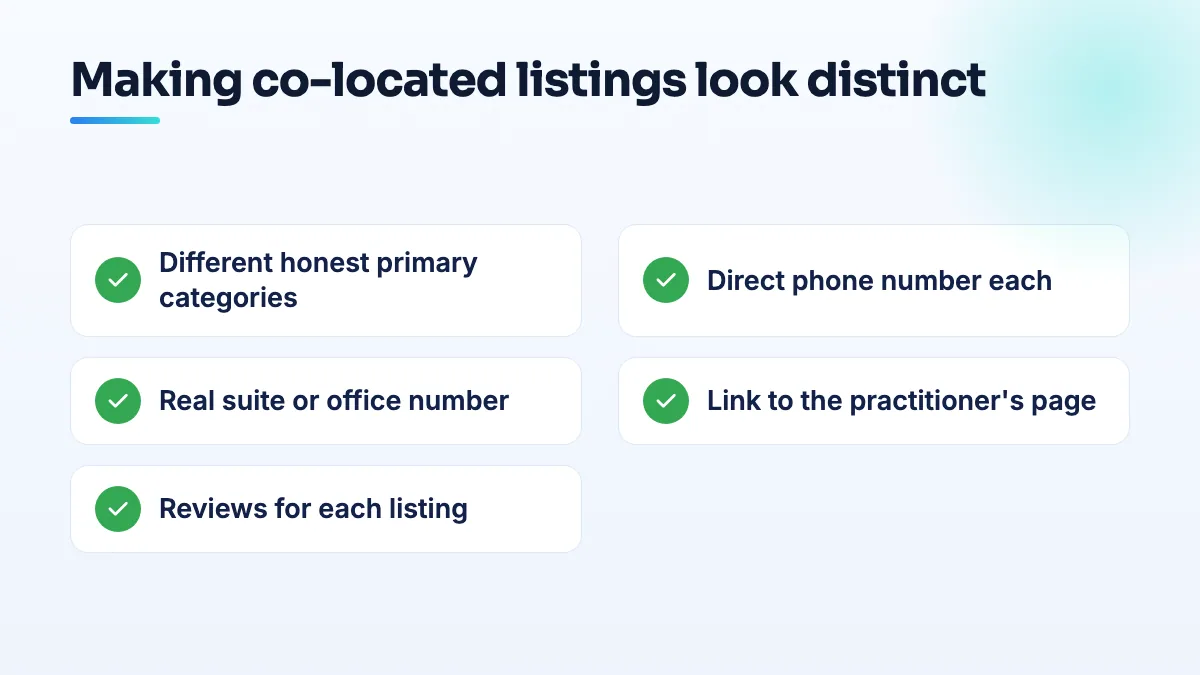
- Give each listing a different primary category where that's honest. An estate planning attorney and a personal injury attorney are genuinely different. Two general practice listings aren't.
- Give each practitioner a direct phone number. Not the office's main line. A shared number is one of the strongest signs two listings are really one business.
- Use a suite or office number where the space is genuinely separate. Only if it's real and shows up on the lease and the door.
- Point each listing at its own page. The practitioner's own page on the site, built around what they do, instead of the homepage every other listing uses.
- Build each listing's own reviews. A filtered listing with a handful of reviews has little chance of being the one Google picks. Ask clients to review the person they worked with.
Before you add more listings to fight the filter, read my answer on whether each practitioner Google Business Profile is worth having. Often the better move is fewer listings, each clearly different.
Real estate agents: why the brokerage address is the hardest place to rank
Agents have it worst, because a brokerage office can have dozens of agents in one category. In a Local Search Forum thread on setting up realtor profiles, contributors said it's extremely hard to verify at the brokerage address because of how many listings already sit there in the same category, and that an agent who gets through is extremely likely to be filtered anyway.
The two setups that forum's members recommend are the home address hidden as a service-area business, which fits agents because they travel to show homes, or the broker's office with the agent's own suite or office number. When I do realtor SEO, the hidden home address is usually the cleaner option. A forum admin in a Local Search Forum thread on agents with brokerage-controlled websites also advised agents to "try to get twice as many reviews as anyone else in town." I agree with that.
Advisors, lawyers and driving instructors
- Financial advisors in a shared branch get filtered the same way as agents. Different designations and specialties justify different categories only if the work really differs.
- Lawyers don't have the agent's way out. Most work from the office every day, so a hidden home address isn't an honest option. Categories by practice area and direct lines are what's left.
- Driving instructors at one school address filter each other too. Independent instructors who pick students up at home can be service-area businesses, which removes the shared address from the equation. It's the first setup I'd look at in driving school SEO.
If you want the listings sorted out and tracked properly, it's part of our Google Business Profile management, and the wider ranking work sits in our local SEO services.
People also ask
Should each practitioner in a practice have their own Google Business Profile?
Only the practitioners people search for by name, and only if each is public-facing and reachable at the practice during set hours. Google allows individual profiles for doctors, dentists, lawyers, financial planners and agents, but listings at one address are often filtered, and each needs its own reviews. Give listings to key practitioners, make each distinct with its own category and phone, and keep everyone else on the practice listing.
Can you use a coworking space or virtual office for Google Business Profile?
Only with your own dedicated office there. Google allows a coworking address only if the office has clear signage, receives customers during business hours, and is staffed during those hours by your own staff, not the operator's reception. A virtual office, mailbox, hot desk or day pass doesn't qualify, and profiles listed at them are regularly suspended.
Read the full answer: Can you use a coworking space or virtual office for Google Business Profile? →
How should a doctor, lawyer or advisor name their Google Business Profile?
It depends on whether you're the only public-facing practitioner at that location. If you are, Google allows your brand followed by your name, as in its own example "Allstate: Joe Miller". If several practitioners share the office, the title should be only your name, without the firm's name. You can add a title or degree such as Dr., MD, JD, Esq. or CFA, and the name should match your license records.
Read the full answer: How should a doctor, lawyer or advisor name their Google Business Profile? →
Why was my second office flagged as a duplicate or suspended?
Because Google can't see enough that makes the second office different from the first. A lease and a sign prove the office exists, but a listing that shares the main office's phone number, web page and hours, or that isn't staffed during the hours it lists, looks like the same business listed twice. Give it its own staff hours, local number and location page.
Read the full answer: Why was my second office flagged as a duplicate or suspended? →
Why does my verified Google Business Profile not show up publicly?
Because verification and publication are separate. Verification proves the business is real; Google still has to be confident enough to show the listing to everyone. A new business with no website, directory listings or registry record can pass verification and stay "Only visible to you", especially if an older business shares its name. Search your name signed out to see which gate you're at, then build that footprint.
Read the full answer: Why does my verified Google Business Profile not show up publicly? →