


Key points
- Acquired brands keep their names, reviews and rankings
- Don't join a spending war on ads or leads
- Own the map pack in your core towns
- Put the owner's name and face everywhere
- Only claim what you can prove
The company across town that's been there for thirty years was bought, kept its name, and now has a bigger ad budget than your whole marketing spend. To compete with private equity HVAC brands, stop matching them on money and compete on the things an acquisition can't transfer: an owner customers can name, a phone answered by a person who knows the area, and a steady record of recent local jobs.
What's happening to local HVAC brands
Owners in an r/HVAC thread about private-equity roll-ups describe more than fifteen Washington contractors bought up and still trading under their familiar local names. A separate r/HVAC discussion of industry consolidation has owners talking through what it means for independents, and a roofing contractors' thread on private equity shows the same buyers moving into roofing.
In search, an acquisition changes very little on the surface. The Google profile keeps its name, its years of reviews and its place in the map pack. What changes is behind it: more budget for search ads, Local Services Ads and lead platforms. A homeowner searching "furnace repair" sees a name they've known for years and has no reason to think anything changed.
Where an independent HVAC company can compete with private equity
I'd split the fight into two. Paid search and lead platforms reward budget, and a roll-up has more of it. HVAC owners already report the limits of that game: $1,400 put into Angi for $250 of work back, and each lead going to several other companies (an r/HVAC thread on Angi lead costs). Another advertiser found a 50% bigger Local Services Ads budget moved cost per lead from $27.50 to $39 with almost no extra leads (an r/PPC thread on stalled LSA leads). More money bought very little.
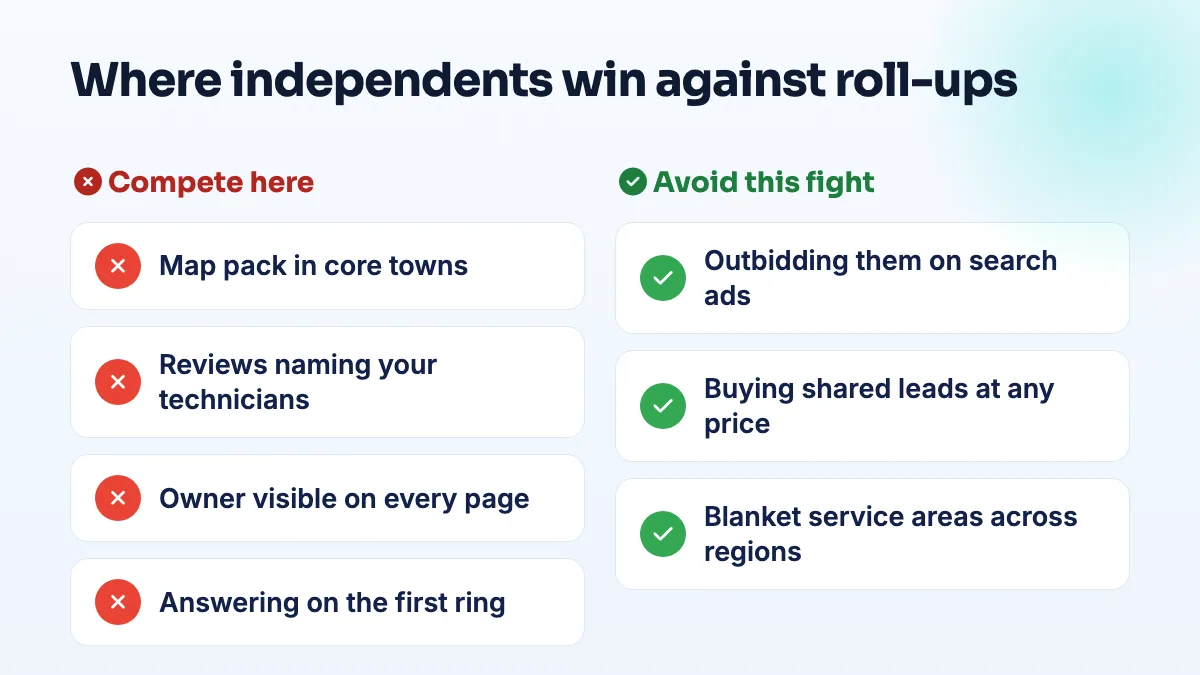
My advice is to leave that fight to them. The map pack and your reputation reward something else: being close, being real, and being chosen by customers recently. That's where an independent can win.
- Find out who you're actually up against. Check each big competitor's website footer, about page and contractor license record. Write down which ones changed hands. You're not doing this to attack them; you're doing it so you know which ones will outspend you and which won't.
- Map where you rank today. This is the first thing I do for any HVAC client. Search "AC repair", "furnace repair" and "HVAC near me" from five to ten points across your service area and save dated screenshots. In my experience most independents rank well near their base and fade a few towns out.
- Tighten your profile around your core towns. Set the primary category to the work you do most, list your real services, and keep the service area to towns you can reach quickly. A small area you dominate beats a regional one you're invisible in.
- Put the owner on the profile and the website. Your name, your photo, your license number, how long you've been in the area, and a plain statement that the company is independently owned, if it is. People who liked the old local brand are looking for exactly that.
- Ask for a review after every job, every week. Recent reviews that mention a technician by name and a real neighborhood are proof of a local team. Ask the day the job finishes. Don't script the wording and don't offer anything for it.
- Set a ceiling on paid leads. Decide the most you'll pay for a booked job and stop there. Let the roll-up buy the expensive clicks.
What not to do
- Don't call competitors "private equity" or "not really local" in ads or reviews unless you can prove it. Talk about what you are, not what they are.
- Don't copy their tactics with a bigger service area or extra listings. A service area across half the state or a second address you don't staff puts your own profile at risk.
- Don't sell below cost to win on price. A company with outside money can hold a low price longer than you can.
- Don't let the phone go to voicemail during the season. Answering on the first ring is the cheapest edge you have over a call center.
What's different for roofers
Roofers face the same buyers, but the demand comes in bursts after storms, when every company advertises at once. The profile and review work has to be done before the season, not during it, and it's the same groundwork I set out for roofing SEO clients.
Proof it can work
An independent doesn't need a bigger budget to get more calls from Google. Our Mississauga HVAC case study shows what profile work did for one contractor's calls. Other trades are dealing with the same thing: I've written about how driving schools compete with a national chain that grew through acquisitions. If you want your profile and service area set up to hold your core towns, that's the heart of our HVAC SEO work, alongside our local SEO services.
People also ask
Are service area pages still safe after the August 2026 spam update?
Service area pages that give each town real, specific information are still safe. Pages that only swap the city name into the same text match Google's description of doorway pages and were at risk long before August 2026. Reports of pages dropping after the update are anecdotal and inconsistent, so audit each page: keep the ones with local substance, merge the thin ones into one service-area page, and cut pages for towns you don't serve.
Read the full answer: Are service area pages still safe after the August 2026 spam update? →
Why does my verified Google Business Profile not show up publicly?
Because verification and publication are separate. Verification proves the business is real; Google still has to be confident enough to show the listing to everyone. A new business with no website, directory listings or registry record can pass verification and stay "Only visible to you", especially if an older business shares its name. Search your name signed out to see which gate you're at, then build that footprint.
Read the full answer: Why does my verified Google Business Profile not show up publicly? →
Does a contractor license help you pass Google Business Profile verification?
Not much on its own. Google doesn't verify you because you're licensed; it checks that your records, profile and video all point to the same business at the same address. A license lookup or corporate filing showing a different address, or a mailbox, can make verification fail. Align every record first, then show the license in your video as supporting proof.
How long does Google Business Profile video verification take?
There's no fixed time. Owners in Google's Help Community report waits from about a week to nearly two months: allied health profiles stuck past 7 days, a verification unprocessed after two weeks, a mover pending 55 days. The status matters more than the days. Pending means wait without editing, rejected means fix the gap and reshoot once, and "No more ways to verify" means you need someone to escalate the case.
Read the full answer: How long does Google Business Profile video verification take? →
Will Google remove a review from someone who was never a customer?
Usually not, if they dealt with your business at all. Google doesn't require reviewers to be customers, only to have interacted with you, so reviews from refused clients, couriers and towed drivers normally stay. Google does remove reviews with no real interaction, reviews about something other than your business, and reviews from someone with a personal conflict of interest. For the rest, a calm reply is your best tool.
Read the full answer: Will Google remove a review from someone who was never a customer? →