

You've taught in your town for years, and now a national chain's location page sits at the top of Google for "driving lessons" in your city, with lesson marketplaces and directories right behind it. A local driving school can compete with a national chain, but not by copying its hundreds of city pages. You win on what the chain can't fake: instructors who know your test routes, a profile customers trust, and pages about your actual area.
This is new for most independent schools, so I'll start with what the results look like, then the setup I'd use, and the mistakes that make things worse.
What the Sacramento results show
When I searched "driving lessons Sacramento CA", Coastline Academy held positions one and three, with separate pages for Sacramento and West Sacramento. Lessons.com's "10 Best Driving Schools in Sacramento" list, YellowPages and Yelp were also above several long-established local schools.
Coastline Academy's own account of the company describes it as the largest driving school in the country, operating in hundreds of cities across eight states, built since 2018 through technology and acquisitions and backed by investment firms. That's the model: a strong central website, a location page for every city it serves, and local schools bought and folded in.
So you're dealing with two things at once. A chain with a far bigger website, and aggregator lists that sit between you and learners. They need different answers.
Where a local driving school can compete with a national chain
- The map pack. The map results show individual businesses near the searcher. A well-set-up local profile with steady reviews competes there on equal terms.
- Local detail. The test center learners will use, the routes examiners tend to take, the tricky junctions near the high school, where you pick up. A central website writing for hundreds of cities can't go that deep for each one.
- People. Parents choosing lessons for a teenager want to know who will be in the car. Instructor names, photos and years of teaching are an advantage a chain's generic page rarely matches.
- Specific learners. Nervous adults, older drivers returning after years off, lessons in another language, automatic versus manual. Each is a search the chain's city page only touches in passing.
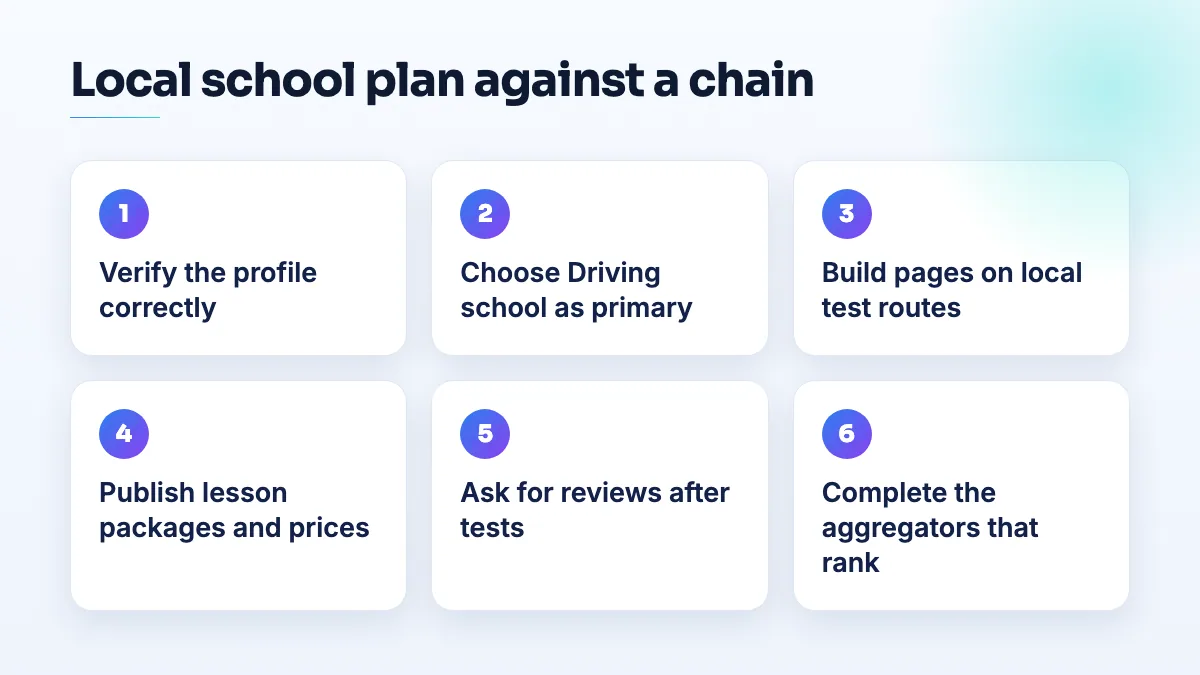
How to set it up, step by step
- Get your profile verified and set up the way your school actually works. If you pick learners up at home and have no office they visit, list as a service-area business with the home address hidden. In a Help Community thread from a driving school stuck in video verification, a Product Expert explained that the video has to show the area around the hidden address, the business equipment or vehicle, and proof you manage the business. Your instructor badge alone won't do it. Film the car with its dual controls and signage, the street, and you unlocking the car or your storage.
- Use "Driving school" as your primary category. There's no category for a single instructor, which a solo instructor raised in a Help Community thread about the missing driving instructor category. Driving school is the closest match for both solo instructors and schools. Put the details in your services and description.
- Build pages about your real area. One page per test center you prepare learners for, covering the routes, the common faults you see there and how your lessons prepare for them. One page per learner type you serve. Written from your instructors' knowledge, not with a town name swapped into the same text.
- Publish your packages and prices. Learners and parents compare. A clear table of lesson lengths, package prices and what's included answers the question the aggregator lists are built on. One school asked in a Search Central thread about structured data for driving schools whether lesson packages can use Course markup. I'd get the plain prices on the page first. Markup only helps if the information is already there and correct.
- Ask for a review after every test, pass or fail. Right after the result is when learners feel most strongly. Ask them to review the school profile from their own phone, and to mention their instructor by name if they want to. Some schools report students' genuine reviews not appearing on their driving school profile, so a steady trickle beats a sudden burst.
- Complete your listing on the aggregators that rank. If Lessons.com, Yelp and YellowPages are on page one for your city, make sure you're on them with exactly the same name, address and phone as your Google profile. You're not trying to beat those pages. You want to be on the list people read.
One listing for the school or one per instructor?
Google treats professionals who serve the public directly as individual practitioners, and some schools try to multiply their presence with a listing per instructor. When several listings share one address and category, the map usually shows one and filters the rest, as discussed in a Local Search Forum thread on practitioner listings at one address. For most schools I'd keep one strong school profile and put instructors on the website. The trade-offs of an individual practitioner listing are covered separately.
Dealing with the aggregator lists
Lessons.com, Yelp and YellowPages rank for the broad searches because a list of ten schools answers "which driving school should I pick" better than any single school's homepage. I don't spend a school's budget trying to outrank them for that exact search. The better return is in the map pack and the specific searches, which is the same approach I set out for aggregator sites in local search across other industries.
What not to do
- Don't create a listing in every nearby town to match the chain's city pages. Addresses you don't operate from break Google's rules and can take your real profile down with them.
- Don't unhide your home address to look more established. If learners don't come to it, a visible home address is a suspension risk.
- Don't copy one area page twenty times. Thin copies won't beat a chain's page and can drag your site down.
- Don't run down the chain in reviews or ads. Talk about your instructors and your pass routes, not about them.
- Don't collect reviews in the office on your Wi-Fi in one sitting. A batch of reviews from one place at one time looks nothing like normal customer behavior, and I wouldn't risk it.
Questions driving schools ask
Should we add "driving lessons" and our city to our business name?
No. It might rank for a while, but keyword-stuffed names break Google's naming rules, competitors report them, and a suspension costs far more than the ranking gains. Use your real registered name.
A learner says Google won't let them review their instructor. Why?
Learners have reported being blocked from reviewing an individual instructor in a Google Maps Help thread from a learner unable to review an instructor. The simplest fix is to send every learner to the school's profile and let them name the instructor in the text. It keeps all your reviews in one place, which is what helps you rank.
When should we spend on ads?
I haven't seen reliable data on when learner demand peaks, and the timing advice floating around comes from agency blogs. Look at your own bookings by month for the last two years and put any ads budget into the weeks before your busiest months. Your records are a better guide than anyone's rule of thumb.
What to do this month
Check your profile's verification status and category, write down your packages and prices, and draft one page for the test center most of your learners use. If you'd like that done with you, it's the core of our driving school SEO work, alongside our local SEO services.
Written by Saifur Rifat, Founder & SEO Lead at SERP Squad.