


Key points
- Compete for searches near your shop
- Own repairs the local chain doesn't offer
- Publish prices for your top repairs
- Build pages per repair service, not per model
- Ask for reviews that name the device
An independent repair shop can compete with chains on Google, just not on the chains' terms. They have hundreds of stores, national brand searches and, it seems, ad exceptions you can't get. You have the map pack near your shop, repairs they don't do, prices you can publish, and reviews from people who met the person who fixed their phone. Pick those battles and leave the rest.
What you're up against
The scale is real. Asurion's own sponsor message on the Local Search Forum describes uBreakiFix as the largest tech repair provider in the US, with nearly 700 stores. On top of that, independents are shut out of Google Ads for repair while, as owners point out in a Help Community thread about repair chains still allowed to advertise, large chains appear to keep running ads. A Product Expert in that thread said the chains might have been given exceptions or grandfathered in. I explain the policy itself in the answer on why computer repair Google Ads are banned for independents.
There's a second competitor most shops don't notice: lead resellers. In a Local Search Forum thread about lead resellers flooding the map pack, the top two results for an AC repair search belonged to companies whose own website footers admitted they were lead referral companies, not the business doing the work, with phone numbers in a sequential run. The same setup turns up in device repair map packs, and it takes calls from real shops just as a chain does.
Where an independent repair shop can compete with chains and win
- The map pack around your shop. Google's local results lean heavily on distance. If the nearest chain store is across town, the searcher two streets from you is yours to lose.
- Repairs the chain near you doesn't do. Check what they actually offer. Board-level work, water damage, data recovery, older devices, consoles and laptops are often where an independent has the only real answer.
- Price searches. People search "how much to fix" before they pick a shop. Published prices answer that directly.
- Specific device searches. A clear page for the repairs you do, with the models and prices, answers "do you fix this model" better than a national template.
- Reviews that sound local. Reviews that name the device, the repair and the person who did it are something a chain's volume doesn't give it.
How I'd set it up, in order
- Search your main repairs from three spots around your shop. Use your phone, search "phone repair", "iPhone screen repair" and your specialist repairs, and screenshot who appears. That's your real competition, which may not be the chain at all.
- Complete your Google Business Profile. Pick the primary category that matches most of your work, list every repair as a service, add products for common repairs with prices, and post real photos of your bench and finished work.
- Publish your prices. A simple price table for your top repairs by model. I go through should I put prices on my website for shops that worry about being undercut.
- Build pages for the repairs you do. One page per repair service per device family, not one per model. I lay out the device repair website structure I use.
- Ask every customer for a review that names the repair. At collection, while the fixed device is in their hand.
- Report reseller listings that break the rules. Document them together, as one network, rather than one at a time. I explain how to spot a lead reseller fake Google listing before you report it.
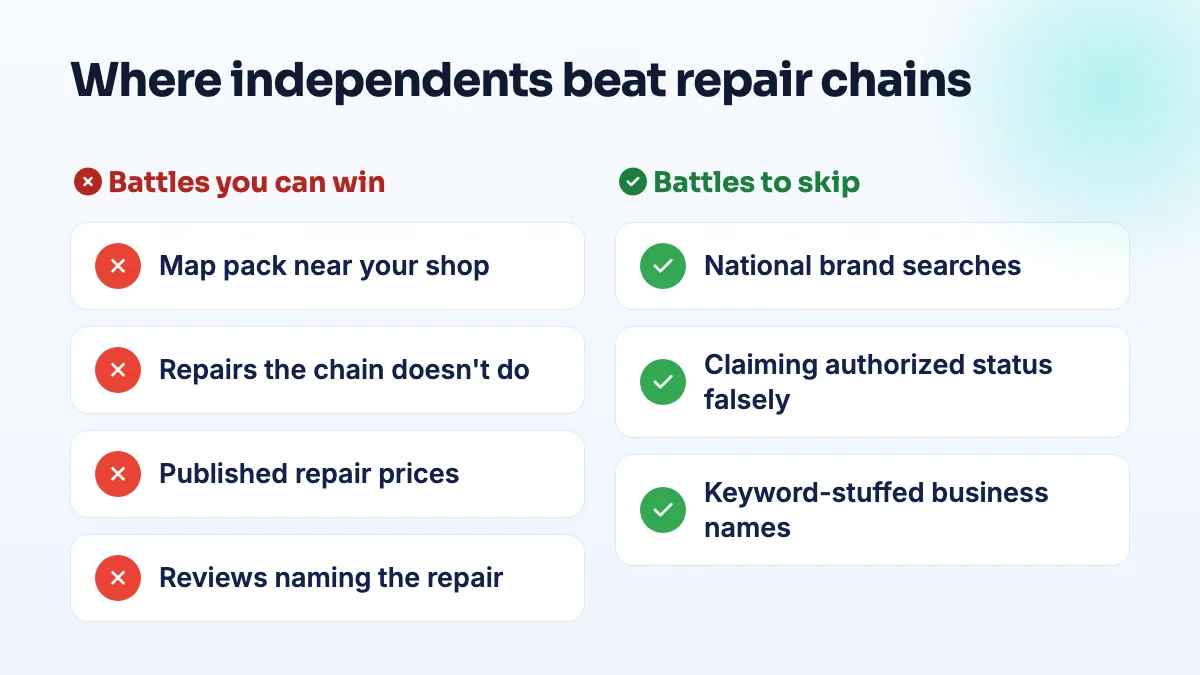
Battles I'd skip
- National brand searches. You won't outrank a chain for its own name, and you shouldn't try.
- Calling yourself authorized when you aren't. It's misleading, and it's a claim a customer or competitor can check.
- Keyword-stuffing your business name. Names like "Cheap iPhone Screen Repair" plus a city sometimes get verified and stay, but they're against Google's rules and a suspension risk you don't need.
- Copying the chain's page templates. A national page written for every city is exactly what an independent can beat with real detail.
There's one newer threat worth watching: an owner on the Local Search Forum reported Google's AI phoning local shops to check prices and calling only the two biggest companies in that area. I cover Google AI check prices calls separately. Published prices are the best protection I know of.
This is the work behind our cell phone repair SEO and SEO for electronics repair shops, built on the same local search optimization we do for every shop.
People also ask
Can phone and computer repair shops advertise on Google Ads?
Usually not. Google Ads restricts third-party phone repair and treats computer and electronics repair as third-party consumer technical support, so independent shops get rejected. Diamond Product Expert Rob Skelton's whole answer to one shop was "No. You cannot advertise." Shops were still being rejected in 2025. Stop resubmitting and move the budget to your Google Business Profile, repair pages, published prices and reviews.
Read the full answer: Can phone and computer repair shops advertise on Google Ads? →
Should a local service business publish its prices online?
Yes, for most local service businesses. Publish fixed prices for fixed-scope jobs, a starting price or range for jobs that vary, and a quick estimator or quote form for custom work. Searchers who type "how much" want a number before they call, and pages that show one win the click. Add a date and a line that the final price is confirmed after inspection.
Read the full answer: Should a local service business publish its prices online? →
Which Google Business Profile categories require a visible address?
Some Google Business Profile categories won't run as a hidden-address service area. Local Search Forum practitioners have confirmed Mechanic and Swimming Pool Contractor, and owners in other categories report being told theirs needs a location customers can visit. If your primary category is one of them, you either show a real address customers can come to during your hours, or choose a different category that fits your work and allows a service area.
Read the full answer: Which Google Business Profile categories require a visible address? →
Should you use Google Business Profile products or Merchant Center?
One shop with a small range that rarely changes can add products straight to its Google Business Profile, for free and without any feed. Use Merchant Center once you have a second store, a large catalog or an online store already, or when you want shoppers to see what's in stock today. Multi-location shops are effectively pushed to Merchant Center.
Read the full answer: Should you use Google Business Profile products or Merchant Center? →
Why did Google change my business category or name without asking?
Google edits profiles on its own when its systems, or suggestions from the public, decide your details are wrong. It happens most to service-area businesses with hidden addresses: Joy Hawkins confirmed one wave of forced re-categorization hit only those listings. Put your category or name back with a single edit, then make your website, signs and other listings use the same words so the change doesn't return.
Read the full answer: Why did Google change my business category or name without asking? →