

Your suite building won't let you put a sign on the door, so Google's reviewer watches your verification video, sees an unmarked door in a long hallway of unmarked doors, and rejects it. Salon suite Google verification comes down to one shot: your business name, fixed permanently at the door your clients walk through. If the landlord allows any permanent name there, even a small plate, you can pass. If the building bans every form of it, you can't verify at that address, and knowing that early saves you attempts you won't get back.
This hits nail techs, estheticians, barbers, massage therapists and tattoo artists who rent private suites in Sola, Phenix, Salon Lofts and independent suite buildings. I went through the Google Business Profile Help Community threads where suite renters were turned down. The paperwork was almost never the problem. The door was.
Why Google rejects a salon suite with no name on the door
In a Help Community thread about a rejected Salon Lofts suite, the renter had a real, private, leased suite and still failed. A Platinum Product Expert traced the rejection to a single detail: the business name wasn't on the suite door or window. The Expert explained that a business in a shared space only qualifies with a dedicated space and permanent signage.
Google's guideline for shared and co-working offices sets three conditions: clear signage, customers received at that location during business hours, and staff from your own business there during those hours. To Google, a suite building is a shared space. The street address belongs to the building, and twenty or forty businesses sit behind it. In a video, the only thing that separates your business from the others is a door with your name on it.
That's why a landlord's sign rule decides everything. In a Help Community thread from an esthetician whose landlord bans door signage, the owner had a licensed business in a real suite and no way to film the one thing the reviewer needed.
Documents don't close that gap. An esthetics studio inside a shared collective, described in a Help Community thread that ended at No more ways to verify, had a state license, a signed booth-rental agreement and 14 reviews, and still ran out of verification options. A license proves you're allowed to work. It doesn't show Google which door is yours.
What counts as signage in a suite building
Google doesn't publish a size or a material. The way I read the rule and the rejections, two things matter: the name has to be permanent, and it has to be at your door, not just somewhere in the building. Here's how I'd rank what a building might let you do, strongest first:
- Your business name on the suite door. Vinyl lettering or a fixed plate, readable from the hallway.
- Your name on the window or glass panel beside the door. Just as good, as long as it's clearly your suite's glass.
- A card in the building's own nameplate holder next to your door. If every unit has one, use it. It's small, but it's permanent and it's at your door.
- A listing on the lobby directory. Worth filming on the way in, but weak on its own, because it doesn't tie your name to one door.
- A paper sign taped up for the video. I'd never do it. It isn't permanent, and filming a sign you'll take down tomorrow is showing Google something that isn't true.
How to pass salon suite Google verification, step by step
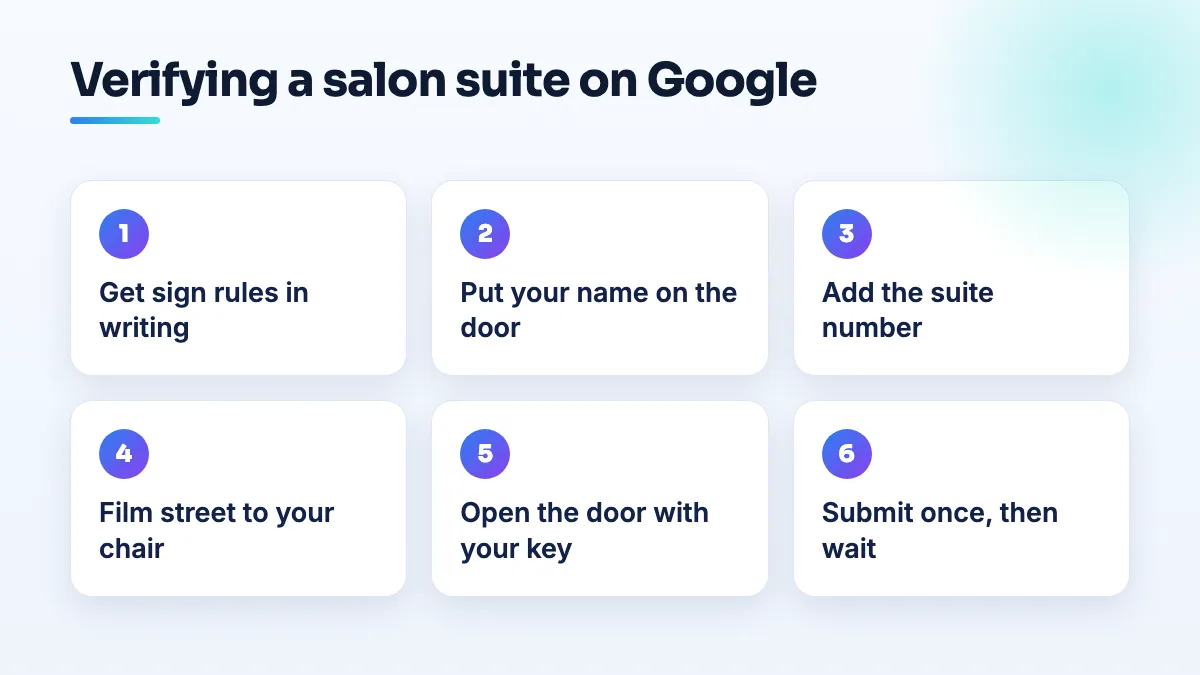
- Get the building's sign rules in writing. Email the property manager and ask one narrow question: can I put my business name on or beside my suite door, as lettering, a plate or a card in the nameplate holder? A rule written to stop posters and promotional signs may still allow a name, so don't ask about "signage" in general. Keep the reply.
- Put the exact profile name up, permanently. Same words, same spelling as the business name on your profile. If the name on the door and the name on Google don't match, the reviewer has nothing to connect.
- Set the profile up to match the suite. Use the building's street address exactly as the post office writes it, with your suite number on the second address line. Set hours you're actually in the suite, because Google's guideline expects customers to reach you there during those hours. Pick the primary category for your main service, such as nail salon, barber shop or massage therapist.
- Film one continuous clip from the street to your chair. Start outside with the street and the building's number or sign in view. Walk through the entrance, past the lobby directory, down the hallway, and stop on your door long enough for the name to be read.
- Open the door with your own key on camera. Then show the inside: your chair, table or station, your tools and products, your license on the wall, and your booking calendar open on your phone or tablet. That's proof you run this space, not just that you know where it is.
- Submit once, then leave the profile alone. No edits to the address, hours or category while the video is under review. If it comes back rejected, change what the reason points at before you film again. Don't resend the same clip.
If you rent a private studio behind an unmarked door that isn't in a suite building, the same logic applies with a few differences. I cover those in the guide to Google verification for a private studio.
When the landlord bans signage completely
Sometimes the answer really is no to everything, including the nameplate holder. Then you're choosing between the options below, and I'd pick one before filming anything else.
- Ask for a written exception. Explain that you need your business name at your door for Google's verification and ask for the smallest thing they'd accept. A manager who refused door lettering may agree to a plate.
- If you also travel to clients, list as a service-area business. In a Help Community thread from a stylist working inside a salon, a Gold Product Expert suggested using the home address, hidden, as a service-area business. That fits a renter who does bridal, house calls or outcall work. It doesn't fit one whose clients all come to the suite. I explain where that line sits in my answer on whether a booth renter can get their own Google Business Profile.
- Stop spending verification attempts. A nail salon owner in a Help Community thread about five or six failed verification videos kept refilming without changing what the reviewer objected to. Every rejection uses up an attempt, and the collective studio above ran out of them entirely.
- Build what doesn't need the address. A simple website with your name, services, prices and booking link, tied to your Instagram, gives clients who search your name somewhere to land while you sort out the listing.
- Make signage a lease question next time. Before you sign for any suite, get the building to confirm in writing that your business name can go on your door. It's the cheapest verification step there is.
What's different for nail techs, estheticians, barbers, massage therapists and tattoo artists
The door rule doesn't change by trade. What goes in the rest of the video does.
- Nail techs: your equipment is easy to recognize, so use it. Film the nail table, lamps, polish wall and ventilation. Profiles are the first thing I fix in nail salon SEO work, because a suite tech with no verified listing is invisible to anyone searching nearby.
- Estheticians: both of the signage threads above came from estheticians. Film the treatment bed, steamer and your state license, and make sure your category describes skin care rather than a general salon.
- Barbers: many suite barbers moved out of a shop. Never reuse the old shop's address or listing, and don't let your old booking link carry the shop's address across with you.
- Massage therapists: a treatment room with a door is the setup Google's rule was written for, so the name on that door does most of the work. For anyone building massage therapist SEO around a suite, keep the hours honest; appointment-only is fine, but list the hours you're there.
- Tattoo artists: private studios often keep the door locked during open hours. That's fine, and opening it with your key on camera helps. The name still has to be on the outside.
What not to do
- Don't leave the suite number off. Without it, your listing claims the whole building's address and collides with everything else listed there.
- Don't film the building's front desk as your reception. Google's rule is that customers deal with your staff, not the building's.
- Don't create a new profile after "No more ways to verify". A second profile for the same business at the same address is a duplicate, and it makes the first one harder to rescue.
- Don't switch to a hidden home address if every client comes to the suite. Google's eligibility rule covers businesses customers visit and businesses that travel to customers. A home you never serve clients from is neither.
- Don't film someone else's suite. The door, the key and the station all have to be yours.
Get the door sorted, then the listing
Most suite verification problems are solved before the camera comes out: one email to the property manager, one permanent name on the door, one clean profile. If you'd rather have someone check the setup before you spend another attempt, that's part of our Google Business Profile management.
Written by Saifur Rifat, Founder & SEO Lead at SERP Squad.