


Key points
- Patients say they distrust walls of identical five-star reviews
- Detailed reviews and replies matter more than the score
- An honest four-star makes the five-stars believable
- Ask every patient, not only the happy ones
- Reply without confirming the reviewer is a patient
A perfect 5.0 isn't bad on its own, but a perfect 5-star rating built from short, identical reviews is something patients openly say they don't trust. What convinces someone choosing a chiropractor or a dentist is detail: reviews that describe a real visit, the odd honest four-star, and replies that show how you handle a bad day.
So my advice is to stop managing the number and start managing what the reviews say. Here's what searchers actually say about perfect scores, what makes a 5.0 look manufactured, and what I'd do instead.
Is a perfect 5-star rating bad? What patients say
Patients talk about this more than owners realize. In a Houston Reddit thread about finding a chiropractor, locals said they distrust chiropractic profiles full of uniform five-star reviews. The same wariness shows up in a back pain subreddit discussion about choosing a provider, where patients describe being wary of perfect ratings rather than reassured by them.
Dentists see it from the other side. In a dentists' thread about a new office with 200 five-star reviews in a few months, the professionals themselves read it as a review farm. If other dentists spot it, patients who've been burned by fake reviews elsewhere can too.
Meanwhile owners worry about the opposite. A chiropractors' thread about rating anxiety shows how much headspace one four-star review can take up. The patients reading your profile aren't doing the same math you are.
What makes a 5.0 look manufactured
These are the patterns I look for when I audit a health practice's reviews, because they're the same things a skeptical patient notices:
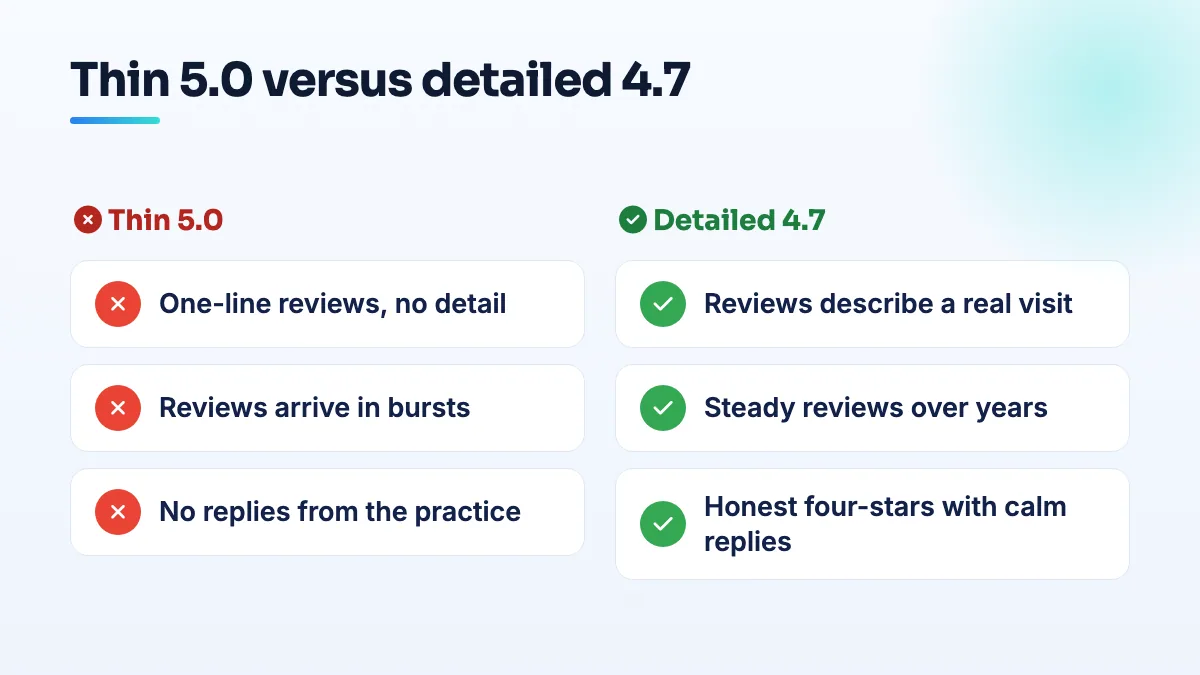
- Most reviews are one line with no detail: "Great place" with no mention of a problem, a treatment or a person.
- Reviews arrive in bursts, twenty in a week and then nothing for months.
- Reviewers have no other reviews or no profile history.
- The same phrases repeat across different reviewers.
- Years of reviews and not a single one under five stars.
- No replies from the practice at all.
A big pile of thin reviews is also fragile. A chiropractor in a Help Community thread about a chiropractic profile emptied over a weekend watched 497 reviews at a 5.0 rating vanish, and the support ticket was closed without an answer. Nobody was told why. It's a reminder that the rating isn't yours to keep, but detailed reviews from real patients spread over years are the ones I'd bet on.
Why a 4.7 with detailed reviews can beat a thin 5.0
A patient reading your profile is trying to answer a few questions: will they listen to me, how's the front desk, will I get surprised on the bill, did it help people like me. Detailed reviews answer those. A couple of four-stars that mention parking or a long wait make the five-stars around them believable, because they show real people wrote them.
Your replies do the rest. A calm, polite reply to a critical review tells the next reader more about your practice than another "Amazing" ever will. That's my view after reading a lot of health practice profiles: people choose on the detail and the replies, and the number mainly decides whether they keep reading.
What to do about your rating
- Ask every patient, not just the happy ones. Pick a routine moment and ask everyone who reaches it. Filtering who you ask is what produces a suspiciously perfect profile in the first place.
- Time the ask to the care. For a chiropractor, that's when a patient tells you they're feeling better or finishes a plan of care, not at the first visit. For a dentist, it's after a completed treatment, not after a cleaning reminder.
- Ask for specifics without scripting them. "If you're happy to, mention what you came in for and how it went" gets you useful reviews. Writing the words for them doesn't, and it breaks Google's rules.
- Spread the requests out. A few a week, every week, looks and is more natural than a campaign that lands forty reviews in a month.
- Reply without confirming anyone is a patient. Thank people generally and take anything specific offline. HHS has fined dental practices over review replies; the HHS resolution agreement with New Vision Dental came to $23,000.
- Fix the complaint that repeats. If three four-star reviews mention wait times, that's your front desk, not your rating, and fixing it changes the next ten reviews.
What's different for chiropractors and dentists
Chiropractors are where the uniform-5.0 distrust shows up most in the public threads I read. Reviews that name the problem someone came in with and how the visits went do far more than stars. Never let the front desk reply in a way that confirms the reviewer was treated; a receptionist doing exactly that is a story that comes up in chiropractic forums.
Dentists get more reviews about money and expectations: billing, insurance estimates, an emergency exam that didn't fix the tooth that day. Those are the reviews that pull a 5.0 down to 4.7, and they're also where a good reply earns trust. Some come from relatives rather than patients, which is worth checking before you reply.
When the number does matter
I'm not saying the rating is irrelevant. A profile sitting in the low fours with recent complaints has a real problem, and review count matters for trust too. I cover how many Google reviews you need separately, and why Google reviews matter for ranking. But between a 4.7 and a 5.0, the content wins.
Reviews are one piece of the profile work we do in chiropractic SEO and dental practice SEO. If you want the whole profile handled, including a review routine your front desk can run, that's our Google Business Profile optimization.
People also ask
Why do emergency dental patients leave one-star reviews after a limited exam?
Because they booked expecting the tooth to be fixed and left with a diagnosis, an X-ray, a bill and another appointment. The visit did what it was meant to do, but nobody told them what that was. Explain what a limited exam includes, what it costs and what usually needs a second visit on the phone, in the confirmation, on your website and at check-in.
Is that Google Business Profile email or call a scam?
Usually yes, if you didn't ask for it. Unsolicited emails and calls warning that your listing will be removed, your site isn't compliant or your ranking is at risk are mostly sales pitches or scams. Real Google requests do exist, so don't judge by how the message looks: close it, sign in to your profile yourself, and act only on requests that appear there.
Read the full answer: Is that Google Business Profile email or call a scam? →
Should each practitioner in a practice have their own Google Business Profile?
Only the practitioners people search for by name, and only if each is public-facing and reachable at the practice during set hours. Google allows individual profiles for doctors, dentists, lawyers, financial planners and agents, but listings at one address are often filtered, and each needs its own reviews. Give listings to key practitioners, make each distinct with its own category and phone, and keep everyone else on the practice listing.
How should a doctor, lawyer or advisor name their Google Business Profile?
It depends on whether you're the only public-facing practitioner at that location. If you are, Google allows your brand followed by your name, as in its own example "Allstate: Joe Miller". If several practitioners share the office, the title should be only your name, without the firm's name. You can add a title or degree such as Dr., MD, JD, Esq. or CFA, and the name should match your license records.
Read the full answer: How should a doctor, lawyer or advisor name their Google Business Profile? →
Should therapists and clinics ask patients for Google reviews?
Mental health therapists generally shouldn't ask current clients for reviews. Several professional ethics codes restrict soliciting testimonials from clients, and clients themselves often aren't sure reviewing a therapist is appropriate. Chiropractors, physical therapists and other clinics can ask, as long as they ask every patient at a consistent point in care, offer nothing in return, and never reply in a way that confirms someone is a patient.
Read the full answer: Should therapists and clinics ask patients for Google reviews? →