


Key points
- Patients hear emergency and expect treatment today
- Say what the exam includes and costs on the phone
- Repeat it in the text, website and check-in form
- Hand over a written plan before they leave
- Reply to the review without confirming the visit
A patient in pain books an emergency slot, gets a limited exam and an X-ray, and leaves with a diagnosis, a bill and a second appointment instead of a fixed tooth. By evening there's a one-star calling it a scam. The limited exam dental bad review is almost always an expectation problem, and the fix is telling patients exactly what the visit includes, and costs, before they walk in.
I went through the threads where dentists compare notes on these reviews. The same story comes up again and again, and it starts on the phone, not in the chair.
Why a limited exam turns into a bad dental review
In a long Reddit thread from dentists about furious reviews after limited exams, dentist after dentist described the same review: the patient expected treatment, got an assessment, and felt charged for nothing. From the clinical side the visit worked. From the patient's side they're still in pain and poorer.
The words do most of the damage. "Emergency appointment" sounds like "we'll fix it today". "Limited exam" means nothing to most patients. And when the treatment plan arrives with a price, it feels like the real cost was hidden until they were in the chair.
Billing complaints add a second layer. In a Reddit thread about dental billing reviews from people who weren't patients, dentists described reviews written by relatives, including a sister who read an insurance pre-determination as a bill. The reviewer wasn't even the patient, and the review still sounded clinical.
How to set limited exam expectations before the visit
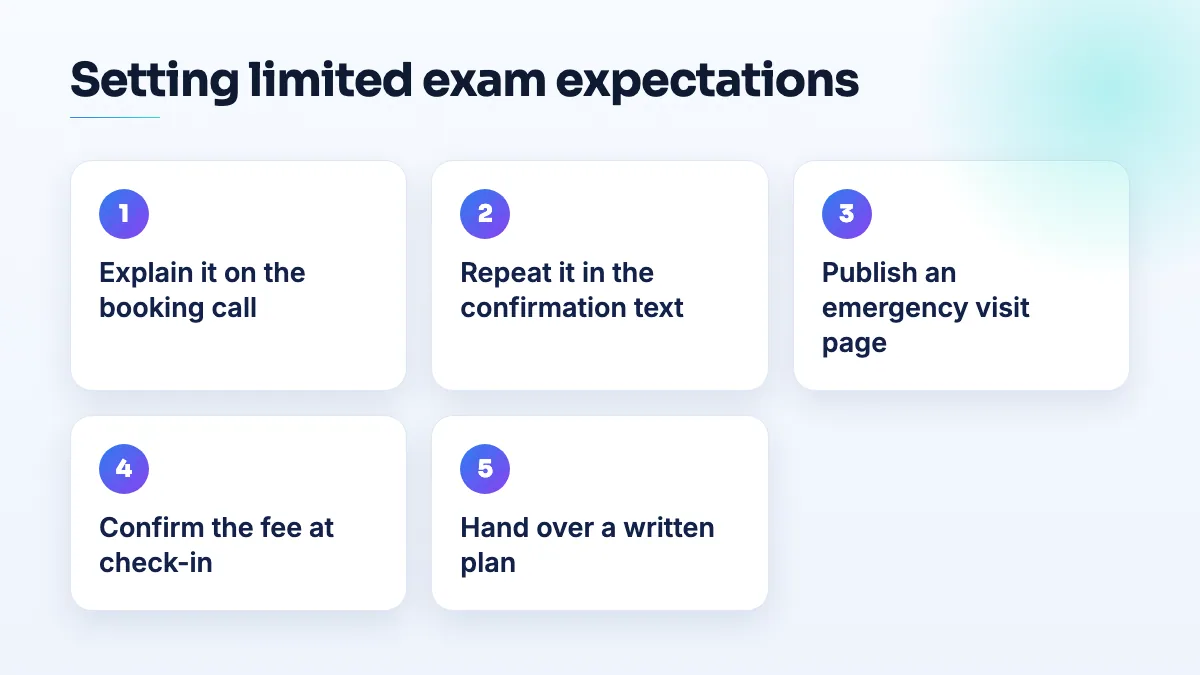
- Say it on the booking call. This is the kind of script I'd give the front desk, used on every emergency call: "Today's visit is an exam of the tooth that's bothering you. The dentist will look at it, take an X-ray if needed, and tell you what's wrong, what the options are and what each costs. Sometimes we can start treatment the same day, but often it needs a separate appointment. The exam itself is [your fee]." Fill in your own fee and wording; the point is that the patient hears all of it.
- Repeat it in the confirmation text. The same three things in writing: what the visit includes, what it costs, and that treatment may be a second visit. A patient in pain doesn't remember a phone call.
- Put it on an emergency page on your website. What happens at an emergency visit, the exam fee, what can often be done the same day and what usually can't, and how insurance tends to handle it. Link your Google Business Profile's appointment button to that page rather than your homepage, so the patient reads it before they call.
- Get it signed at check-in. A short form in plain words that says what today's visit includes and its fee. It isn't a legal shield; it's one more moment where the patient hears it before anything happens.
- Hand over a written plan before they leave. The diagnosis, the options, the cost of each and the next appointment, on paper or by email. A patient who walks out with a clear plan is much less likely to feel tricked than one who walks out with only a receipt.
My view is that none of this means changing how you practice. It's the same visit, described honestly at every step.
When the one-star arrives anyway
Some will, however good the process, and I'd rather you expect it than take it personally. Reply calmly and never confirm that the reviewer was a patient, which rules out explaining what happened at "their" limited exam. The privacy rules on this are strict, and dental practices have paid settlements over replies. I cover the wording in detail in the guide to a HIPAA review response, but a reply like this is safe:
"Our emergency visits are designed to find the cause of the pain and explain every option and its cost before any treatment. If you'd like to talk this through, please call our office manager."
That sentence explains your process to every future patient reading it, without saying a word about the reviewer. For the relative writing about a bill, use the same approach: explain how your billing works in general, never what anyone was charged. My broader advice on whether and how to respond to negative reviews applies too.
What not to do
- Don't promise "we'll get you out of pain today" on the phone or in ads. It's the exact expectation that produces the review.
- Don't hide the exam fee until checkout. A price the patient hears first at the desk feels like a trick, even when it's fair.
- Don't explain the patient's visit in your reply. The more accurate your explanation, the more health information you've published.
- Don't ask only happy patients for reviews. Asking everyone keeps you inside Google's rules and gives you enough reviews that one angry emergency visit doesn't define you.
Emergency searches are some of the most valuable a practice can win, and they bring in the most anxious patients. Getting the emergency page, the profile and the front desk telling the same story is part of the dentist SEO work I do, and keeping the review side steady is part of our Google Business Profile management.
People also ask
Is that Google Business Profile email or call a scam?
Usually yes, if you didn't ask for it. Unsolicited emails and calls warning that your listing will be removed, your site isn't compliant or your ranking is at risk are mostly sales pitches or scams. Real Google requests do exist, so don't judge by how the message looks: close it, sign in to your profile yourself, and act only on requests that appear there.
Read the full answer: Is that Google Business Profile email or call a scam? →
Is a perfect 5.0 Google rating bad for a business?
Not in itself, but a perfect 5.0 made of short, identical reviews is something patients openly say they distrust. People choosing a chiropractor or dentist read the reviews, not just the score. A profile with detailed reviews, a few honest four-stars and calm replies to criticism usually looks more believable than a flawless rating. Ask every patient, spread requests out and let the content build trust.
Read the full answer: Is a perfect 5.0 Google rating bad for a business? →
Should each practitioner in a practice have their own Google Business Profile?
Only the practitioners people search for by name, and only if each is public-facing and reachable at the practice during set hours. Google allows individual profiles for doctors, dentists, lawyers, financial planners and agents, but listings at one address are often filtered, and each needs its own reviews. Give listings to key practitioners, make each distinct with its own category and phone, and keep everyone else on the practice listing.
How should a doctor, lawyer or advisor name their Google Business Profile?
It depends on whether you're the only public-facing practitioner at that location. If you are, Google allows your brand followed by your name, as in its own example "Allstate: Joe Miller". If several practitioners share the office, the title should be only your name, without the firm's name. You can add a title or degree such as Dr., MD, JD, Esq. or CFA, and the name should match your license records.
Read the full answer: How should a doctor, lawyer or advisor name their Google Business Profile? →
How should an electrician describe their license on their website?
Say exactly who holds the license, what kind it is and the number, and make sure it matches the state lookup. If you work under another electrician's or a company's license, say so plainly instead of writing "licensed master electrician" about yourself. A website implying a license you don't personally hold has already cost one electrician his Google Business Profile for about seven months.
Read the full answer: How should an electrician describe their license on their website? →