

Most group practice websites have one "Meet the team" page with a photo and three lines on each clinician, and every clinician's Google listing points at the homepage. Neither tells Google or a searching patient what each person actually does. Group practice clinician pages work when they sit under specialty pages: each specialty gets its own page, each clinician gets a page built around their main specialty, and each practitioner listing links to that clinician's page instead of the homepage.
This applies to therapy groups, dental and medical practices, chiropractic clinics and law firms: anywhere several professionals share one website and clients choose a person, not just a practice. Below is the structure I use, what goes on each clinician page, and the mistakes that make pages compete with each other.
Why a team page and homepage links don't work
The idea comes from a Local Search Forum exchange about law firms. In a Local Search Forum thread on which page an attorney listing should link to, Joy Hawkins said a family law attorney's practitioner listing should link to the family law page, not the homepage. The way I see it, the page a listing points to is part of how Google works out what that listing is about. A homepage is about everything the practice does, so it says nothing specific about one person.
A shared team page has the same problem from the patient's side. Someone searching for a couples therapist or an implant dentist wants to know who does that work, how they do it, and how to book with them. Three lines of bio won't answer that.
Google's own guidance points the same way. Google's guidance on creating helpful content asks whether it's clear who created a piece of content, recommends bylines where readers would expect them, and suggests explaining the author's background. It does not set a credential requirement, and I explain what it actually asks of clinics in the guide on the medical content byline question. A proper clinician page is where that background lives.
The structure: specialty pages first, clinician pages under them
| Page | What it targets | Links to |
|---|---|---|
| Specialty page (for example couples counseling, dental implants, family law) | The service, for the whole practice | Every clinician who does that work |
| Clinician page (one per person) | That person, doing their main specialty | Their specialty pages and their booking link |
| Articles and guides | Patient or client questions | The author's clinician page and the matching specialty page |
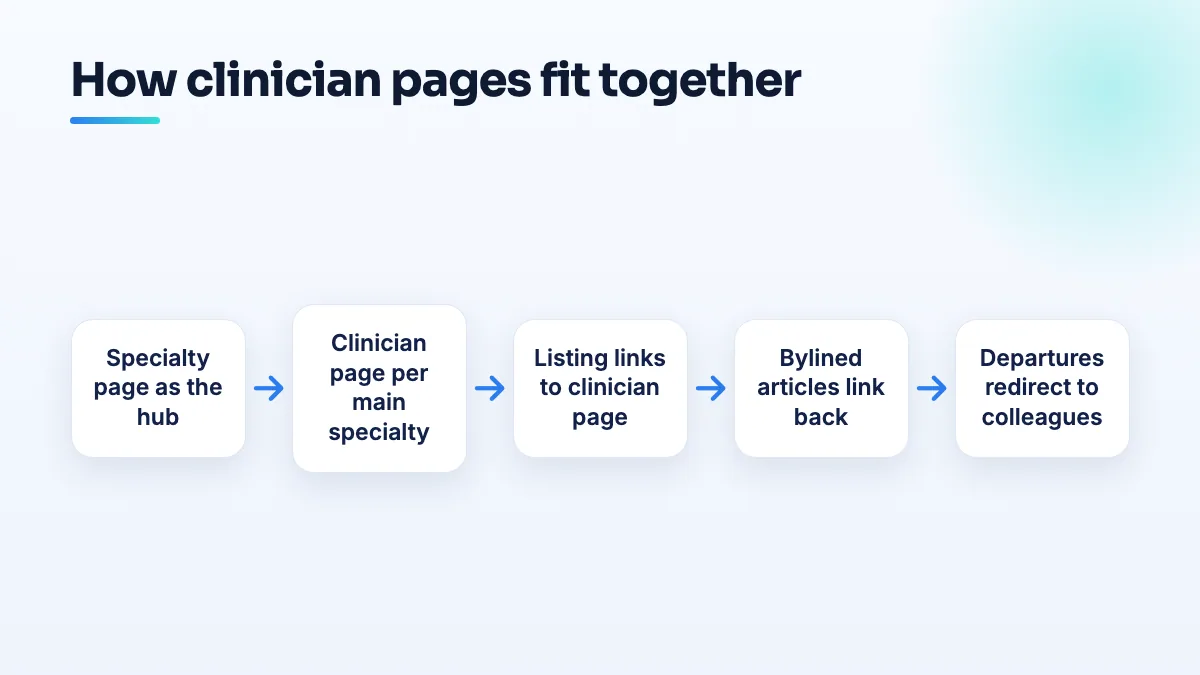
The specialty page is the hub. The clinician page is the proof that a named, qualified person does that work here. Keep the URLs simple and consistent, such as a team folder with one page per name.
How to build group practice clinician pages, step by step
- List every clinician and give each one a main specialty. One main specialty, plus two or three others they genuinely do. The main one is what their page is built around.
- Build the specialty pages before the clinician pages. One page per service the practice offers, written for the patient's question, with every clinician who does that work listed and linked. This is service page writing, not bio writing.
- Give clinicians who share a specialty a different angle. Two anxiety therapists shouldn't have two pages saying the same thing. One might focus on teenagers, the other on panic and trauma work. A photographer in a Local Search Forum thread about overlapping service pages found maternity, newborn and family pages competing against each other. Clinician pages overlap in exactly the same way.
- Write each clinician page around the person doing that work. Name and credentials at the top, who they help in plain words, how they work, where and when they see people, and how to book. The full checklist is below.
- Link both ways. Each specialty page links to its clinicians. Each clinician page links back to its specialty pages. Articles link to their author's page.
- Point each practitioner listing at the clinician's page. If a clinician has a Google listing, its website link goes to their own page. If that page is still thin, link the specialty page instead, as Joy Hawkins suggests, until the clinician page is built out.
- Plan for departures now. When a clinician leaves, their page becomes a short note that they've moved on, linking to colleagues in the same specialty. Don't delete it and leave a dead link on their old listing.
Whether each clinician needs a listing at all is a separate decision. I cover it in my answer on giving each doctor a separate Google Business Profile.
What goes on a clinician page
- Name, credentials and license type, written the same way as on the clinician's Google listing and license record.
- Their main specialty in the page title and first heading, for example the clinician's name followed by "couples therapist" or "implant dentist".
- Who they help and with what, in the words patients use, not only clinical terms.
- How they work: approaches, techniques or modalities, and what a first appointment looks like.
- Practical details: location, days they're in, telehealth, languages, fees or insurance.
- A booking link or intake form that goes straight to that clinician.
- Links to their specialty pages and to articles they wrote.
- A real photo. Not a stock image, and recent enough that a patient recognizes them.
What's different for therapy, dental, medical, chiropractic and law practices
- Therapy groups get the most from this structure, because clients choose a therapist, not a building. The big directories take a lot of broad "therapist near me" searches, so clinician pages earn their keep on the specific ones: an issue, an approach, an age group. It's the core of the therapy practice SEO work I do.
- Dental practices should give specialists, such as an orthodontist or periodontist, their own pages under the matching specialty. General dentists who all do the same work share the specialty page and differ on the smaller things: languages, nervous patients, children.
- Medical practices should put credentials and board certifications on the page, and have the clinician review anything published under their name. Health is where Google's guidance on who wrote the content matters most.
- Chiropractic clinics can separate clinicians by technique or patient group, such as sports injuries or pregnancy care, as long as it reflects real work.
- Law firms build attorney bio pages around a practice area, as in Joy Hawkins' example. Be careful with wording: under the ABA's model rules on lawyer advertising, a lawyer can claim to be a "specialist" only with certification from an approved body, which must be named, and truthful past results can still mislead. Your state's rules may differ.
What not to do
- Don't point every listing at the homepage. It throws away the one link that tells Google what each person does.
- Don't copy the same bio across the site and directories. Write the clinician page properly and keep directory bios short, with a link back.
- Don't build two pages for the same person doing the same thing. One clinician, one page. Specialties go on specialty pages.
- Don't publish a page the clinician hasn't read. Their name and credentials are on it, and their license is behind it.
- Don't pad pages with city names. A clinician page is about a person, not a list of suburbs.
Start with the specialty pages
If your site has a team page and nothing else, build the specialty pages first, then one clinician page at a time, starting with whoever gets asked for by name. If you'd rather hand it over, the structure is part of our website design work for group practices.
Written by Saifur Rifat, Founder & SEO Lead at SERP Squad.