

Clinics get two opposite pieces of advice about health content: that every article must be written by a doctor or Google won't rank it, or that nobody checks who wrote anything. Both are wrong. Google EEAT guidance on health content asks for a clear author and real expertise, and weights both more heavily on health topics, but it sets no credential rule. The answer is a simple process: the right clinician writes or reviews each page, and the page says so.
This matters to medical practices, dental offices, therapy practices and testing labs alike, because the pages that bring in patients are the ones that explain conditions, treatments and tests. Below is what Google actually says, who I'd have write and sign each kind of page, and the review process I set up for practices.
What Google's EEAT guidance says about the author of health content
The source is Google's guidance on creating helpful, reliable content. It's short, and I'd ask anyone writing for a clinic to read it. The parts that matter here:
- Who wrote it should be obvious. Google asks whether it's self-evident to visitors who created the content, suggests bylines where readers would expect them, and suggests those bylines lead to more information about the author and their background in the topic.
- Health topics are held to a higher standard. Google says its systems give more weight to expertise, authoritativeness and trustworthiness on topics that could affect people's health, financial stability or safety. Trust is the part it treats as most important.
- How and why it was made count too. Google asks publishers to be open about how content was produced, including any automation, and to write for people rather than to rank.
- EEAT isn't a switch. Google describes it as something its systems look for through a mix of signals, not a single ranking factor you can add with a badge or a line of code.
What the page doesn't say is just as important. It never says health content must be written by a physician. It doesn't name a degree, a license or a job title. Anyone who tells you "Google requires" a particular credential on the byline is repeating something that isn't in Google's documentation.
What that means in practice
No rule isn't the same as no standard. If a page tells patients how a condition is treated, the person behind it should know that treatment, and a reader should be able to see who they are. A marketing coordinator can write a clear page about parking and insurance. They shouldn't be the only person who has read a page about medication side effects.
My test is simple: if a patient asked "who wrote this and why should I believe it?", could the page answer without anyone in the building having to explain?
Who should write, review and sign each type of page
| Page | Who drafts it | Who reviews and signs it |
|---|---|---|
| Condition or treatment explainer | Writer working from a clinician interview | The clinician who treats it |
| Service or procedure page | Writer or practice manager | Clinician checks the medical facts |
| Test preparation and results timing | Lab or clinic staff | Lab director or supervising clinician |
| Insurance, fees, hours, parking | Front office or practice manager | Signed as the practice |
| Therapy approach or modality page | The therapist who practices it | The same therapist |
The writer doesn't have to be the expert. The expert has to have shaped the content and checked it, and their name has to be on it honestly. A clinician who spends 20 minutes answering questions on a call gives a writer more real expertise to work with than an hour of research online ever will.
How to set up an authorship and review process
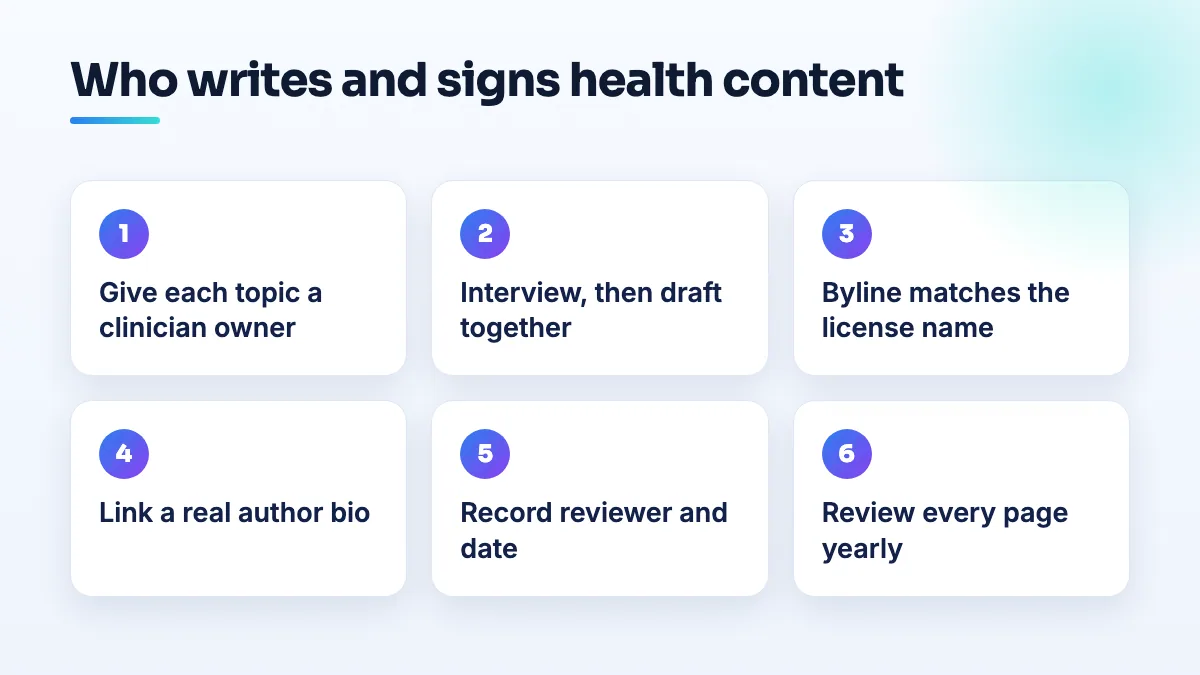
- Give every health topic a clinician owner. List the conditions, treatments and tests your site covers and put one name next to each: the person who actually treats it or runs it. That person approves anything published on the topic.
- Draft from an interview, not from other websites. Record a short conversation with the owner: what patients ask, what they get wrong, what you do differently, when someone should come in. Write from that. It's the experience Google's guidance keeps asking for, and competitors can't copy it.
- Put the byline in the exact name form the clinician uses everywhere else. Google's business listing guidelines treat doctors, dentists and similar professionals as individual practitioners and allow a title or degree such as Dr. or MD in the name. In a Help Community thread about a doctor's listing name, the point came up that a reinstatement appeal needs the name to match the NPI registry, the state license and directory profiles. Use that same name on the byline, the bio and the listing.
- Link every byline to a real author page. Credentials, license and state, what they treat, how long they've practiced, a photo. For a group practice, these pages do double duty, which I cover in the guide to group practice clinician pages.
- Show who reviewed it and when. If a second clinician checked the page, say "Reviewed by" with their name and the date. Change the date only when the content changes. A date that updates itself every month tells readers nothing.
- Review each page once a year, or when practice changes. New guidelines, a new treatment, a clinician leaving. When an author leaves, reassign the page to a current clinician and have them review it before their name goes on it.
What's different for each kind of practice
Medical practices. The biggest risk I see is a group website where every article is signed by the owner physician, including topics they don't treat. Sign each page with the clinician who actually handles it. It helps patients and it helps that clinician's own name build recognition, which is the point of medical practice SEO for a multi-provider clinic.
Dental offices. The dentist or specialist signs treatment pages: implants, orthodontics, root canals, periodontal care. The front office writes and signs the insurance, financing and emergency-visit pages, because that's who patients will speak to. Keep patient details out of all of it. The HHS Office for Civil Rights has already settled with a dental practice over patient information disclosed in public review replies (the HHS resolution agreement with New Vision Dental), and a "patient story" on a blog carries the same risk. I apply the same rule in every dental SEO project.
Therapy practices. Therapists are usually the best people to write about their own modality, and readers want to hear their voice. Never use client stories, even disguised. Write about what sessions look like, who the approach suits and who it doesn't. Each therapist's pages should link to their own bio, which is also how therapy practice SEO gets individual clinicians found.
Testing labs and collection sites. The pages people need are practical: how to prepare, what chain of custody involves, which cut-off levels apply to a test, how long results take. Have the lab director or the most experienced collector review them. Don't interpret results on the website. Tell people who will explain them.
What not to do
- Don't put a clinician's name on a page they haven't read. It's the one thing in this whole area that is genuinely deceptive, and it's the first thing a patient complaint will expose.
- Don't invent an author. No stock photo with a made-up "Dr." and a bio. If the practice has no one qualified to review a topic, don't publish that topic.
- Don't buy a "medically reviewed" stamp from someone who has never seen your practice. A reviewer who doesn't know how you treat patients can't confirm the page describes your care.
- Don't mass-produce symptom pages. Fifty thin pages on symptoms you don't treat won't carry your expertise. A dozen pages on the conditions you see every week will.
- Don't claim credentials that aren't held. Board certification, specialist titles and degrees on a byline need to be exactly right, because the same name appears on your listing and your license.
Does any of this matter for AI answers?
Patients now ask chat assistants and read AI Overviews before they book. You'll see big percentages quoted about how many health searches show an AI answer. I haven't found a primary source for them, so I don't plan around a number. What I can say is that a clear author, a real practice and specific, checked answers are the same things that make a page worth citing. I cover that side in more depth in how to get recommended in AI Overviews and by ChatGPT.
Where to start
Pick your five most visited health pages. For each, write down who wrote it, who should have reviewed it, and whether a reader can tell. Fix the bylines and bios first, then work through the review process above. If you'd rather have your clinicians interviewed and the pages written and signed properly, that's how our SEO content writing works for healthcare practices.
Written by Saifur Rifat, Founder & SEO Lead at SERP Squad.