

Before a clinic, lab or pharmacy spends a dollar on Google Ads, it needs to know whether it faces a certification gate, because the wrong answer means ads that are restricted, disapproved or never shown. The Google Ads healthcare certification you need depends on what you offer, not what kind of business you are: addiction treatment needs LegitScript, online pharmacies need LegitScript or NABP in the US, and some countries shut certain categories out entirely.
I've built this on Google's healthcare and medicines policy, because it's the page that sets the gates, rather than on what gets repeated in forums. Here's how to work out which rules apply to you, business by business.
The two Google Ads healthcare certification gates
The policy covers a lot of ground, but for clinics, labs and pharmacies it names two certifications that decide whether you can advertise at all.
Addiction services: LegitScript
If you offer treatment for drug or alcohol addiction, you need LegitScript certification to advertise in the US and Canada. In Australia, France, Ireland and New Zealand, only government entities can advertise these services. The policy says impulse-control, behavioral and nicotine addiction are out of scope, which in practice leaves counselors treating gambling or gaming addiction with no certification to apply for.
LegitScript's fees aren't small. LegitScript's addiction treatment certification page lists $1,395 to $1,595 per facility to apply and $2,550 to $3,095 a year after that, or $535 and $1,070 a year for individual practitioners. The standards also include no affiliation with lead generators.
Online pharmacies: LegitScript or NABP
A US pharmacy advertising prescription medicines online needs certification from LegitScript or NABP. Some countries don't allow online pharmacy promotion at all, so a pharmacy near a border or shipping internationally has to check each country it targets, not just its own.
How to work out which gate applies to you
I run through this with every healthcare client before we set up a single campaign. It takes an afternoon and saves weeks of disapprovals.
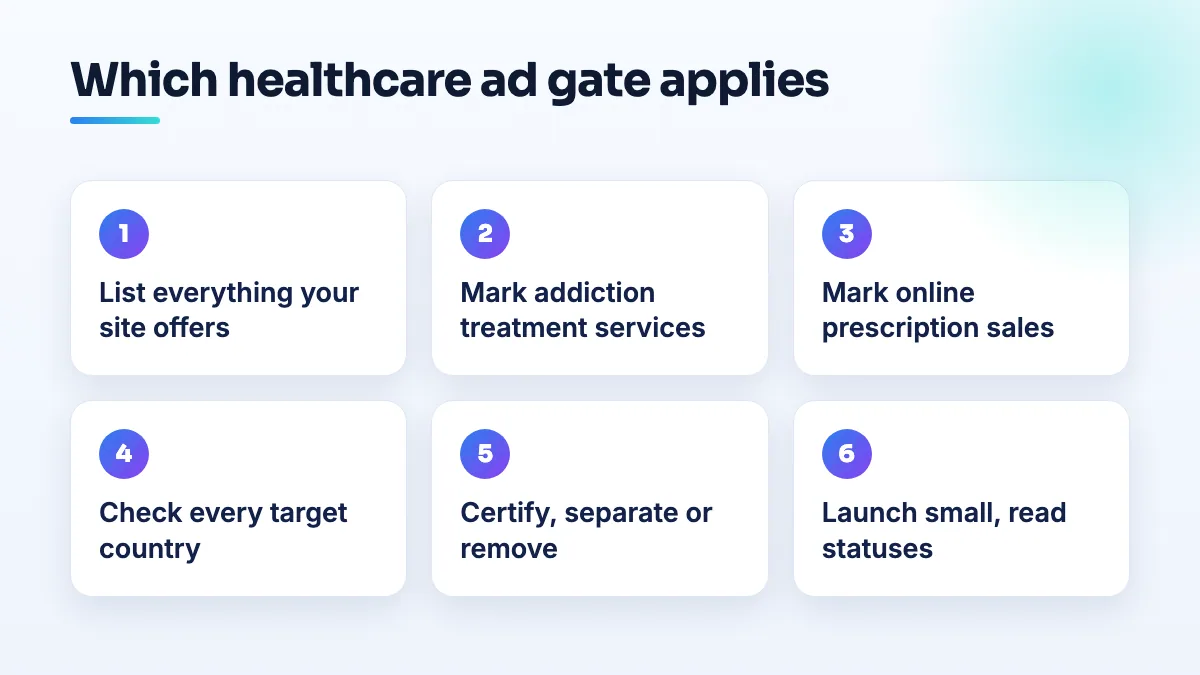
- List everything your ads and your website offer. Not just what you plan to advertise. Every service page, every product, every clinician bio. Google reviews the site your ads point to, and therapy practices have found that out when one addiction specialty got their psychotherapy ads restricted.
- Mark anything that touches addiction treatment. Detox, medication-assisted treatment, substance use counseling, recovery programs. If any of it is on the site, the addiction gate applies to that site.
- Mark anything that involves selling or dispensing prescription medicines online. Online refills, mail-order prescriptions, telehealth that ends in a prescription you fill. That's the pharmacy gate.
- List the countries you want to target. Check each one against the policy. A certification in the US doesn't open Australia or France for addiction services, where only government entities can advertise.
- Decide per item: certify, separate or remove. Certify if it's core to your business and you want to advertise it. Move it to a separate site if you want to advertise everything else freely. Remove it if it's a leftover line nobody acts on.
- Get certified before you build campaigns. Certification takes time, and launching first just gives you a row of disapproved ads to explain later.
- Launch small and read the statuses. Healthcare ads often come back approved (limited), which means they can only serve in some places or to some searches. Check impressions after the first few days, not just approval.
What each business type runs into
| Business | What triggers a gate | What you need |
|---|---|---|
| General clinic or physician | Addiction treatment or online prescription sales on the site | Nothing extra if neither is present; otherwise LegitScript, or LegitScript or NABP |
| Clinic offering addiction treatment | Any substance use treatment, including medication-based | LegitScript (US and Canada); government only in Australia, France, Ireland, New Zealand |
| Lab or collection site | Addiction treatment content on the site | Keep the site to testing services, or certify |
| Pharmacy | Promoting prescription medicines online | LegitScript or NABP in the US; check each country |
| Behavioral addiction counseling | Out of scope for certification | No certification path under the current policy |
Doctors and medical clinics
A general practice that offers neither addiction treatment nor online prescription sales doesn't meet either gate. Where practices get caught is scope creep: a clinic adds medication-assisted treatment, or a telehealth partner starts filling prescriptions, and the website quietly moves into restricted territory. Keep a list of what's on the site and review it whenever a service is added. It's the same discipline I use for medical practice SEO, where the site has to describe exactly what the practice does.
Labs and collection sites
Drug testing, DOT collections, paternity tests and background-check fingerprinting aren't addiction treatment or pharmacy services, so neither gate applies to them on their own. The policy covers more than these two gates, so read it for the specific test you sell. The risk is the website around them. A collection site that also describes a recovery program, or partners with one on the same pages, can pull the addiction rules onto its ads. Keep testing pages about testing: what the test is, who orders it, turnaround time, chain of custody, walk-in hours. Those same pages are what lab testing SEO is built on.
Pharmacies
An independent pharmacy advertising store hours, vaccinations or free delivery is in a different position from one promoting prescription refills online. The second needs LegitScript or NABP in the US. If you plan to push online refills or mail-order, get certified first. It's often the first question in independent pharmacy SEO projects, because the organic side has no such gate.
Other platforms have their own gates
Google isn't the only one. For addiction treatment, Meta's policy on addiction treatment ads asks for LegitScript certification and prior written permission from Meta. That's two approvals, and having one doesn't give you the other. If you plan to run both, budget time for both.
What not to do
- Don't launch and wait to see what gets disapproved. Every disapproval sits in your account history, and I'd rather it stayed clean. Audit first.
- Don't reword restricted services to slip past review. "Substance use support" is still addiction treatment. Misrepresenting what you offer is a bigger problem than a restriction.
- Don't open a second account to run what the first can't. It looks like circumventing a policy decision.
- Don't assume last year's answer holds. Google changes this policy. Re-read the page before any new campaign or new service line.
Questions practices ask
Does a doctor need certification to advertise a general clinic?
Not under the two gates in this guide, as long as the site doesn't offer addiction treatment or sell prescription medicines online. The ads are still reviewed under the healthcare policy, so write them plainly and keep claims factual.
We're certified. Why do our ads still show nothing?
Certification lets ads run; it doesn't make them win the auction. Check that the certification is attached to the right account and domain, that you only target countries it covers, and that your bids are realistic for your market.
Is Google Business Profile affected by these rules?
No. These are advertising policies. Your Business Profile and your organic rankings run on separate rules, which is why every healthcare business should have them in order whether or not it advertises.
Where to start
Do the audit in the steps above before you spend anything. If certification is on the table, the guide to LegitScript certification cost sets out the fees in full. And if you'd like the audit, certification and campaigns handled together, that's our Google Ads management.
Written by Saifur Rifat, Founder & SEO Lead at SERP Squad.