


Key points
- Google reads the whole site, not just the ad
- US and Canada addiction ads need LegitScript certification
- Remove the offer of treatment, not just the word
- Certification costs from $535 plus $1,070 a year
- Behavioral addictions have no certification path
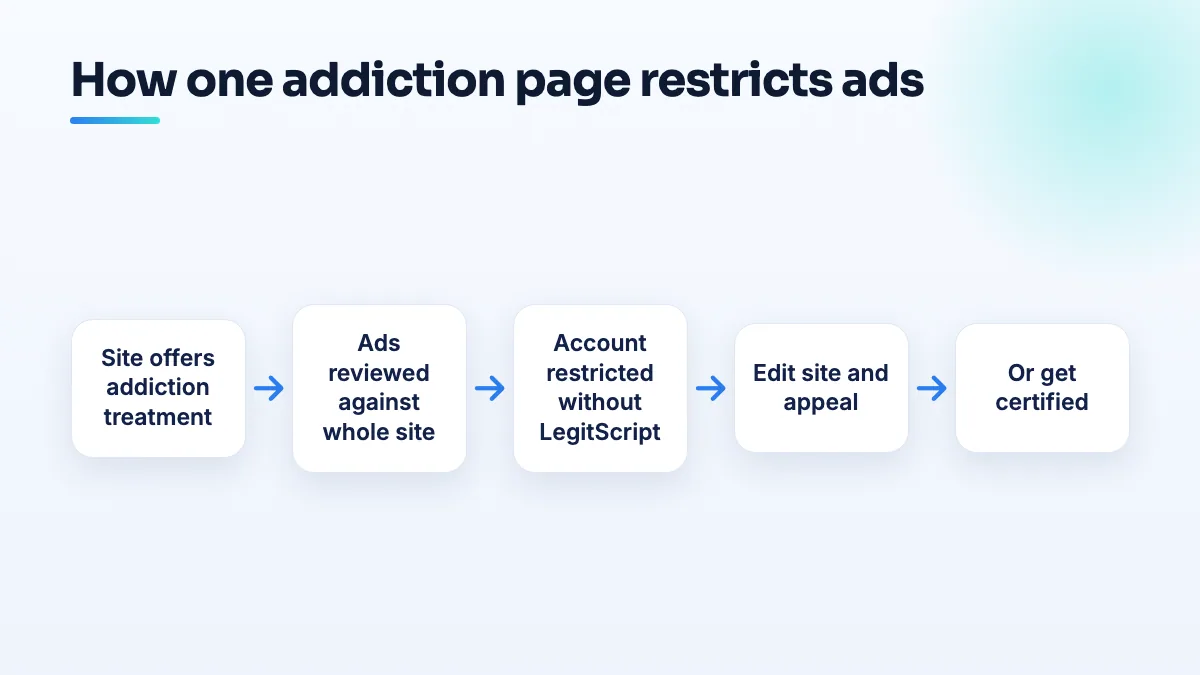
Your ads were restricted because Google read your website, found treatment for addiction offered on it, and put your account under its addiction services policy. It doesn't matter that you run a general psychotherapy practice. When Google Ads restricted addiction services on a therapy site, the fix is one of two things: change the site so it no longer offers addiction treatment, or get certified.
This catches therapists, counselors and group practices that list addiction as one specialty among ten. A practice owner who wasn't a rehab posted the same restriction in a Reddit thread from a therapy practice whose ads were restricted over addiction mentions, and cross-posted it to three subreddits looking for an answer. Here's the answer I'd have given.
Why Google Ads restricted addiction services on your site
Google's healthcare and medicines policy treats addiction services as a restricted category. In the US and Canada, an advertiser offering drug or alcohol addiction treatment needs LegitScript certification. In Australia, France, Ireland and New Zealand, only government entities can advertise these services at all.
The policy is about what your business offers, not what one ad says. Your ad might be about couples counseling, but if the site it points to lists substance use or addiction therapy as a service, the review sees an addiction treatment provider that isn't certified. It has no way of knowing that addiction is a small part of your caseload.
Two details catch people out:
- It's the whole site, not the landing page. A specialties list in your footer, a clinician bio that says "treats addiction", or an old blog post about alcohol use can all be enough.
- Behavioral addictions sit outside the certification. The policy says impulse-control, behavioral and nicotine addiction are out of scope. That doesn't make gambling or gaming addiction ads safe to run. Providers in that area report ads restricted with no way to certify, which I cover in the guide on marketing without LegitScript certification.
Should you edit the site or get certified?
Be honest about what addiction work means to your practice. If it's a real part of your income and you want to advertise it, certify. If it's one line on a list and your ads are for anxiety, trauma or couples work, edit the site. I'd pick one and commit to it, because a half-edited site keeps getting flagged.
Certification isn't cheap. LegitScript lists a $535 application and $1,070 a year for practitioners, and $1,395 to $1,595 per facility plus $2,550 to $3,095 a year for facilities. The full breakdown is in the guide on LegitScript certification cost.
How to lift the restriction by editing the site
- Find every page that mentions addiction. Search Google for site:yourdomain.com addiction, then also check your services page, specialties list, footer, clinician bios, blog posts and page descriptions. Make a list with the URL and the exact sentence.
- Remove the offer of treatment, not just the word. "We treat alcohol and drug addiction" has to go. Swapping it for "substance use support" says the same thing and I'd expect it to be flagged the same way.
- Deal with the blog. Older articles about addiction count as content on your site. Delete them or move them off the domain your ads use. Don't leave them live and hope.
- Check the clinician pages last. Bios are where addiction training quietly survives a cleanup. Rewrite them to describe the work the practice actually advertises.
- Ask Google to review the ads again. Once the site is clean, appeal the policy decision from your Ads account and say plainly that the practice doesn't offer addiction treatment. If it comes back restricted, the review found something you missed. Go back to step one.
If you decide to certify instead
Apply for LegitScript certification for the practice and the website your ads will use. LegitScript's addiction treatment certification page sets out the standards, and one of them is no affiliation with lead generators. If you buy referrals or leads, sort that out before you apply.
Certification doesn't guarantee your ads will show. Certified advertisers report ads marked approved but limited that still serve zero impressions, so budget time for troubleshooting after approval, not just the application.
If you also plan to advertise on Facebook or Instagram, Meta's policy on addiction treatment ads asks for LegitScript certification and written permission from Meta. That's two approvals, not one.
What not to do
- Don't open a second Ads account for the same practice. It looks like an attempt to get around a policy decision, and it puts the account you have at risk.
- Don't hide addiction content on a page with no menu link. If the page is live on the domain, treat it as part of the site.
- Don't keep appealing an unchanged site. Each appeal is read against the same pages.
While the ads are paused, the searches for your other specialties still run through Google Maps and your website. That's where SEO for therapists keeps the phone ringing. If you'd rather have someone go through the site and the account for you, it's part of our Google Ads management.
People also ask
Is buying addiction treatment leads legal under EKRA?
It can be, but how you pay decides it. EKRA makes paying for referrals to addiction treatment a federal crime, it covers private insurance, and in 2025 the Ninth Circuit confirmed it reaches marketing intermediaries. Paying per admission or per patient is where the risk sits, with penalties up to $200,000 and 10 years per occurrence. Have a healthcare lawyer review any lead deal. This is not legal advice.
Read the full answer: Is buying addiction treatment leads legal under EKRA? →
Why do LegitScript-certified rehab ads get zero impressions?
Certification lets addiction ads run, but it doesn't make them win. Zero impressions usually means the certification isn't applied to the account and domain your ads use, a campaign targets a country where certified ads can't serve, your bids are far below the rehab market, or specific keywords aren't allowed to trigger. Check those four in that order, then take screenshots to Google Ads support.
Read the full answer: Why do LegitScript-certified rehab ads get zero impressions? →
How long does Google Business Profile video verification take?
There's no fixed time. Owners in Google's Help Community report waits from about a week to nearly two months: allied health profiles stuck past 7 days, a verification unprocessed after two weeks, a mover pending 55 days. The status matters more than the days. Pending means wait without editing, rejected means fix the gap and reshoot once, and "No more ways to verify" means you need someone to escalate the case.
Read the full answer: How long does Google Business Profile video verification take? →
Can a sober living home have a Google Business Profile without showing its address?
Yes. Create one Google Business Profile for the operator, hide the address, and set a service area covering the towns where your homes are. Local search expert Phil Rozek advises against a profile per house, and I agree: every extra listing is another address you have to protect. Keep house numbers and street views out of your photos and website, and share addresses only with accepted residents.
Should therapists and clinics ask patients for Google reviews?
Mental health therapists generally shouldn't ask current clients for reviews. Several professional ethics codes restrict soliciting testimonials from clients, and clients themselves often aren't sure reviewing a therapist is appropriate. Chiropractors, physical therapists and other clinics can ask, as long as they ask every patient at a consistent point in care, offer nothing in return, and never reply in a way that confirms someone is a patient.
Read the full answer: Should therapists and clinics ask patients for Google reviews? →