


Key points
- Mental health therapists: don't ask current clients
- Check your own ethics code and licensing board
- Clinics can ask every patient at a care milestone
- Never offer anything or ask only happy patients
- Replies must never confirm someone is a patient
Every marketing guide tells you to ask for reviews, and for a health practice that advice runs straight into ethics and privacy. Should therapists ask for reviews? For mental health therapy, my answer is generally no, not from current clients. For chiropractors, physical therapists and similar clinics, yes, if you ask every patient at the same point in their care and offer nothing in return.
This is a position, not a rule from Google. Google allows businesses to ask for reviews. Your professional code and licensing board are what decide the rest, so check them before you act on anything here.
Should therapists ask for reviews at all?
Start with how clients feel about it. In a Reddit thread where therapy clients ask whether reviewing a therapist is appropriate, clients weren't sure it was even appropriate to write one. That hesitation is a signal. A request from the person who holds your most private information isn't a neutral ask.
Therapists are uneasy about reviews among themselves too. In a Reddit discussion among therapists about the ethics of reviewing providers, clinicians debated whether they should even review other providers, which tells you how cautious the profession is about public ratings.
An ethics-first position for therapy practices
There are three problems with asking a therapy client for a review, and none of them are about marketing:
- The power imbalance. A client may feel unable to say no, or worry about how saying no affects their care.
- Confidentiality. A Google review under their name publicly identifies them as your client, often permanently.
- Your code. Several mental health professional ethics codes restrict soliciting testimonials from current clients. Read yours, and your state board's advertising rules, before anything else.
So this is what I'd do. Don't ask current clients, in session or by message. Don't ask at the final session either; ending therapy is part of the clinical work. If you want reviews to be possible, make sure your profile is complete and findable, and let any review arrive unprompted. Then reply to reviews without ever confirming the person is a client; I cover the wording for how a therapist can respond to a negative review in the HIPAA guide.
A quiet review profile isn't a failure for a therapist. Clients choose therapists on specialty, fit and availability, which your website and profile can show without a single review. That's where I put the effort in SEO for therapists.
Physical therapy is different. The relationship is closer to any other clinic, the treatment isn't secret, and the steps below fit it better than the mental health position above.
Chiropractors and clinics: when to ask so it looks genuine
Chiropractors argue about this openly. In a Reddit debate among chiropractors about legitimate review solicitation, the question was where a normal request ends and something that looks manufactured begins. Patients have a view too: in a Houston Reddit thread where locals discuss chiropractor reviews, people treated a wall of uniform five-stars as a reason to distrust a practice, not choose it.
So the aim isn't the most reviews. It's reviews that read as real. The timing I'd use:
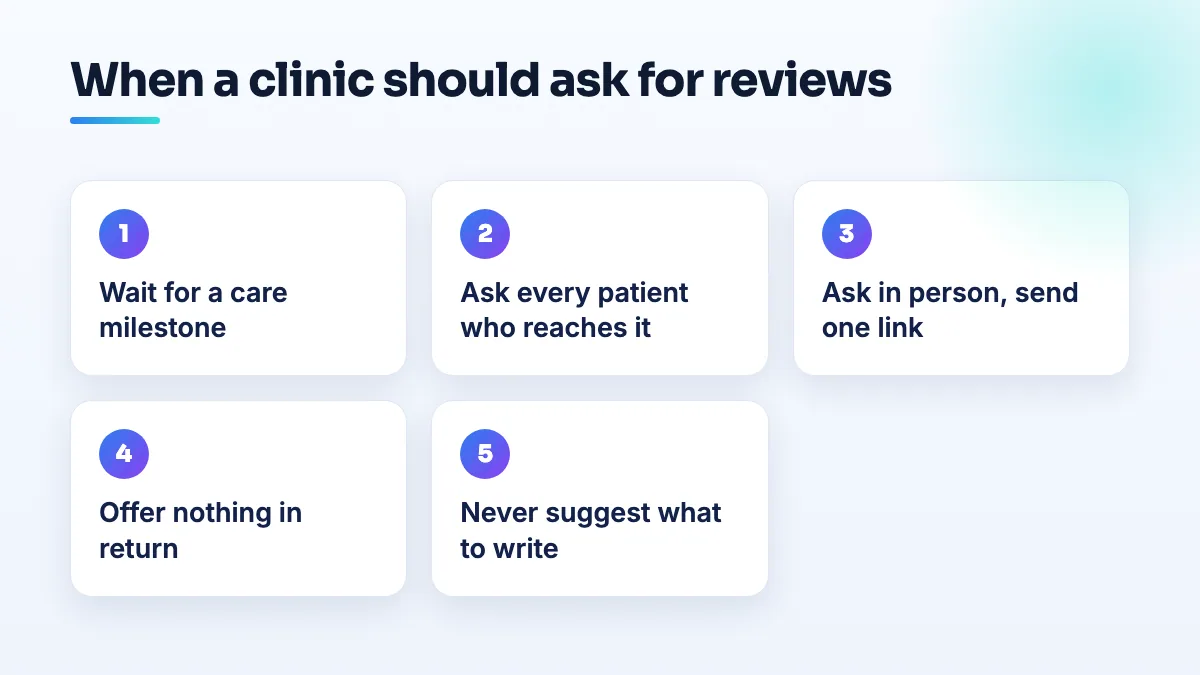
- Wait for a care milestone. A progress re-exam where the patient reports improvement, or the end of an initial care plan. Not the first visit, when they haven't had any results yet.
- Ask everyone who reaches it. Every patient at that milestone, not only the ones who are clearly delighted. Asking only happy patients is review gating, and Google doesn't allow it.
- Ask in person, then send one link. One sentence from the doctor or front desk, then the direct review link by text or email that day, and one reminder a few days later.
- Offer nothing. No discounted visit, no free adjustment, no prize draw. Any reward tied to a review breaks Google's policy.
- Never suggest what to write. Varied reviews in patients' own words are exactly what makes a profile believable to the skeptical reader.
A steady run of reviews over years, some less than perfect, looks far more trustworthy than a sudden burst. That pacing is part of every chiropractic SEO plan I put together.
What not to do in any health practice
- Don't ask staff, family or friends to post reviews. It breaks Google's policy and, in a small community, people notice.
- Don't send review requests that mention the treatment. "How's your back after your adjustment?" in a text that others may see says more than it needs to. Keep the request generic.
- Don't pressure anyone who says no. Take the no and never raise it again.
- Don't thank a reviewer for a specific treatment. Even a warm reply shouldn't confirm what someone was treated for.
For everything else about asking, the general answer on asking for Google reviews applies. If you'd like a review process built around your code rather than a generic template, that's part of our Google Business Profile management.
People also ask
How long does Google Business Profile video verification take?
There's no fixed time. Owners in Google's Help Community report waits from about a week to nearly two months: allied health profiles stuck past 7 days, a verification unprocessed after two weeks, a mover pending 55 days. The status matters more than the days. Pending means wait without editing, rejected means fix the gap and reshoot once, and "No more ways to verify" means you need someone to escalate the case.
Read the full answer: How long does Google Business Profile video verification take? →
Is a perfect 5.0 Google rating bad for a business?
Not in itself, but a perfect 5.0 made of short, identical reviews is something patients openly say they distrust. People choosing a chiropractor or dentist read the reviews, not just the score. A profile with detailed reviews, a few honest four-stars and calm replies to criticism usually looks more believable than a flawless rating. Ask every patient, spread requests out and let the content build trust.
Read the full answer: Is a perfect 5.0 Google rating bad for a business? →
Can two businesses share the same address on Google Business Profile?
Yes, if they are genuinely separate businesses and Google can tell them apart. Each needs its own suite or unit number, its own permanent sign, its own staff on site during business hours, and its own phone number and website. Two businesses on the same street address with no suite number and the same category look like a duplicate, and one or both can be suspended.
Read the full answer: Can two businesses share the same address on Google Business Profile? →
Why did Google Ads restrict my therapy site for mentioning addiction?
Because your website offers addiction treatment, even as one service among many. Google's healthcare policy treats addiction services as restricted, and in the US and Canada that category needs LegitScript certification. The review reads your site, not only the ad, so one specialties line or blog post can restrict the account. You either remove the offer of addiction treatment from the site and appeal, or you get certified.
Read the full answer: Why did Google Ads restrict my therapy site for mentioning addiction? →
Can an agency's restricted Google account get my profile suspended?
Yes. If an agency, freelancer or vendor with access to your listing has its Google account restricted, Google can suspend every profile connected to that account, and yours goes with it. The notice says a Google account associated with the profile was restricted. Proving your address won't fix it: remove the account, have the agency resolve its restriction, and appeal on that point.
Read the full answer: Can an agency's restricted Google account get my profile suspended? →