

Someone searches your treatment center by name, clicks the top ad, and ends up talking to a call center that isn't you. If you suspect a competitor bidding on your business name, the answer is to prove it first: search your own name, screenshot every ad, call every number and log who answers. Then report what you found to Google and, if callers are being told they've reached you, to the FTC.
This isn't paranoia. In 2025 the Federal Trade Commission sued marketers over exactly this in addiction treatment, and a related FTC matter ended with a treatment provider paying $1.9 million. Below is what the FTC described, how to check whether it's happening to you, and how to keep your calls coming to your phone.
What the FTC said was happening
The FTC's June 2025 press release on its lawsuit against Mercury Marketing and others describes Google ads that showed the names of real clinics. People who called the number in those ads reached a call center run by the defendants, where, according to the FTC, staff pretended to be the clinic the caller was looking for. Aliya Health Group was among those named. Separately, Evoke Wellness agreed to pay $1.9 million to settle FTC claims.
Notice what the FTC described went beyond buying a keyword. The ads used real clinics' names, and the people on the phone claimed to be those clinics. That distinction matters for what you do next.
Brand bidding versus impersonation
Plain brand bidding, where a competitor's ad shows up when someone searches your name, is common in every industry. It's annoying, and it costs you clicks, but on its own it's a different thing from what the FTC went after. The pattern to watch for has three parts:
- The ad uses your name as if it were theirs. Your center's name in the headline, or a display URL that looks like your website.
- The phone number isn't yours. It goes to a call center or another facility.
- The person who answers doesn't say who they are, or says they're you.
If all three are true, you're looking at the call center impersonating a clinic pattern, and you should treat it as a consumer protection problem, not a marketing annoyance. If only the first is true, it's brand bidding, and your answer is mostly your own ads and your own profile. I'm not a lawyer, and if you think you're being impersonated, have your own counsel look at the evidence before you contact anyone.
How to check if a competitor is bidding on your business name
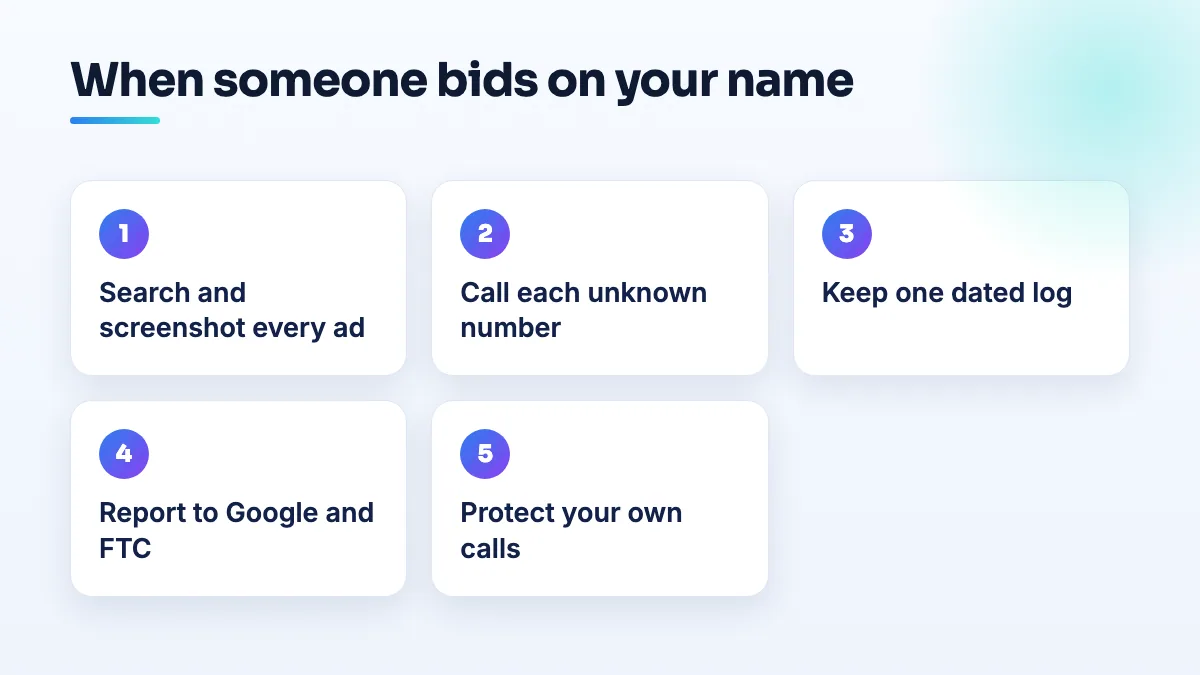
- Search your exact name on several devices and locations. Use a phone and a computer, signed out of Google, and ask staff in other towns to do the same. Ads rotate, so search at different times of day over a week. Search variations too: your name plus "reviews", "phone number", "admissions" and "cost".
- Screenshot every ad with the date and time. Capture the headline, the display URL, any phone number and the location you searched from. Save them in one folder, named by date.
- Call every number that isn't yours. Ask plainly, "Which facility have I reached, and what's its address?" Note the date, time, number, what you were told, and whether they claimed to be your center. Have a second staff member make a separate call on a different day.
- Click the ads and save the landing pages. Record the domain and whether the page names your center, uses your photos, or says nothing about who runs it.
- Ask new callers how they found you. Train your admissions team to ask every caller "Did you speak to anyone else about us before calling?" A family saying they already called "you" at a different number is exactly the evidence you need. Write it down with the date, without recording any health details.
- Keep one log. A simple spreadsheet: date, search term, ad headline, number, who answered, what they said. That log is what Google, the FTC and your lawyer will all want.
How to report it
To Google
Report the ad to Google from the search results or through Google's ads reporting and trademark complaint routes, and attach your screenshots and call log. Google's forms change, so I won't give you button paths that may be out of date. What matters is that your report says exactly what's false: "This ad shows our center's name and the number goes to a call center that told our staff member it was us." If you hold a registered trademark for your name, say so, since that gives Google a clearer basis to act.
To the FTC
If callers are being told they've reached you, file a consumer protection complaint with the FTC and include your log. The FTC's own case shows it treats this pattern as deceptive advertising in addiction treatment. Your state attorney general's consumer protection office is worth contacting too.
To your lawyer
If you can identify who's behind the ads, a lawyer can advise on a demand letter or a trademark claim. Don't call the other business yourself to argue. It rarely helps, and it can make you look like the aggressor.
How to protect your calls while you wait
Reports take time. These are the things you control today:
- Run ads on your own name, if you're certified. A brand campaign puts your real ad above theirs, and your own name is usually the cheapest keyword you'll ever bid on, because your site is the most relevant answer. Addiction treatment ads in the US and Canada need LegitScript certification under Google's healthcare and medicines policy, so if you're not certified, this option isn't open to you. The guide on LegitScript certification cost sets out what it takes.
- Make your Google Business Profile unmistakable. Your exact registered name, your real address, one main phone number, current photos of your building and signage. When a family searches your name, the profile panel is often the first thing they see, and it doesn't depend on ads.
- Put your phone number everywhere, the same way. Website header, contact page, Google profile, directory listings and printed referral material. A family who has seen your number twice will notice a different one.
- Add a short "how to know you've reached us" note. On your contact page: "Our admissions team will always tell you our center's name and address. If someone won't, you haven't reached us." It costs nothing and it arms the families who are most at risk.
- Tell your referral partners. Therapists, hospitals and interventionists who send families to you should give out your direct number, not "search for us".
What not to do
- Don't bid on their name with ads that pretend to be them. That's the conduct you're reporting. Google suspends accounts for unacceptable business practices, and owners in a Reddit thread on Ads accounts suspended for unacceptable business practices describe losing whole accounts after years without a problem. You don't want to hand Google a reason.
- Don't buy leads or calls from sellers who won't say where they come from. Some of those calls came from ads like the ones you're fighting. Under federal kickback rules for recovery, the way you pay for leads can also create legal exposure, which I explain in EKRA and buying rehab leads legally.
- Don't click competitors' ads over and over to drain their budget. It proves nothing and looks bad in your own log.
- Don't put patient information in any report. Your log records ads, numbers and what was said to your staff, never who the caller was calling about.
Questions treatment centers ask
Is it illegal for a competitor to bid on my name?
Bidding on a name by itself is widespread and generally treated differently from impersonation. Using your name in the ad as if it were theirs, or answering calls as you, is what the FTC went after. For your specific case, ask a lawyer.
Should I bid on competitors' names myself?
I wouldn't in addiction treatment. Families searching a specific center are often in crisis, and an ad that interrupts that search looks like the thing the FTC sued over, even when it isn't. If you do it anyway, your ad must say clearly who you are and never use the other center's name.
How do I know if I'm losing calls?
Compare how many people search your name with how many call you. If your profile shows lots of name searches but calls are falling, and your admissions team keeps hearing "I already called you", take that seriously.
Where to start
Do the search-and-call check this week and start the log. If you want the brand campaign, the profile and the reporting handled together, that's what our Google Ads management and SEO for treatment centers cover.
Written by Saifur Rifat, Founder & SEO Lead at SERP Squad.