

Every marketing playbook tells you to lead with customer stories, and in residential treatment you can't. Rehab marketing without testimonials works when you replace the client's voice with proof families can check themselves: the named people who will treat their son or daughter, the building they'll live in, exactly what happens each day, and what it costs.
A marketer put the problem well in a Reddit thread on marketing when anonymity is the product: the thing clients are paying for is that nobody finds out. No photos, no stories, no names. I agree with that, and I'd go further. Anonymity isn't a gap in your marketing. Handled well, it's part of the pitch.
Why testimonials don't work for treatment programs anyway
Even if clients were willing, I'd be cautious. A former client who goes public about treatment today may regret it in five years, and a page with their face on it doesn't go away. Clinical staff also have their own privacy and ethics rules to follow, which don't bend for marketing.
Reviews have the same problem in a different form. A mental health facility described in a Local Search Forum thread about a facility's missing reviews watching its count drop from 210 to 176 in weeks while its state board effectively forbade replying at all. So you can't count on reviews to carry the trust load either, and you shouldn't try to answer them with details. The rules for that are in the guide to a HIPAA review response.
And there's a practical point. Families searching for treatment have learned to be suspicious. The rehab map pack is described by practitioners as full of spam, and the FTC has sued marketers who ran ads under real clinics' names. A wall of glowing quotes with first names only reads as exactly the kind of thing they've been warned about.
What Google looks for on health pages
Google's guidance on creating helpful content asks who created a page, how, and why. It says trust matters most, and that topics which can affect people's health are held to a higher standard. It recommends making clear who wrote the content, through bylines and background about the author. It doesn't say a doctor has to write it, and I'd be wary of anyone who tells you it does. The detail is in the guide on choosing a YMYL content author.
That's useful for you, because the trust signals Google asks for are exactly the ones you can publish without exposing a single client.
How to build trust without client stories
These are the pages and assets I'd build for a residential program, in this order. Each one answers a question a family asks before they call.
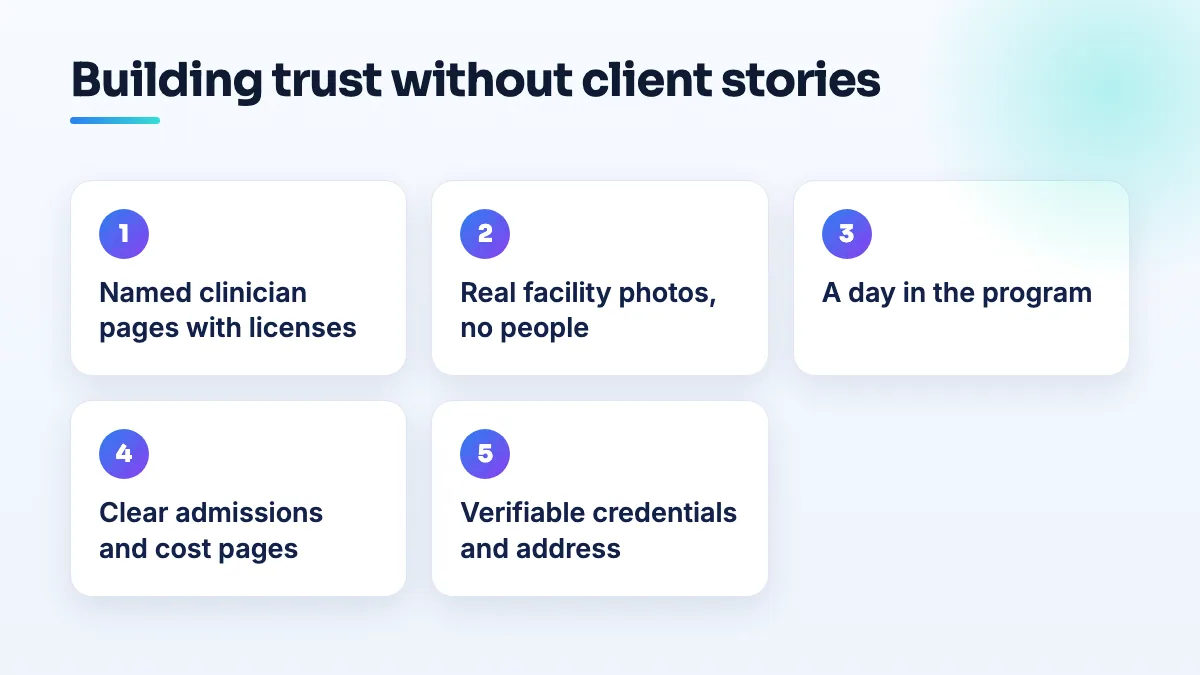
- Publish a page for every clinical lead. Name, photo, role, license or certification with the number and issuing board, training, and what they actually do with residents. A family can look up the license in two minutes. That single check is worth more than any testimonial, because it can't be faked.
- Photograph the facility, not the people. Bedrooms, the kitchen, group rooms, outdoor space, the view from the front door. Real photos, taken on a normal day with nobody in frame. Stock photos of smiling "patients" do the opposite of what you want; families recognize them.
- Write "a day in the program" hour by hour. Wake-up time, meals, groups, individual sessions, free time, phone rules, visiting. It's the page that answers "what will actually happen to my kid", which is the question behind most calls.
- Explain admissions and cost in plain words. Who you take and who you don't, how assessment works, how long it takes to get a bed, what you charge, which insurance you work with. My view is that programs that hide price push families toward the call centers that promise everything.
- Put your credentials where they can be checked. State license, accreditation, and LegitScript certification if you have it, each linked to the issuer's verification page where one exists. Show your full address and a main phone number that matches your Google profile.
- Have clinicians review your content and say so. Each page on detox, withdrawal, dual diagnosis or family therapy should carry the name of the clinician who reviewed it and the date. That's the byline Google's guidance points to.
- Answer the family's questions, not the client's. Often the searcher is a parent or partner. Write pages for them: how to talk to someone about treatment, what to pack, what visiting looks like, what happens after discharge.
Rehab marketing without testimonials: what replaces them
| Instead of | Publish | Why it works |
|---|---|---|
| Client stories | Named clinician pages with license numbers | Families can check them independently |
| Photos of clients | Real photos of rooms and grounds | Shows the place they'll live, not a stock model |
| "Life-changing" quotes | A day in the program, hour by hour | Answers the real question behind the search |
| Star ratings as proof | Admissions and cost pages | Removes the uncertainty that stops calls |
| Anonymous success claims | Outcome data with the method explained | Only if you actually measure it |
That last row matters. If you track outcomes, such as completion rates, publish the number, how you measured it and over what period. If you don't track them, don't publish a number. An invented statistic on a health site is a far bigger problem than having none.
What about alumni who want to speak publicly?
Some people in recovery choose to talk about it openly, and some want to help others by doing so. If a former client offers, I'd still be careful. Get written consent that makes clear the content will be public and searchable, let them choose their own words and whether their face or name appears, and agree how they can withdraw it later. Never ask. The offer has to come from them.
Staff who are themselves in recovery are a different case, and often a stronger one. A counselor who chooses to mention their own recovery on their bio page speaks to families directly, without any client being involved.
What not to do
- Don't write testimonials yourself or use "composite" stories. They're fabricated, however they're labeled, and families and regulators treat them that way.
- Don't use photos of real clients, even blurred. Someone will recognize the room, the tattoo or the jacket.
- Don't ask clients for Google reviews during treatment. The power imbalance is obvious, and it puts their privacy in your hands at the worst moment.
- Don't reply to reviews with any detail about care. Not even to correct something unfair.
- Don't copy the spam playbook. Keyword-stuffed names and dozens of city pages are what families are learning to avoid.
Questions program directors ask
Will a site without testimonials convert?
It can, if what replaces them is specific. A named clinician, a real room and a clear price do more work than "This place saved my life" from someone called J. Measure calls from each page and you'll see which ones pull.
Should we show our staff's faces?
Yes, if they're comfortable with it. Staff are the people families will trust with someone they love, and a face with a name and a license is the strongest signal on the site.
Can we use video?
Yes: a walkthrough of the empty building, or a clinician explaining how the first week works. Film on a day with no residents around, or in areas they don't use.
Where to start
Start with the clinician pages and the day-in-the-program page. They're the quickest to produce and they answer the two biggest questions families have. If you'd like them written and clinician-reviewed properly, that's our SEO content writing, and it's the foundation of our recovery center SEO work.
Written by Saifur Rifat, Founder & SEO Lead at SERP Squad.