


Key points
- A bad review doesn't trigger the self-defense exception
- Client reviewers get a one-line acknowledgment, nothing more
- Never mention the matter, even if the reviewer did
- Report reviews that break Google's rules separately
- Check your own state's version of Rule 1.6
A former client, or someone who never was one, has posted a one-star that gets the facts wrong, and every instinct says set the record straight. Can a lawyer respond to a negative review? Only in a narrow way. The ABA's ethics opinion on this says a bad review doesn't give you permission to reveal anything about the representation, so the public reply is short and the real work happens elsewhere.
This is my reading as a marketer who works with law firms, not legal advice. The rule that binds you is your own state's, so treat the steps below as a starting point to check against it.
What ABA Opinion 496 says about responding to reviews
ABA Formal Opinion 496 on responding to online criticism starts from Model Rule 1.6(a), which bars a lawyer from revealing information relating to a representation. That covers far more than secrets. It includes almost anything you learned while working on the matter.
The key finding is that a negative online review does not trigger the self-defense exception. That exception exists for real legal disputes about your conduct, not for a bad write-up on Google. So if the reviewer is a current or former client, the opinion's position is that you may not respond online other than to acknowledge that your professional obligations don't permit a response.
The client posting details of their own case doesn't change that. They can talk about their matter. You still can't.
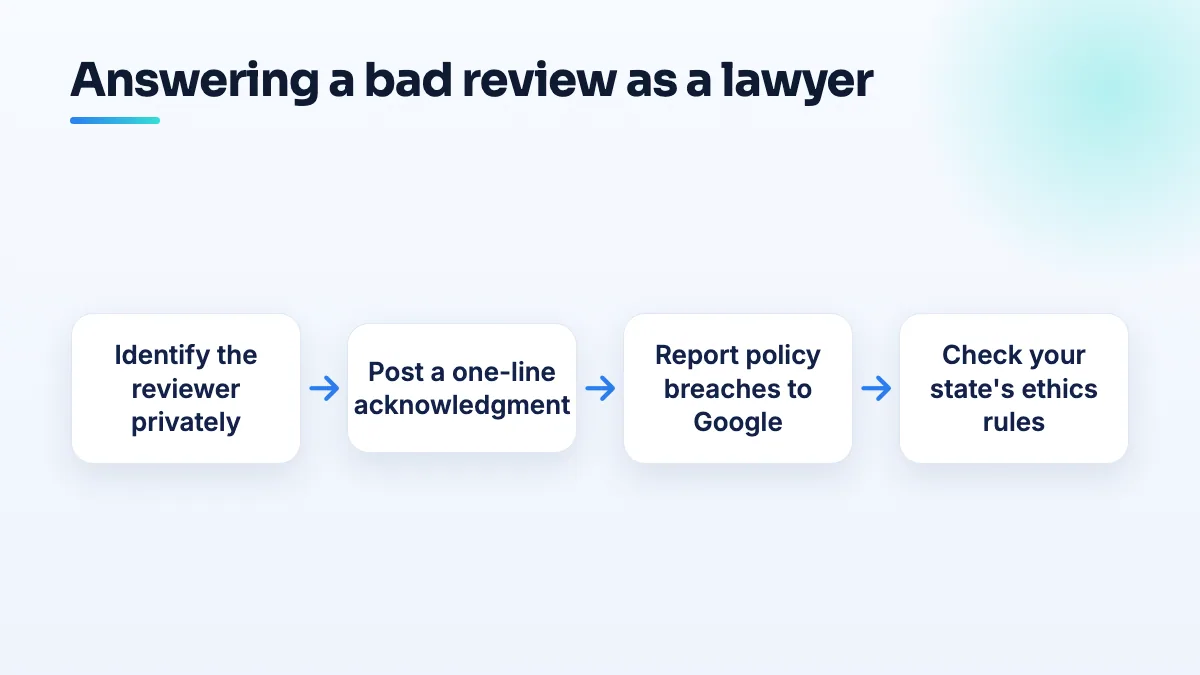
How a lawyer should respond to a negative review, step by step
- Work out who wrote it, privately. A current or former client, an opposing party, a stranger, or a competitor. I'd never post anything until I knew which, because it decides what else you can do.
- Reply with one line, whoever it is. Something like: "Our professional obligations don't allow us to discuss any matter in a public forum. We take all feedback seriously." It reads the same whether they were a client or not, which is the point.
- Don't identify their role, even if they're not a client. Writing "this person was on the other side of my client's case" reveals information about your client's matter. Keep the same one-line reply.
- Report the review if it breaks Google's rules. Reviews from people with a conflict of interest, such as an opposing party promoting a rival firm, can be reported under Google's policy. I walk through how that works for an opposing party review separately.
- If it's a former client, consider a private conversation. A call to resolve the complaint offline can do more than any public reply. Keep it to resolving their concern, and check with your state bar's ethics hotline first if you're unsure.
- Check your state's rule before you post anything longer. States adopt the Model Rules with changes and issue their own ethics opinions. A five-minute call to the ethics hotline costs less than a grievance.
What the opposing-party case shows
A family-law firm in Utah is a clear example of how tight the box is. In a Help Community thread about a one-star from an opposing party, the reviewer said they'd been the opposing party in a family law case and ended by recommending a named rival attorney. The firm reported and appealed, and Google decided the review didn't violate its policies.
I don't think the firm had a good public answer. It couldn't correct the record without talking about its client's case. That's the reality of Opinion 496: when the report fails, the reply can't do the job either. What's left, in my experience, is volume. A handful of reviews means one unfair one sets the tone; a steady run of genuine client reviews puts it in context.
What else a law firm can do
- Ask for reviews when a matter closes well. A consistent ask at the end of every matter is the most reliable protection against one bad review. It's the core of the review work in our Google Business Profile management for firms.
- Keep advertising rules in mind in every reply. The ABA comment on Rule 7.1 about communications on a lawyer's services warns that even truthful past results can create an unjustified expectation. Replying to a critic with "we've won millions for our clients" is advertising, and it's the wrong kind.
- Don't reply to positive reviews with case details either. "Glad we won your custody hearing" discloses a matter just as much as a rebuttal would.
- Don't ask friends or staff to post reviews to drown it out. That breaks Google's policy and, depending on your state, possibly your advertising rules too.
My general advice on when to reply at all is in the piece on responding to bad reviews. For lawyers, the ethics rules simply narrow what that reply can say. If you'd like help building the review profile that makes this less painful, that's part of our SEO for lawyers.
People also ask
Can an agency's restricted Google account get my profile suspended?
Yes. If an agency, freelancer or vendor with access to your listing has its Google account restricted, Google can suspend every profile connected to that account, and yours goes with it. The notice says a Google account associated with the profile was restricted. Proving your address won't fix it: remove the account, have the agency resolve its restriction, and appeal on that point.
Read the full answer: Can an agency's restricted Google account get my profile suspended? →
Can you appeal a Google review decision more than once?
No. You get one appeal on each review Google decides not to remove, and once the appeal is denied, that decision is final for that review. Wait for the first decision before appealing, and only appeal with new evidence tied to a specific policy clause. After that, your options are a calm public reply, reporting new reviews from the same accounts, and outnumbering the review with genuine ones.
Read the full answer: Can you appeal a Google review decision more than once? →
Can you use a coworking space or virtual office for Google Business Profile?
Only with your own dedicated office there. Google allows a coworking address only if the office has clear signage, receives customers during business hours, and is staffed during those hours by your own staff, not the operator's reception. A virtual office, mailbox, hot desk or day pass doesn't qualify, and profiles listed at them are regularly suspended.
Read the full answer: Can you use a coworking space or virtual office for Google Business Profile? →
Will Google remove a review from a former employee or opposing party?
Sometimes. Google's review policy lists current or former employment and industry competitors as conflicts of interest, so a review from an ex-employee or a rival can come down. In practice Google often leaves these reviews up, as a family-law firm found with a one-star from the opposing party. Your report has to name that clause and show the relationship with evidence Google can check.
Read the full answer: Will Google remove a review from a former employee or opposing party? →
Should my Google Business Profile use my legal name or my trading name?
Use the name your customers actually see: the one on your signs, website, vehicles and invoices. For most businesses that is the trading name, not the LLC on the registration. Google asks for your real-world name, so a legal name nobody recognizes, or a sudden rename to match paperwork, can read as deceptive. If the two names differ, register the trading name as a DBA so a document ties them together.
Read the full answer: Should my Google Business Profile use my legal name or my trading name? →