


Key points
- "Best" is a comparison you usually cannot prove
- Certified specialist claims must name the certifying body
- Past results need context and a clear disclaimer
- Say what you practice, not how you rank
- State bar rules can be stricter than the Model Rules
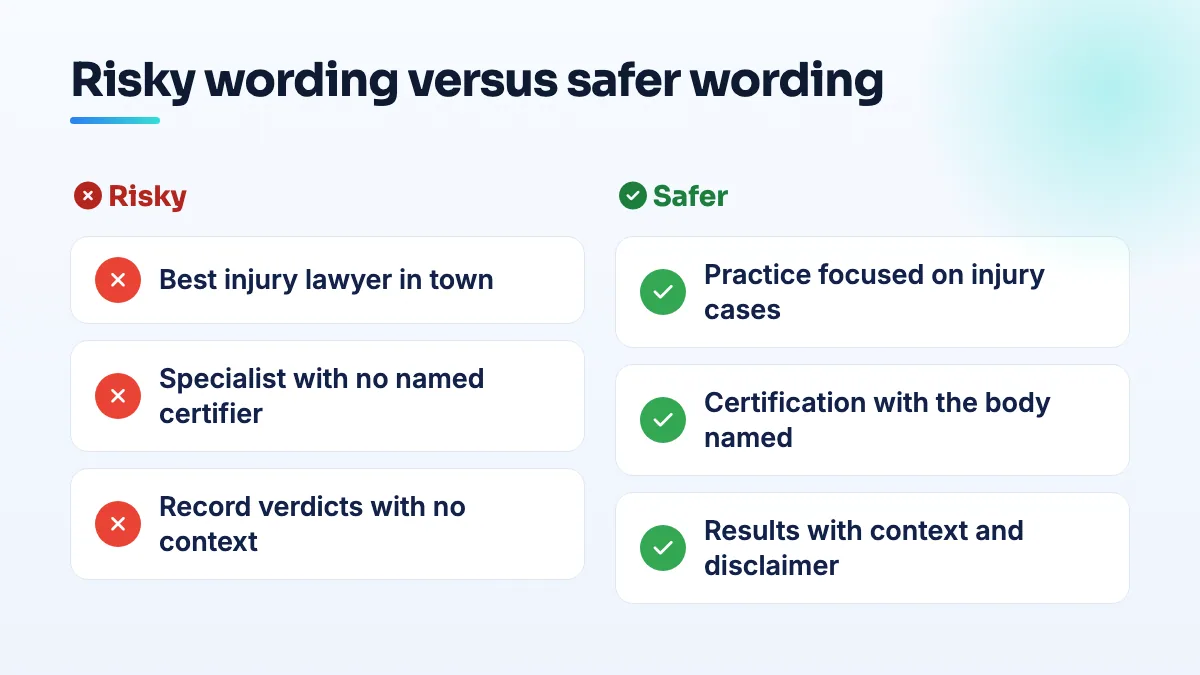
"Best" and "specialist" are the two words law firm marketers want most, and they're the two most likely to get a firm in trouble with its bar. Under the ABA Model Rules, "best" is usually an unsubstantiated comparison, and a lawyer can only claim to be a certified specialist when an approved or ABA-accredited body did the certifying and the page names it.
Below is what the Model Rules say, how I rewrite pages and profiles that break them, and the part I can't answer for you: your own state's version of the rules.
When lawyers can advertise as specialists, and why "best" fails
Model Rule 7.1 bars any false or misleading communication about a lawyer's services, and a truthful statement can still be misleading. The ABA comment on Rule 7.1 says truthful past results can mislead when they create "an unjustified expectation that the same results could be obtained for other clients." The same comment treats an unsubstantiated comparison with other lawyers' services as potentially misleading when it's specific enough that a reader would assume it can be proved. "Best personal injury lawyer in Columbus" is exactly that kind of claim.
For specialists, Rule 7.2(c) is the one that matters. A lawyer may not state or imply that they're certified as a specialist in a field of law unless two things are true:
- The certification comes from an organization approved by an appropriate state authority or accredited by the American Bar Association.
- The name of the certifying organization is clearly identified in the communication.
Saying which areas you practice in is a different matter, and the Model Rules generally allow it as long as it isn't misleading. "Our practice is limited to workers' compensation" is a description. "Workers' comp specialists" implies a status, and that's where state rules vary most.
That last point is the honest limit of this answer. I've checked the ABA Model Rules. States adopt their own versions, some with extra restrictions on "specialist," "expert," past results and required disclaimers, and I haven't verified any single state's text here. Before anything goes live, check it against your state bar's current advertising rules.
How to rewrite your pages and profiles
- Search everything you publish for the risky words. Look for "best," "top," "#1," "leading," "specialist," "specializing," "expert," "record" and "guaranteed." Check page text, but also title tags, meta descriptions, image alt text, your Google Business Profile description, Local Services Ads copy and directory profiles. In my experience the most common place to find "best" is a title tag an SEO plugin or a past agency wrote.
- Swap comparisons for facts you can prove. Years in practice, bar admissions, the courts you appear in, languages spoken, the types of cases you take. "Serving Franklin County injury clients since 2009" does more for a reader than "best," and you can back it up.
- Fix every specialist claim. If you hold a certification, name the certifying body in the same sentence as the claim. If you don't, change it to "focuses on" or "practice limited to," subject to your state's rules.
- Give results pages context. Explain what each case involved and add a clear statement that results depend on the facts of each matter and past results don't guarantee a similar outcome. The ABA comment notes an appropriate disclaimer or qualifying language may prevent a finding that a statement creates unjustified expectations. Your state may require specific wording.
- Describe awards exactly as they were given. Name the organization, the year and the category. Don't turn "listed in a directory in 2021" into "award-winning" with no date.
- Get sign-off and keep a copy. Have the responsible lawyer check each changed page against the state rules and save a dated copy of what went live.
Why search pushes firms toward the wrong wording
People type "best divorce lawyer near me," so marketers want the word on the page. When I searched "best personal injury lawyer Columbus Ohio," the first five results were Justia, Super Lawyers twice, Yelp and a curated listicle, with firm websites below all of them. Putting "best" in your title tag doesn't beat directories, and it adds bar risk for almost no ranking benefit.
What does work is a strong page for each practice area and city, written from real expertise, plus a well-built Google Business Profile. Keep "best" out of the profile name too. Google's guidelines on business names expect the real-world name, and lawyers can add a title such as Esq. or JD to a practitioner name, not a marketing claim. For paid leads, Google's list of Local Services Ads practice areas shows the categories you can choose, from bankruptcy and DUI to immigration and personal injury. Match your pages to those areas and let the areas do the describing.
Edge cases
- Clients who call you "the best" in a review. Their words on Google are theirs. Once you quote them on your site or in an ad, they become your advertising, so apply the same care. Replying to reviews brings its own confidentiality limits, which I cover in the answer on whether a lawyer can respond to a negative review.
- Firm names. A name like "Injury Specialists Law Group" puts the claim everywhere the name appears, including your profile. Check it with your bar before you build a brand on it.
- Multi-state firms. A page read in two states has to satisfy both. Write to the stricter one.
Most of the rewrites above are part of the service page writing we do in law firm SEO projects, where every page is written to rank without leaning on words your bar won't accept. When the whole site needs replacing, the same checks go into the website design before launch, including the title tags nobody reads until a bar complaint arrives.
People also ask
Can an agency's restricted Google account get my profile suspended?
Yes. If an agency, freelancer or vendor with access to your listing has its Google account restricted, Google can suspend every profile connected to that account, and yours goes with it. The notice says a Google account associated with the profile was restricted. Proving your address won't fix it: remove the account, have the agency resolve its restriction, and appeal on that point.
Read the full answer: Can an agency's restricted Google account get my profile suspended? →
Can you appeal a Google review decision more than once?
No. You get one appeal on each review Google decides not to remove, and once the appeal is denied, that decision is final for that review. Wait for the first decision before appealing, and only appeal with new evidence tied to a specific policy clause. After that, your options are a calm public reply, reporting new reviews from the same accounts, and outnumbering the review with genuine ones.
Read the full answer: Can you appeal a Google review decision more than once? →
Can you use a coworking space or virtual office for Google Business Profile?
Only with your own dedicated office there. Google allows a coworking address only if the office has clear signage, receives customers during business hours, and is staffed during those hours by your own staff, not the operator's reception. A virtual office, mailbox, hot desk or day pass doesn't qualify, and profiles listed at them are regularly suspended.
Read the full answer: Can you use a coworking space or virtual office for Google Business Profile? →
Will Google remove a review from a former employee or opposing party?
Sometimes. Google's review policy lists current or former employment and industry competitors as conflicts of interest, so a review from an ex-employee or a rival can come down. In practice Google often leaves these reviews up, as a family-law firm found with a one-star from the opposing party. Your report has to name that clause and show the relationship with evidence Google can check.
Read the full answer: Will Google remove a review from a former employee or opposing party? →
Can a lawyer respond to a negative Google review?
Only in a very limited way. ABA Formal Opinion 496 says a negative online review doesn't trigger the self-defense exception to Model Rule 1.6(a), the confidentiality rule. If the reviewer is a current or former client, the public reply can do little more than say your professional obligations don't allow you to respond. State rules can differ, so check yours before posting anything.
Read the full answer: Can a lawyer respond to a negative Google review? →