


Key points
- Online-only businesses and brands aren't eligible
- A mailbox or virtual office doesn't qualify you
- In-person service or a staffed location is required
- Win brand searches on your own website
- Create any future profile on your own account
If your startup has no office, sells online and never meets customers in person, the answer is no: it can't have a Google Business Profile, and trying to force one usually ends in a suspension. Startup Google Business Profile eligibility comes down to one test in Google's own rules: either customers visit a place you staff, or you travel to serve them face to face.
Founders ask this constantly in a Help Community thread where founders ask whether a startup qualifies and plenty of others like it. Here's the rule, the few startups that do qualify, and where I'd put the effort instead.
Startup Google Business Profile eligibility: what Google's rule says
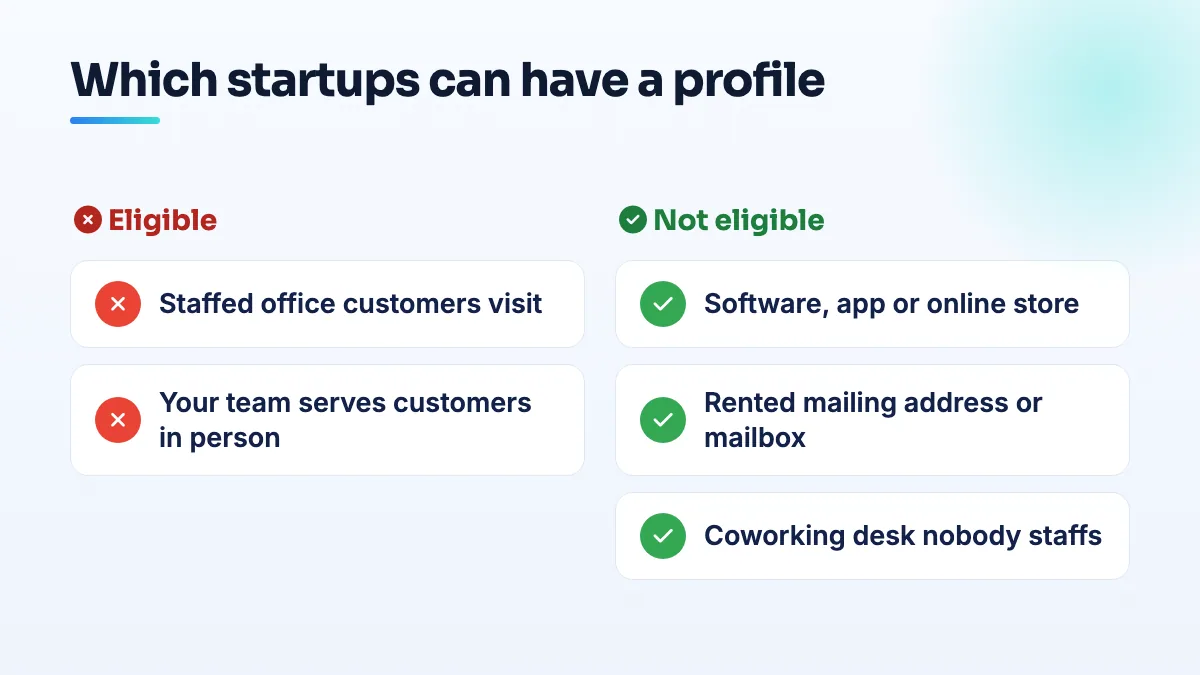
Google's eligibility rules for Business Profiles are short. A business qualifies only if it has a physical location customers can visit, or if it travels to customers in person. Then come the exclusions that catch most startups: online-only businesses, brands and organizations aren't eligible, a rented mailing address you don't operate from isn't eligible, and P.O. boxes and remote mailboxes aren't acceptable.
That rules out most of what people call a startup: a SaaS product, an app, a direct-to-consumer brand shipping from a warehouse, a newsletter, an online course. None of them has in-person contact with customers, so none of them fits, however real the company is.
The startups that do qualify
- You have premises customers visit. A clinic, a studio, a showroom, a lab with a reception desk. It must be staffed by your own people during the hours you list.
- Your own team serves customers at their location. A home services startup with its own crews, a mobile repair service, a tutoring company whose staff go to students. You list as a service-area business with your base address hidden.
- You're a marketplace or broker. This is the gray zone. If independent providers do the in-person work, the platform itself usually doesn't qualify. The same test applies to mail-in repair on Google Business Profile, brokers and kiosks.
What to do if you don't qualify
- Don't rent an address to get one. A virtual office, a mailbox or an unstaffed coworking desk doesn't make you eligible. Coworking is the obvious shortcut, and the Help Community is full of suspended ones, as in a Help Community thread about a suspended coworking address. The rules for a coworking address on a Google Business Profile are strict: signage, customers received on site, and your own staff there during business hours.
- Put your brand search on your own website. When someone searches your company name, your site should answer everything a profile would: what you do, who it's for, pricing, how to reach you, and who's behind it. That's the job of early SEO for startups.
- Target the problems your buyers search, not your city. A software company wins on content that answers buyers' questions, comparison pages and product documentation, not on the map pack. That's where SaaS SEO spends its effort.
- Use one name everywhere. Founders often register one legal name and market another. Keep them clearly connected on your site and filings; a mismatch between legal name and trading name has triggered "deceptive content" rejections for businesses that did later qualify.
- If you open a qualifying location later, create the profile yourself. Use a company Google account you control, not an agency's. Ownership disputes with former agencies are a recurring mess in the forums, and I'd never let an outside vendor own your first Google asset.
Edge cases founders ask about
- "We have an office, but customers never come." Then the office doesn't make you eligible. The test is customer contact, not having a lease.
- "We do demos in person sometimes." Occasional sales meetings at a client's office aren't the same as serving customers in person as your core business. I wouldn't build a profile on that.
- "A competitor has one." Plenty of ineligible listings exist until someone reports them or Google's checks catch up. That's not a model I'd copy with a company you're trying to build trust in.
- "Our first location opens next quarter." Wait until it's open, staffed and signed, then create the profile. A profile for a place that isn't operating yet is exactly what the verification video will fail to show.
If you do have a location that qualifies, setting it up properly the first time is part of our Google Business Profile management.
People also ask
Can an agency's restricted Google account get my profile suspended?
Yes. If an agency, freelancer or vendor with access to your listing has its Google account restricted, Google can suspend every profile connected to that account, and yours goes with it. The notice says a Google account associated with the profile was restricted. Proving your address won't fix it: remove the account, have the agency resolve its restriction, and appeal on that point.
Read the full answer: Can an agency's restricted Google account get my profile suspended? →
Can you use a coworking space or virtual office for Google Business Profile?
Only with your own dedicated office there. Google allows a coworking address only if the office has clear signage, receives customers during business hours, and is staffed during those hours by your own staff, not the operator's reception. A virtual office, mailbox, hot desk or day pass doesn't qualify, and profiles listed at them are regularly suspended.
Read the full answer: Can you use a coworking space or virtual office for Google Business Profile? →
Why did Google reject my website URL on my Business Profile?
Google doesn't say, but the cause is usually one of a few things: the link redirects to another address, it's a social or booking page rather than your own site, the site won't load cleanly, or the site shows a different name, address or phone from the profile. Enter the final https address of your own homepage, match the details, and resubmit once other edits have cleared.
Read the full answer: Why did Google reject my website URL on my Business Profile? →
Should my Google Business Profile use my legal name or my trading name?
Use the name your customers actually see: the one on your signs, website, vehicles and invoices. For most businesses that is the trading name, not the LLC on the registration. Google asks for your real-world name, so a legal name nobody recognizes, or a sudden rename to match paperwork, can read as deceptive. If the two names differ, register the trading name as a DBA so a document ties them together.
Read the full answer: Should my Google Business Profile use my legal name or my trading name? →
Is buying addiction treatment leads legal under EKRA?
It can be, but how you pay decides it. EKRA makes paying for referrals to addiction treatment a federal crime, it covers private insurance, and in 2025 the Ninth Circuit confirmed it reaches marketing intermediaries. Paying per admission or per patient is where the risk sits, with penalties up to $200,000 and 10 years per occurrence. Have a healthcare lawyer review any lead deal. This is not legal advice.
Read the full answer: Is buying addiction treatment leads legal under EKRA? →