

You add Chauffeur service or Taxi service to your Google Business Profile and it comes back rejected as a policy violation, or worse, the whole listing goes down minutes later. If your chauffeur service category was rejected by Google, the category itself usually isn't the problem: in ground transport, a category edit sends the entire profile back for review, and the review is checking whether you look like a real, in-person transport business at that address.
Limo companies, taxi firms, airport shuttles and private-hire operators are all running into this in 2026. I went through the threads on the Google Business Profile Help Community and the Local Search Forum, and no other industry I researched shows Google reacting this sharply to category names.
Below is what's actually happening, what I check before touching a transport category, and what to do if you're already rejected or locked.
What limo and taxi firms are seeing
Three cases show the range.
Five categories rejected, then locked. A licensed taxi firm in a Help Community thread about transport categories rejected as a policy violation tried Chauffeur service, Taxi service, Minibus taxi service, Transportation service and Airport shuttle service. Every one was rejected. The appeal was denied, and the owner wrote that they were "locked out of properly representing my business", despite local authority licensing and council registration.
One secondary category, suspended in minutes. On the Local Search Forum, a consultant described a years-old limo listing in Vail. They added Chauffeur service as a secondary category and, in the words of a Local Search Forum thread about a limo listing suspended after adding Chauffeur service, "A few minutes later (with no other changes) their listing was suspended." Google then ruled that it wasn't eligible to display under its quality guidelines.
Licensed operators suspended and stuck. A Help Community thread from a licensed London private-hire firm describes a suspension it couldn't get reversed. In another thread, a licensed limo company with a staffed office was suspended for deceptive content for months. Product Expert Amy Toman found a second limo company registered at the same street address with no suite number, and explained that Google doesn't usually approve two businesses sharing an address unless they have separate suite or office designations.
Why a chauffeur service category gets rejected by Google
Google doesn't publish a list of sensitive categories, so this part is my reading of the evidence. Ground transport is full of businesses that don't fit the Business Profile rules: brokers with no vehicles, operators with no license, lead sellers, and listings at addresses nobody works from. Spammers pick categories on purpose. In moving, a documented network of fake listings chose "logistics company" specifically to dodge the stricter verification movers face. Towing is a close cousin, and a Gold Product Expert has said outright that Google puts greater scrutiny on towing companies.
So when you add a transport category, the review that follows isn't only about the category. It looks at everything: the address, whether it's shared, whether the name matches your license, whether you actually meet customers in person. Three things come up again and again in the threads:
- Brokers without vehicles. A limo broker in a Help Community thread from a limo broker who couldn't verify was told by a Diamond Product Expert that he's eligible "ONLY in case you serve your customers face to face". If you pass bookings to other operators, the profile has a problem before any category is added.
- Shared or unmarked addresses. Two limo companies at one address with no suite numbers, in the same category, is exactly what the Amy Toman case turned on.
- A name, address or license that don't line up. The review compares your profile with your license, your website and the directories. A trading name on the profile that appears nowhere on your license looks like misrepresentation.
Categories also change the rules you're held to. Some categories force a visible address, and Google has been known to change the category on service-area listings with hidden addresses without asking. Picking Google Business Profile categories in this industry is a compliance decision as much as a ranking one.
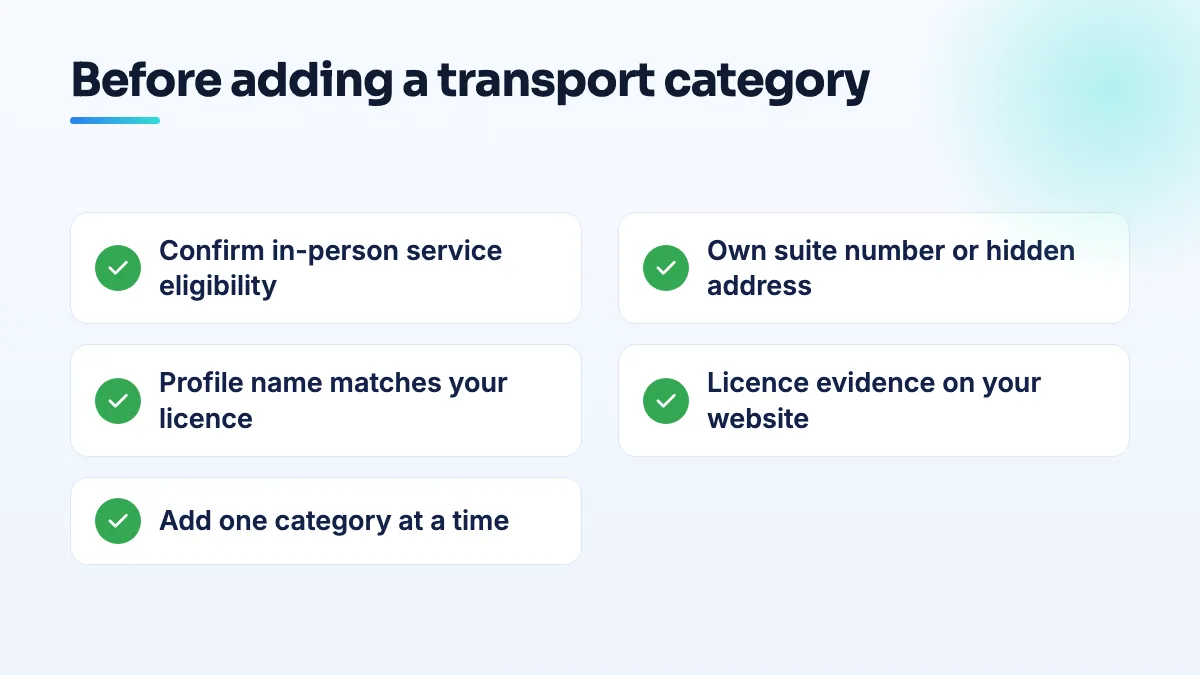
Before you add or change a transport category
This is the order I work in with limo and taxi clients. It takes a week or two of preparation for an edit that takes ten seconds, and it's worth it.
- Confirm you're eligible as the business you're listing. You need to meet customers in person with vehicles you operate or dispatch under your own license. If you're a pure booking broker, don't add operator categories. Talk to someone about whether a profile fits you at all.
- Fix the address before anything else. A staffed office needs its own suite or unit number and your name on the door. If customers never come to you, set it up as a service-area business with the address hidden and the service area kept to where you really drive.
- Make the name match your license. The profile name should be the name on your operator license and business registration, with no "airport", "cheap" or city names added.
- Put the evidence on your website first. Your license or permit numbers, the licensing authority, photos of your own vehicles with plates visible, and a page for each service you're about to add as a category: airport transfers, chauffeur hire, weddings.
- Screenshot the whole profile, then add one category and nothing else. No name, hours or description changes that day. If something goes wrong, you'll know exactly which edit caused it and you'll have a record of what the profile looked like before.
- Wait before the next edit. Let the change settle and the profile stay live for a couple of weeks before you add a second category. Stacking edits is how owners end up in the situations I describe in editing Google Business Profile suspended cases.
Which categories to choose
My advice is to pick the primary category that describes most of your revenue and add as few secondaries as you can defend with a page on your website and a line on your license.
| Your business | What I'd lean toward | What to have in place first |
|---|---|---|
| Limo company with its own fleet | Limousine service as primary, Chauffeur service only if you really run chauffeur hire | Operator license, fleet photos, chauffeur page |
| Licensed taxi or private-hire firm | Taxi service as primary | Local authority license and numbers on the website |
| Airport transfer operator | The category matching your license, with Airport shuttle service only if you run shared shuttles | Airport permits and a transfers page |
| Booking agent with no vehicles | Don't add operator categories | Get advice on eligibility before creating anything |
If your category was rejected or your profile suspended
- Stop editing. Don't try the category again, and don't try the next similar one. The taxi firm that tried five in a row ended up locked.
- Read the exact wording. A rejected category and a suspended profile are different problems. Screenshot the status with the date.
- Fix what the review would have found. Shared address, broker model, name mismatch. Appealing without fixing it wastes the appeal.
- Appeal once, with documents that answer the reason. Your operator license, business registration and insurance in the exact profile name, and photos of your vehicles at your base. I explain how to match evidence to the stated reason in Google Business Profile appeal evidence.
- If the appeal is denied, go to the Help Community. Post the category you added, the date, the exact message, your license authority and any case ID. Product Experts can't approve categories, but they can spot the problem you missed and escalate a clear mistake.
One more trap: if you run duplicate listings and one is suspended, forum members report that you can't merge them until the suspension is resolved. Sort out the suspended one first.
What not to do
- Don't add every transport category that fits a little. Each one is another reason for review and another thing to defend.
- Don't copy the keyword-stuffed names you see winning in big cities. They may rank for a while. They are also the easiest thing for a reviewer or a competitor to flag.
- Don't open a second listing to get the category you were refused. Duplicates are their own suspension reason and make the merge problem worse.
- Don't share an address with another operator without a separate suite number. Even if the other company is a friend.
Getting the profile right before the busy season
Prom, weddings and airport travel peaks are the worst time to discover a rejected category. Most of the limo work we do starts with exactly this audit, and it's the foundation of our limo company SEO. For taxi and fleet operators the same checks apply, and in transportation SEO I do them before any ranking work. If you want someone to set the categories up and handle a rejection, that's part of our Google Business Profile management.
Written by Saifur Rifat, Founder & SEO Lead at SERP Squad.