


Key points
- Organic ranks your pages; the pack ranks your profile
- Distance from the verified address limits the pack
- Primary category must match what customers search
- Review counts decide close pack contests
- Service area size doesn't change pack rankings
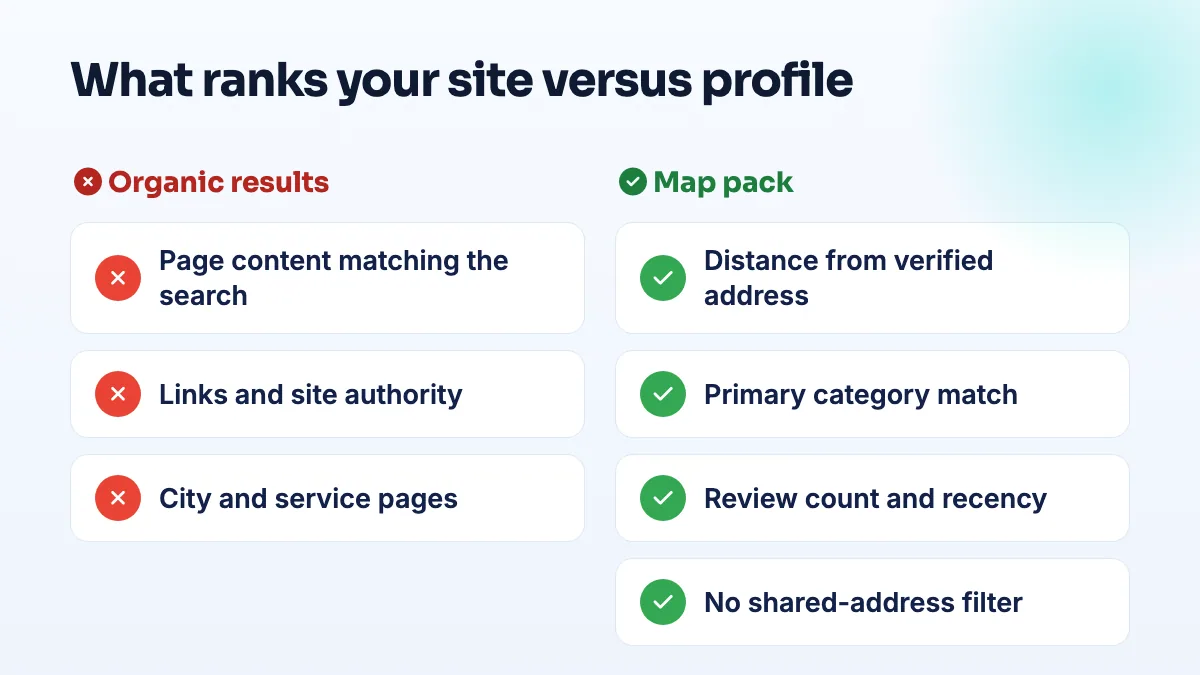
Your website sits on page one for the search that matters, yet the three businesses in the map above it are never you. A website ranks but not in the map pack because the two are ranked by different systems: organic results rank your web pages, while the pack ranks your Google Business Profile, and that leans heavily on where the profile is verified, its primary category and its reviews.
Limo operators have described this on Local Search Forum for years, and landscapers run into it constantly. Here's what's going on and what I'd fix first.
Why a website ranks but is not in the map pack
Organic rankings are about your pages: how well they answer the search, how the site is built and who links to it. A strong site can rank across a whole metro, even for towns you've never had an office in. The Google map pack ranks something else, your profile, and the profile is tied to a point on the map.
The way I explain it to clients: the pack weighs how relevant the profile is to the search, how close it is to the searcher, and how prominent the business is, with reviews a big part of that. A Local Search Forum admin put the location part bluntly in a Local Search Forum thread on a transport company serving two countries: "the service area has zero impact on where you rank. Ranking is based on the physical address that you use to verify the listing."
That explains most of the frustration. In a long-running forum thread from a limo company ranking organically but not in the pack and a second limo operator's thread about missing the local pack, the websites did their job. The profiles were what stayed out.
The usual causes, in the order I check them:
- Distance. Your verified address is outside or on the edge of the area you're searching from. A limo company based in the suburbs rarely shows for downtown searches, whatever its website does.
- Primary category. The profile's primary category doesn't match the search. If people search "lawn mowing" and your category and site say "landscaping design," you're relevant for the wrong thing. A lawn care owner on LawnSite who couldn't find their business on Google got exactly that answer: customers search lawn mowing, not the phrase the site ranked for.
- Reviews. Fewer and older reviews than the three businesses in the pack.
- A filter. Another business at the same address in the same category. In a Help Community thread about a limo company sharing an address, a Product Expert found another limo company at the same street address with no suite number, which Google doesn't usually accept.
- A hidden address. Service-area businesses hide their address as Google asks, and some agencies report that costs visibility. In a forum thread on whether service-area businesses are disadvantaged, one practitioner described close to a dozen cases that didn't show until the address was displayed. Only show it if customers genuinely visit you.
How to close the gap
- Measure the pack from where customers are. A single search from your desk tells you little. Check from several points across your area, or use a grid rank tracker, and note where you appear and where you don't. That map is your real target.
- Match the primary category to the money search. Look at the primary categories of the three businesses that do show, and pick the one that describes what customers are searching for. Put secondary services in secondary categories.
- Link the profile to the matching page. Point the profile's website link at the page that ranks organically for your main service, or your homepage if that's what ranks, and make sure that page shows the same name, address and phone as the profile.
- Close the review gap. Count the reviews of the pack businesses and ask every recent customer, every week, until you're level. Plain asking works better than incentives, and incentivized reviews break Google's rules anyway.
- Clear any filter. If another business shares your address and category, use a distinct suite number, phone and category, or fix whichever duplicate is yours.
- Accept the distance limit and use organic for the rest. If the pack you want is 30 miles from your verified address, it usually won't come. Keep ranking there with service and city pages, which is what your website is already good at.
Exceptions and edge cases
Keyword-stuffed competitors. In big cities, limo profiles with the search phrase in the business name can outrank real brands. Don't copy them. Report the names that don't match the real business.
Ranking without work. Being in the pack isn't the goal on its own. In a LawnSite thread from a landscaper ranking well but getting little work, the owner had rankings without enough work coming in. Check that you rank for the jobs you want, in the towns you serve.
Service areas. Adding more towns to your service area won't move the pack, as the admin quote above makes clear. I cover that in the answer on whether a service area affects Google ranking. And if the profile doesn't appear at all, even by name, that's a different problem: start with why a business is not showing on Google Maps.
For a limo or landscaping company, closing this gap is usually the first job in our limo SEO and lawn care SEO work, with the profile side handled through our Google Maps optimization and the website side through our local SEO services.
People also ask
Why are my customers' Google reviews not showing up?
Usually because Google is holding the review back, not because it was never written. A filtered review stays visible to the person who wrote it, so their screenshot doesn't prove it's public. New or empty accounts, sudden bursts of reviews and anything rewarded are the usual triggers. If nobody at all can leave a review, check your profile for a suspension, a verification request or a ratings restriction.
Read the full answer: Why are my customers' Google reviews not showing up? →
Can you offer a discount or gift card for a Google review?
No. Google's review policy doesn't allow money, discounts, gift cards, free services or other incentives in exchange for reviews, even if you never ask for five stars. It often doesn't work either: one lawn care operator gave gift cards to all 21 of their clients, spent $500 and got zero reviews. A plain request at the right moment, with a direct link, does better and stays inside the rules.
Read the full answer: Can you offer a discount or gift card for a Google review? →
Can editing my Google Business Profile get it suspended?
Yes. Changes to your name, address, primary category, service area and even opening hours can send a profile back through Google's review, and real businesses have been suspended within minutes of making them. Photos, posts and review replies are rarely a problem. Before a risky edit, make sure your website and directories already show the change, make one planned change per session, and never edit while verification or an appeal is pending.
Read the full answer: Can editing my Google Business Profile get it suspended? →
Is that Google Business Profile email or call a scam?
Usually yes, if you didn't ask for it. Unsolicited emails and calls warning that your listing will be removed, your site isn't compliant or your ranking is at risk are mostly sales pitches or scams. Real Google requests do exist, so don't judge by how the message looks: close it, sign in to your profile yourself, and act only on requests that appear there.
Read the full answer: Is that Google Business Profile email or call a scam? →
Are service area pages still safe after the August 2026 spam update?
Service area pages that give each town real, specific information are still safe. Pages that only swap the city name into the same text match Google's description of doorway pages and were at risk long before August 2026. Reports of pages dropping after the update are anecdotal and inconsistent, so audit each page: keep the ones with local substance, merge the thin ones into one service-area page, and cut pages for towns you don't serve.
Read the full answer: Are service area pages still safe after the August 2026 spam update? →