

A caller asks why your first clean costs ten times what they saw in an ad for a $19 cleaning. If you're wondering how to compete with Homeaglow and offers like it, the answer is not to match the price. Show your real price plainly, explain what it buys, and put your effort into customers and searches where a rock-bottom number isn't the first filter.
This hits residential cleaners hardest, and most of all the owner-operators and small teams who can't absorb a loss-leader. Below is what the $19 offer actually was, why it hurts even when nobody takes it, and the pricing and marketing setup I'd use against it.
What the $19 cleaning offer was
Truth in Advertising's article on Homeaglow's $19 cleanings examined the offer, set against an industry average of roughly $230 for a cleaning. Washington's Attorney General reached a consent decree with the company in May 2026. I'll leave the legal detail to those sources. What matters for your business is simpler: when an advertised price is around a tenth of the normal price of the job, it's not the price of a clean. It's the price of getting a customer's attention.
Why it hurts you even when customers don't buy it
The damage is to expectations. A homeowner who has seen "$19" calls you with that number in their head, and your honest quote sounds like a markup. The lead marketplaces make it worse. A software vendor's breakdown of Angi leads for maid services describes cleaning leads sold to four or five companies, users trained to collect several quotes and pick the lowest, and chances dropping by up to 80% if you're not the first to call.
So you're fighting on two fronts: a price anchor you didn't set, and platforms built to make price the deciding factor. Neither is a fight you win by going lower.
How to compete with Homeaglow-style offers without cutting your price
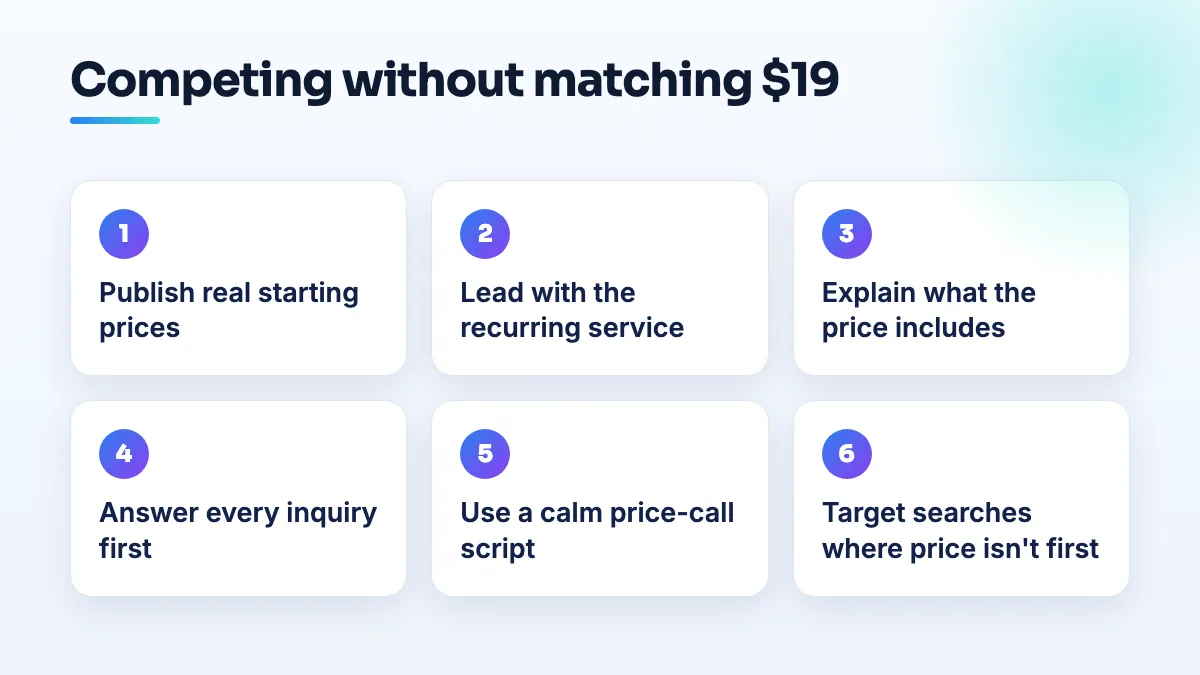
- Publish real starting prices on your website. Price by home size or number of bedrooms and bathrooms, with standard and deep cleans shown separately and add-ons listed. A customer who sees an honest range before calling is far less likely to be shocked by your quote. I cover the pros and cons of whether to put prices on your website in more detail, and for cleaners I think it's clearly worth it.
- Lead with the recurring service. Most of your profit is in weekly and every-other-week clients. Show the per-visit price for recurring cleaning first, and price the first deep clean as its own line so customers understand why it costs more.
- Say exactly what your price includes. Insurance, whether the same cleaner comes each time, whether you bring supplies, how long a visit takes, what happens if something is missed. Only list what's true for you. This is the list a discount offer can't match, and customers can't see it unless you write it down.
- Answer every inquiry first. On shared leads, the first company to call has a large advantage. Set up text-back on missed calls and reply to form inquiries within minutes during working hours.
- Use a calm script for the "$19" call. Something like: "That offer is a promotional price for getting you signed up. Our first clean for a home your size is usually in this range, it includes these things, and after that a regular clean is this much. I can send it to you in writing." No comments about the other company. Let the customer compare.
- Go after searches where price isn't the first filter. Move-out cleaning, post-construction cleaning, office and janitorial work, short-term rental turnovers, and recurring cleaning in the neighborhoods you already serve. Build a page for each service you actually offer, with its own pricing guidance and photos of real jobs.
Watch what paid leads really cost
Marketplaces and ads can still bring work, but price-driven leads have a ceiling. A carpet cleaner in an r/PPC thread about rising Local Services Ads costs saw leads go from $35 to $71 and concluded that $71 a lead wasn't worth it for a $175 job. Work out what a booked job is worth to you and what you can pay to get one, then compare that to what each platform actually delivers. I go through the arithmetic in cost per booked job on lead platforms.
What your profile and website should say
- Services with prices on your Google profile. List each service you offer and add starting prices where you can. It filters out customers who were only ever going to pay $19.
- Reviews that mention reliability. Ask regular clients for a review after their third or fourth visit, when they've seen that you turn up every time. That's the proof a new-customer promotion can't show.
- Plain descriptions, no keyword lists. Don't stuff "cheap", "affordable" and every town name into your description. A maid service with 92 five-star reviews lost its profile and its Local Services Ads campaign after a keyword-stuffed description, as described in a Help Community thread about a suspended maid service.
- A website that answers the price question. Pricing, what's included, service areas, and a booking or quote form that works on a phone. If yours can't do that, a small business website built around those pages is worth more than another month of shared leads.
The customers you'll lose, and why that's fine
Some people will only ever buy the cheapest clean. You won't win them, and trying costs you more than losing them. The customers worth having want the same reliable cleaner every other week for years. That's who your pricing page, your reviews and your script should speak to.
What not to do
- Don't match the $19. A national marketplace can fund a loss on the first clean. You can't, and it teaches your market that your price is negotiable.
- Don't run a bait price of your own. If you do run a promotion, make the conditions clear in the ad and honor it exactly. This offer ended up in front of a state attorney general.
- Don't criticize the competitor in replies or ads. Stick to what you include and what you charge.
- Don't buy every shared lead. If a platform's leads cost more than your margin on the job, stop.
- Don't hide your price until the walkthrough. In a market where customers have seen $19, silence reads as "expensive".
Questions cleaners ask
Should I offer a first-clean discount to compete?
A modest discount tied to signing up for recurring cleaning is fine, as long as the ad shows the real regular price next to it. What I'd avoid is a headline number that isn't what the customer will actually pay. It attracts the same price shoppers the marketplaces do, and they leave when the discount ends.
Should I be on the same marketplaces?
Only if the numbers work. Track every booked job from each platform for three months, divide what you paid by the jobs you kept, and compare it to your margin. If a platform can't produce regular clients at a cost you can live with, drop it and put the money into your own profile and website.
Does this affect commercial cleaning?
Much less. Offices and property managers rarely buy on a $19 headline. The harder problem there is visibility: a janitorial company in a Help Community thread about a janitorial profile invisible for commercial cleaning searches could be found by name but not for "commercial cleaning near me". A separate commercial services page, the right categories and reviews from business clients are where I'd start.
Where to start
Write your starting prices and your "what's included" list this week and put both on your website and your Google profile. If you want help with the pages, the profile and the searches that bring in regular clients, that's our cleaning business SEO work, part of our local SEO services.
Written by Saifur Rifat, Founder & SEO Lead at SERP Squad.