

You can rank first for a phrase and still get no calls, because the phrase is yours and not your customers'. To find the keywords customers use, a local business has to listen to how people describe the job, check what Google suggests and what already brings visitors, and then use those exact words in the profile, the categories and the pages.
This catches trades and services that name things the way the industry does: lawn care companies, fingerprinting and testing services, flooring firms and commercial cleaners. The words on the invoice aren't always the words in the search bar.
Below is why the gap happens, the method I use to close it, what changes by industry, and the mistakes that turn keyword research into a suspension risk.
Why you can rank and still get no calls
A lawn care owner on LawnSite found this out first hand. The business ranked for "lawn care" plus its town, and in a LawnSite thread about a lawn business not showing up on Google the problem was put plainly: "no one would search that they would search Lawn mowing." The ranking was real. It just wasn't for anything customers typed.
The gap runs the other way too. People buying fingerprinting often don't know what to call it. In a Reddit thread from people confused about live scan and FD-258 cards, applicants tried to work out which service they actually needed. The terms in play are "live scan", the FD-258 card and ink fingerprint cards, and each buyer searches whichever one they were told to get. A business that only says "fingerprinting services" misses most of them.
And sometimes the business simply isn't described as what customers want. A flooring company in a Help Community thread about a flooring firm missing for installer searches didn't appear for "flooring installers" at all. A janitorial company in a thread about a verified cleaning profile invisible for commercial cleaning could be found by name but not for "commercial cleaning near me", and the only reply it got was to post more often. Posting wasn't the problem. The profile didn't say the words.
How to find the keywords customers use for your local business
None of this needs paid software. It needs a notebook and an afternoon.
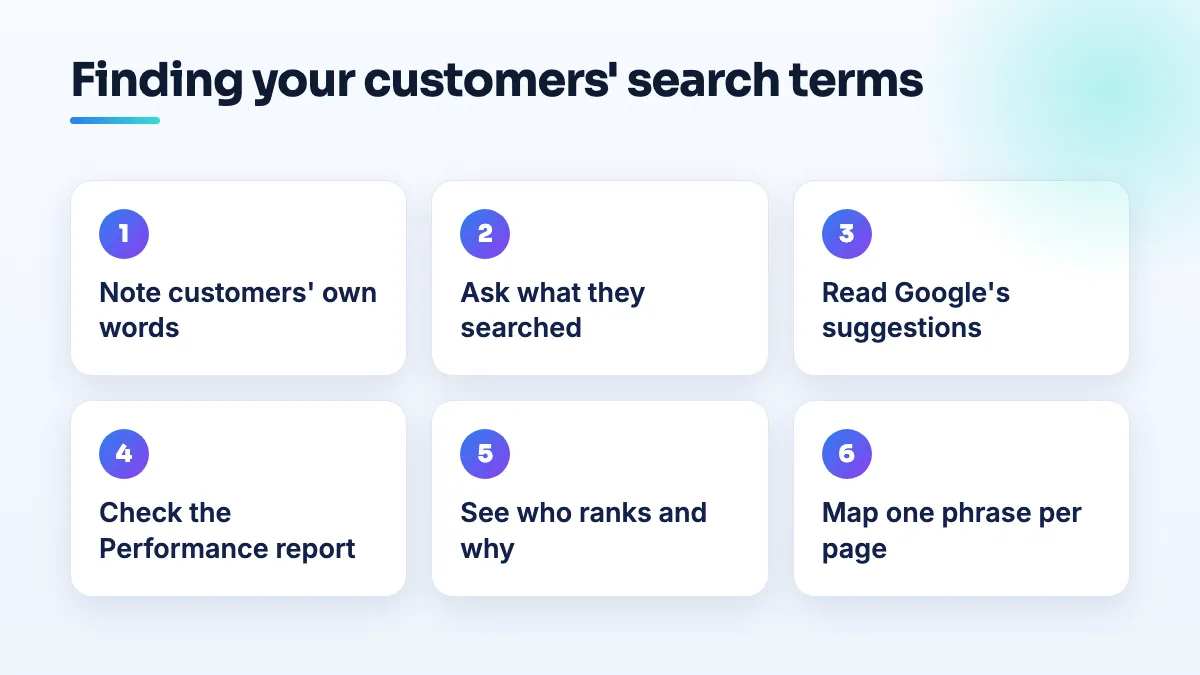
- Write down the words customers use with you. For two weeks, note the exact phrase every caller, email and quote form uses to describe the job. Read your reviews too. Customers describe the work in their own words there, and that's the vocabulary you want.
- Ask new customers what they searched. Add one question to your booking call: "What did you type into Google to find us?" Write the answer down word for word.
- Type your service into Google like a customer. On your phone, type the start of the service and read the suggestions that appear. Then search it and read "People also ask" and the related searches at the bottom. Each one is a phrase real people use often enough for Google to suggest it.
- Read your Business Profile's Performance report. It lists the searches that showed your profile. A fencing contractor in a Help Community thread about a reinstated profile ranking in the wrong towns used exactly this report to see that Google was showing him for searches 30+ miles away. It tells you what Google thinks you are.
- Check Search Console if you have a website. The queries report shows what people typed before they saw or clicked your pages. Look for phrases with lots of impressions and few clicks: those are the terms you nearly rank for.
- Check who ranks for each phrase. Search each candidate phrase and look at the top three map results. Note the primary category shown under each name. A Local Search Forum thread on choosing a primary category among many options gave the same advice: see which category wins for each search you care about.
- Put each phrase where it does its job. The main term goes in your primary category choice, your services list and the title of the page for that service. Close variants go in the page text and FAQs. One service, one page, one main phrase.
Where your words and customers' words split
These are the gaps that show up in the research I did for these industries. Use the right-hand column as terms to test with the steps above, not as a final list.
| What the business says | What customers type | Where to fix it |
|---|---|---|
| Lawn care | Lawn mowing | Services list, homepage title, a mowing page |
| Fingerprinting services | Live scan, FD-258, ink fingerprint cards | One page per term, services list |
| Flooring store | Flooring installers | Categories, services, an installation page |
| Janitorial | Commercial cleaning near me | Categories, services, a commercial cleaning page |
What changes for your industry
Landscaping and lawn care
The words you rank for decide who calls. Mowing searches bring recurring residential work. Design and hardscape searches bring bigger, rarer jobs. One LawnSite member said half his calls were price shoppers and only a quarter were genuinely interested in design and build, which is why I'd keep mowing and design on separate pages and decide which one the homepage leads with. That split is where most landscaping SEO work I do starts.
Fingerprinting and lab testing
Here the customer often has the term handed to them by an employer, a licensing board or an immigration form, and searches for that exact term. Build a page for each: live scan, FD-258 card printing, ink cards, and for drug testing, the specific test types employers ask for. Mobile operators in this space often default to cold outreach to schools and employers instead of search, which leaves the searches to whoever bothered. You can read what we did for a Miami fingerprinting business in our fingerprinting case study, and the approach is the base of our fingerprinting SEO work.
Flooring
Flooring firms are usually a showroom, an installer or both, and customers search those differently. "Flooring store" and "flooring installers" are different searches with different winners. If you install, say so in your categories and services, and give installation its own page with real projects. That identity question comes first in any flooring contractor SEO project.
Cleaning
Residential and commercial buyers use different words and want different proof. A house cleaning profile that also does offices should list commercial cleaning and janitorial work as services and have a page for them. Be careful with the description, though. A Miami maid service with 92 five-star reviews was suspended over a keyword-stuffed description, and it lost its Local Services Ads campaign with it. Customer words belong in sentences, not lists.
What not to do with the words you find
- Don't put keywords in your business name. Your name is your registered name. Adding "lawn mowing" or "live scan" to it is a guideline breach and the first thing reviewers check.
- Don't stuff the description. Write it for a person. Mention your main services once each in plain sentences.
- Don't build near-identical pages for every synonym. A photographer on the Local Search Forum found maternity, newborn and family pages competing against each other. If two phrases mean the same job, they belong on one page.
- Don't chase volume over fit. A phrase with fewer searches that matches the job you want beats a big phrase that brings price shoppers.
- Don't change your primary category on a hunch. Category edits can send a profile back for review. Pick it once, from the competitor check, and leave it. If nothing fits, read my answer on picking the closest category Google offers.
Turning the list into pages
Once you have the words, the work is writing pages and profile content around them without sounding like a keyword list. Our service page writing starts from exactly this kind of customer vocabulary, and it sits inside our wider local SEO services. If you'd rather run the rest yourself, work through the local SEO checklist next.
Written by Saifur Rifat, Founder & SEO Lead at SERP Squad.