

Is Xometry worth it for a machine shop? For filling idle spindle time at a margin you've actually measured, it can be. As the main source of work, I don't think it is, because the marketplace sets the price, owns the customer and now also owns a major industrial directory you'd use to find customers of your own.
Machinists have been arguing about this for years. The Practical Machinist thread asking who is doing Xometry work runs to more than 26 pages, and a common complaint in it is jobs that pay barely above material cost. Below is how I'd judge marketplace work on real numbers, what changed with Thomasnet, and what to build so you quote there because you want to, not because you have to.
Why marketplace jobs pay so little
A marketplace sits between you and the buyer. It takes the RFQ, sets or strongly shapes the price, and keeps a cut. Machinists on Practical Machinist discussed Xometry's take growing to 39 percent in a quarter, and the reaction was what you'd expect: the more the platform keeps, the less is left for the shop cutting the chips.
That shows up in the pay. Shops in the long thread describe parts where the price barely covers the stock, before machine time, setup, finishing, inspection and packing. Other RFQ portals have the same problem from a different direction: a Practical Machinist thread on the good, bad and ugly of MFG.com describes quoting hours burned on jobs that go to overseas lowballers.
None of that means every marketplace job loses money. It means you can't tell from the job price alone. You have to measure.
Thomasnet now belongs to Xometry
The alternative many shops reached for was a paid directory. That changed when, as covered in a Practical Machinist thread on Xometry buying Thomasnet, Thomasnet ended up owned by Xometry. A listing budget spent there now funds the same company you're trying to depend on less.
Paid directory listings had a mixed record before that. In a Practical Machinist discussion of what Thomasnet listings deliver, one owner called roughly $6,000 spent on a listing a waste, and in other threads generalist shops said their listings were buried. I'd only pay for a directory if you can track RFQs from it and the listing is specific to what you do.
Is Xometry worth it for your shop? How to decide
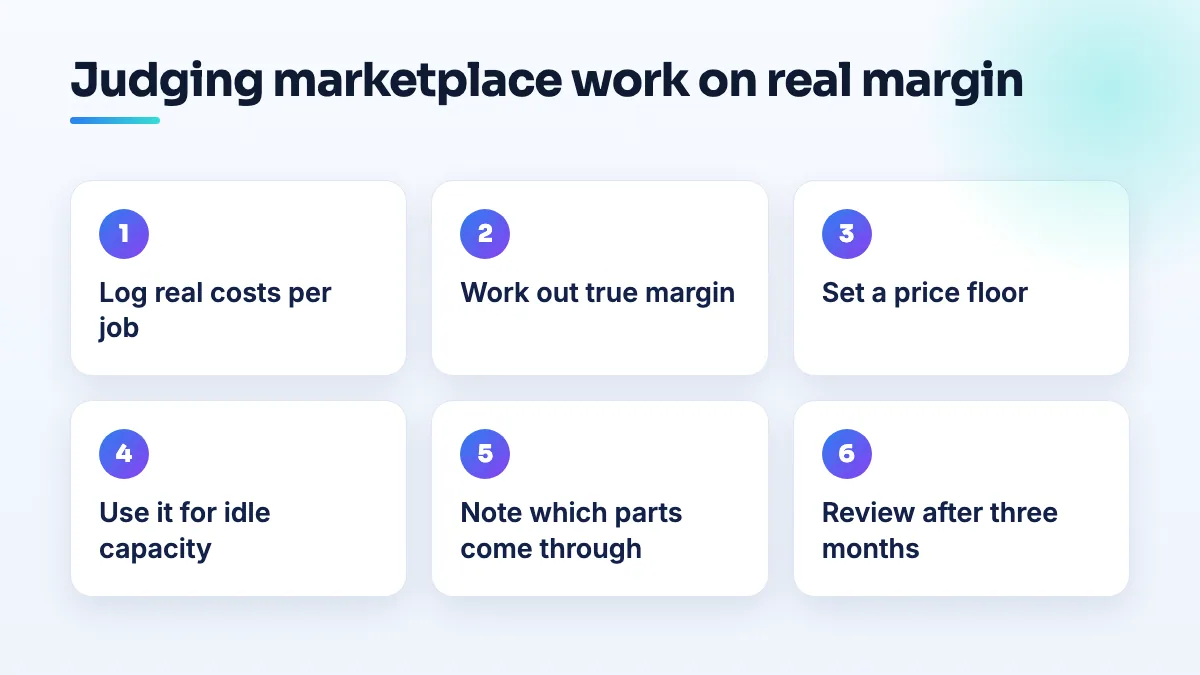
Treat marketplace jobs like any other customer and measure them. This is the process I'd run for one quarter.
- Log every marketplace job with its real costs. Price paid, material, programming and setup time, run time at your shop rate, secondary operations, inspection, packing and shipping, and the time spent quoting jobs you didn't win. A spreadsheet is fine.
- Work out the true margin per job. Price minus everything above. Compare it with what the same machine hours earn on your direct work. That comparison is the answer to whether it's worth it, not the job price.
- Set a floor and stick to it. Decide the lowest effective hourly rate you'll accept. Don't accept jobs below it, however quiet the week looks.
- Use the marketplace for gaps, not for your base load. Marketplace work makes the most sense when a machine would otherwise sit idle. If it's pushing out direct customers or keeping you in on Saturdays, it's costing you.
- Write down what kinds of parts come through. Materials, tolerances, quantities, industries. Where you consistently win and make money is a sign of what direct buyers would search for, and it becomes your list of capability pages.
- Review after three months. If the marketplace is under your floor on average, cut it back. If it's above, keep it for gaps and put the saved quoting time into building direct channels.
Marketplace work compared with direct customers
| Marketplace | Direct customer | |
|---|---|---|
| Who sets the price | Largely the platform | You, through your quote |
| Who owns the relationship | The platform | You |
| Repeat orders | Go back through the platform | Come to you |
| Cost of getting the job | The platform's cut | Your quoting time and marketing |
| Best use | Idle capacity, learning what sells | Base load and long-term accounts |
The direct column is harder to build. That's the honest trade-off. But every direct customer you win is one whose next order doesn't pay anyone a cut.
What to build so you depend on marketplaces less
Owners in a Practical Machinist thread asking whether industrial marketplaces are worth the time keep coming back to the same doubt. Underneath it is a problem I see in most shops: no channel of their own apart from referrals. Here's what I'd build first.
- Capability pages. One page per process, material or type of work you want more of, written the way engineers search: material, tolerance, finish, quantity. I set out how to write each machine shop capability page in a separate guide.
- A Google Maps listing that's set up properly. Even in a Practical Machinist thread doubting search for job shops, the Maps listing came up as something that genuinely brings calls. Local buyers still want a shop they can drive to.
- A website that lets a buyer send a drawing. Clear capabilities, equipment, who to contact, and an RFQ form that accepts files.
- Follow-up with every past customer. Referrals are real, but they're not a plan you control. I cover the rest of fabrication shop marketing beyond referrals separately.
Be wary of anyone selling a shortcut. In a Reddit thread from machinists asking whether MFG.com is worth it, quoting platforms are pitched to manufacturers and agencies show up in the replies selling their own services. Ask any vendor how you'd measure the result before you pay.
Questions shop owners ask
Should I quit Xometry completely?
Not until you have direct work to replace it. Measure first. If a quarter of honest numbers says the work is under your floor, cut it back gradually as direct RFQs come in.
Is Thomasnet still worth a listing?
Only if you can track the RFQs it sends and the listing is specific enough that you're not one generalist among many. Knowing who owns it now, I'd put that money into pages on my own site first.
Are the other quoting platforms any different?
The model is the same: someone else runs the RFQ and the relationship, and you compete on price with every shop on the platform, including overseas ones. Measure them the same way, with quoting time counted as a cost. Quoting time is the cost shops forget most often, and on a platform where you win a small share of what you quote, it adds up fast.
How long does it take to build direct channels?
Months, not weeks, and I won't pretend otherwise. That's why I'd keep marketplace work for gaps while the direct side grows, instead of dropping one before the other exists.
The short version
Marketplace work is a tool for filling capacity, measured on true margin, not a business plan. The shops that do well long term are the ones buyers can find and contact directly. That's what our machine shop SEO work builds, and for shops selling to engineers and buyers across the country it's part of our B2B SEO.
Written by Saifur Rifat, Founder & SEO Lead at SERP Squad.