

An industrial buyer looks at your machine shop website before sending a drawing, and a dated or empty site costs you the chance to quote. Once they're through, a vague "contact us" form fills your inbox with requests that were never going to become orders. The fix is a site that answers a buyer's credibility questions in a minute, and an RFQ form that asks enough to sort serious requests from the rest.
Machinists have argued about both for years on Practical Machinist. In a Practical Machinist thread asking whether a job shop needs a website, the view was that a site might not win much work directly, but having none costs credibility. In a Practical Machinist thread about RFQ websites, owners describe hours spent quoting tire-kickers who never award anything.
Here's what buyers check, the form I'd put on every page, and how to handle the quotes you shouldn't be sending.
What buyers check on a machine shop website
An engineer or purchasing manager isn't reading your history page. They're answering four questions, fast:
- Is this a real, current shop? A physical address, photos of your actual floor and machines, recent work, and a copyright date that isn't from another decade. A site that looks abandoned makes a buyer wonder if the shop is too.
- Can they make my part? Specific capabilities: processes, materials, tolerances you hold, part size range and quantities. "Precision machining for all industries" answers nothing.
- Can I trust their quality? Your inspection equipment, your quality system and any certifications with their scope. If you're not certified, say how you inspect and document parts.
- Who do I talk to, and how do I send a drawing? A named contact, a direct phone number and a form that accepts files. Buyers want a person, not a general inbox.
Answering the second question well is the biggest job, and it's what capability pages are for. I explain how to plan each CNC capability page separately.
The credibility checklist for your homepage
Go through your current homepage against this list. Anything missing goes on the fix list.
- Say what you do and where in one sentence at the top. The main processes, the materials you're known for and your city. No slogans.
- Replace stock photos with your own. The floor, the machines, the inspection room, finished parts. Take them on a clean day with good light. Blur anything a customer wouldn't want shown.
- Add an equipment list. Make, model, axes and travel for the machines that matter. Buyers use it to judge whether you can hold their part.
- Show your quality setup. Inspection equipment, how you document first articles, and certifications with scope and expiry if you have them.
- Name the people. The owner and whoever handles quotes, with a direct phone number and email.
- Put the RFQ form on every page. Not only on a contact page three clicks deep.
- Check it on a phone. Buyers look you up between meetings. If the equipment table breaks or the form won't upload a file on a phone, fix that first.
An RFQ form that filters tire-kickers
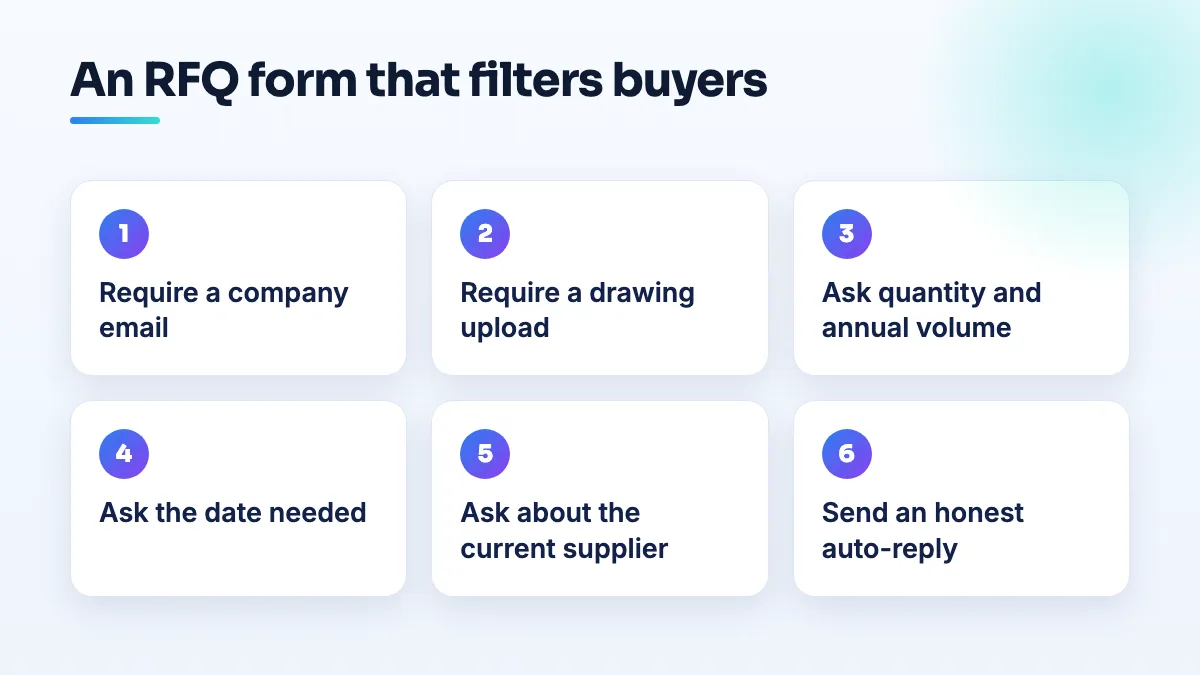
Every question on a form is a small cost for the buyer. A serious buyer with a real part will answer them, because they've got the information in front of them. Someone fishing for a number to wave at their current supplier usually won't. That's the filter. Here are the fields I'd use.
- Require a company name and a work email. A company buyer has both. You can still accept personal emails; just sort those to the back of the queue.
- Require a drawing upload. STEP, PDF or both. No drawing, no quote. Offer to sign an NDA before they send it, and say so right next to the upload.
- Ask for quantity and expected annual volume. One prototype and 5,000 a year are different jobs. Buyers with a real program know the number.
- Ask for the date they need parts. A real date tells you the job exists. "ASAP" with no date is worth a follow-up question before you quote.
- Ask whether the part is new or currently made by another supplier. An honest question, asked plainly. It tells you whether you're being asked to win work or to provide a comparison price.
- Send an honest auto-reply. Say when they'll hear back, who will call, and what you'll need if anything's missing. It sets expectations and makes you look organized.
When a buyer is using your quote as a bargaining chip
Some quote requests aren't meant to be awarded. In a Practical Machinist thread on explaining a no-quote to customers, owners describe buyers who use a fresh quote to push their existing supplier's price down. You do the work; the incumbent keeps the job.
You can't stop that completely, but you can make it cheaper for yourself:
- Use the "current supplier" answer. If the part is already made elsewhere and the buyer has never ordered from you, quote it, but don't put your best estimator on it first.
- Keep a simple record of who awards. A spreadsheet of company, quotes sent and orders won. After a year you'll know who only ever asks.
- Politely no-quote the repeat askers. A short, courteous note that you're at capacity for that kind of work is enough. You don't owe a long explanation.
- Ask a question before quoting. "What's driving the change of supplier?" A buyer with a real reason will tell you. That answer often tells you how to win the job.
What's different for machine shops and fab shops
A CNC buyer is usually judging precision, so the equipment list, inspection and tolerance statements carry the most weight. For SEO for machine shops, those pages are where search visibility and credibility come from at once.
A fabrication buyer is more often judging size, capacity and logistics: crane capacity, largest weldment, whether you install, how far you deliver. Put those limits on the homepage and the form, and add a field for installed or delivered, because it changes the whole quote. It's the part of fabrication shop SEO most sites leave out.
Reviews and B2B shops
Some B2B shops avoid public reviews altogether. In a Practical Machinist thread about staying B2B or taking public work, an owner weighed retail work partly out of fear of public Google reviews. I understand the worry, but a shop with a handful of reviews from real business customers looks more established than one with none. I cover how to ask for machine shop Google reviews without it being awkward.
What not to do
- Don't hide the address. Buyers want to know they could visit. A shop without an address looks like a broker.
- Don't ask twenty questions. The six above are enough. More fields and serious buyers give up too.
- Don't publish a price calculator for custom parts. It attracts exactly the price-shoppers you're trying to filter.
- Don't let the site go stale. Put a date in the calendar twice a year to update photos, equipment and recent work.
Where to start
Add the RFQ form fields this week; that's the quickest win and it starts saving quoting time straight away. Then work through the credibility checklist. If the site needs rebuilding rather than patching, that's our website design work, and making it findable by engineers and buyers is our B2B SEO.
Written by Saifur Rifat, Founder & SEO Lead at SERP Squad.