


Key points
- Trade prices live behind a login, never public
- Public prices leave room for resellers' markup
- Vet who counts as trade before approving
- Offer blind shipping and unbranded packaging
- Send resellers' clients back to the reseller
The worry is real: if your public website shows prices lower than what a reseller charges their own client, you've just competed with the customer who buys from you. You can run trade only pricing for a print shop and a public site at the same time, but only if the two price lists never meet.
Why a public price list can cost you trade customers
Printers and sign makers who sell wholesale have been arguing about this for years. In a Signs101 thread about VistaPrint and wholesale pricing, owners describe trade-only pricing as the only real defense against competing with your own customers. If a sign shop buys your printed banners and resells them, and their client can find your website selling the same banner for less, you lose the sign shop.
It's also why many printers don't publish prices at all. In an r/CommercialPrinting discussion about quoting, shops describe pricing so complex that they build their own estimators rather than publish a list. That's a fine choice, but it doesn't solve the trade problem on its own. Resellers still need fast, predictable prices, and they'll go to a wholesaler who gives them one.
How to set up trade only pricing for a print shop
This is the setup I'd use for any printer or sign shop that sells to both end customers and resellers. It works whether you publish full prices or only a quote form.
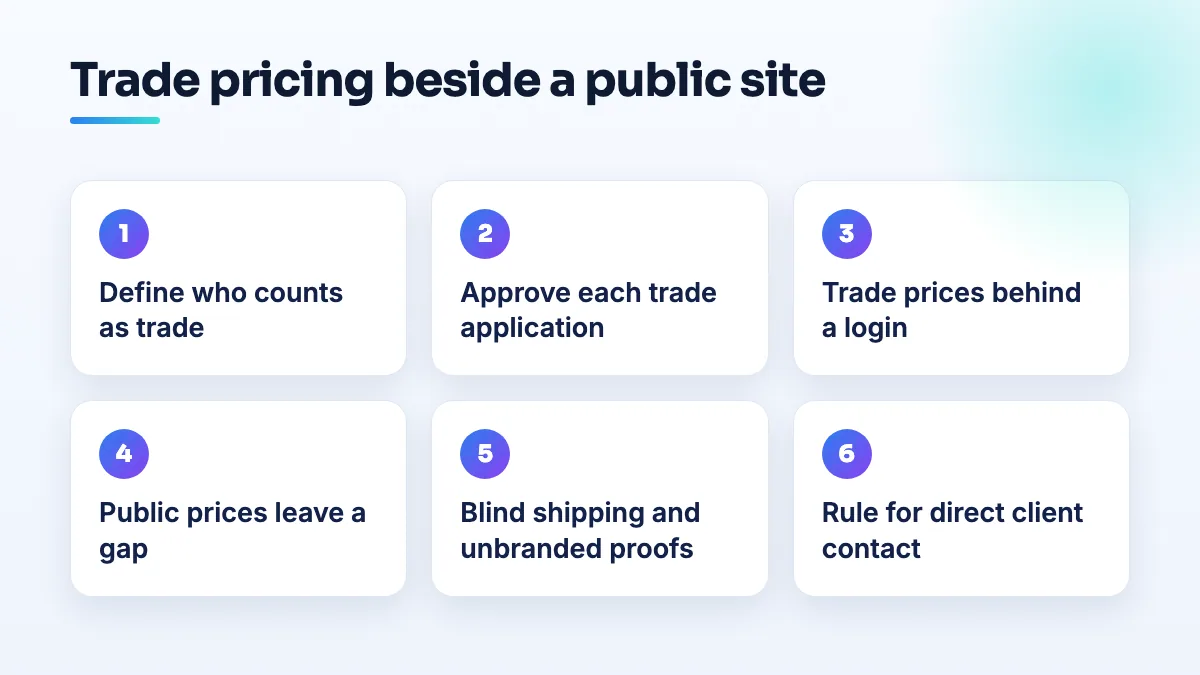
- Write down who counts as trade. Sign shops, print brokers, designers and agencies who resell print, promotional product distributors. Decide what they have to show you: a business website, a resale certificate or tax registration where your state or province uses one, or a history of orders.
- Put an application form on the public site. A short "Trade accounts" page explains who it's for and what they get, then collects the business name, website and contact. Approve each one by hand. It takes a minute and stops end customers signing up for trade prices.
- Keep trade prices behind a login. I'd never put them on a public page, a PDF linked from the site or a page that's only "hidden" from the menu. Anything reachable without logging in can be found, shared or indexed.
- Set public prices with a gap for resellers. Whatever you show publicly, as a full price list or "starting at" prices, should sit comfortably above your trade price, so a reseller can buy from you, add their margin and still not look expensive next to your own site.
- Offer blind shipping and unbranded packaging. Ship to the reseller's client with no invoice, logo or price inside, and send proofs without your branding. This is what lets a reseller put their name on your work.
- Write a rule for when a reseller's client contacts you. If a client who came through a reseller calls you directly, send them back to the reseller or quote them at your public price. Tell resellers you do this. In my experience it's the promise that makes them trust you with their clients' contact details.
What's different for print shops and sign shops
For a commercial printer, most trade buyers are designers, agencies and brokers. They care about gated prices, blind shipping and a proofing process they can show their client. The trade page is really the same page you'd build to win designers, which I cover in the post on becoming a trade printer for designers.
For a sign shop, the trade side is often other sign shops buying fabrication: channel letters, cabinets, large-format prints or install services. They're direct competitors in the retail market and customers in the trade one, which makes the direct-contact rule in step six even more important. I'd also keep a sign shop's trade catalog focused on what you actually fabricate for others, not everything you sell retail. It's a detail I check early in SEO for sign shops.
The edge cases
- If you only sell to the trade, say so clearly on the public site and don't show any prices without a login. End customers who find you can be pointed to your reseller list.
- If you mostly sell retail and do a little trade, a simple trade discount off your public prices, applied at login, is easier to manage than a separate price list.
- If your pricing is too complex to publish, keep a quote form on the public site and give trade accounts faster quotes or an estimator only they can use.
- If an online wholesaler already sells the same product to your resellers, compete on what they can't do: proofing, local pickup, rush jobs and a person who answers.
Setting this up is mostly a website job: a public catalog, a trade login and an application form that go together. That's the kind of small business website build we do for printers, and it's usually part of the groundwork in print shop SEO too.
People also ask
How do you ask a B2B buyer for a Google review?
Ask one named person who saw the job go well, such as the engineer whose first article passed or the manager who watched your sign go up, within a day or two of the job. Ask in person first, then send a short email with your direct review link. Tell them they don't need to mention part numbers or their company, and never offer anything in return.
Read the full answer: How do you ask a B2B buyer for a Google review? →
Should a print shop build a web-to-print storefront?
Only if you already have repeat customers ordering fixed-spec products. A web-to-print storefront works best as a private portal where existing business clients reorder cards, forms and branded items at agreed prices. As a public shop it puts you up against online printers on price, adds a platform bill and brings file-prep disputes walk-in orders never had. Most commercial printers get more from strong product pages and a quote form that takes files.
Read the full answer: Should a print shop build a web-to-print storefront? →
Should a local service business publish its prices online?
Yes, for most local service businesses. Publish fixed prices for fixed-scope jobs, a starting price or range for jobs that vary, and a quick estimator or quote form for custom work. Searchers who type "how much" want a number before they call, and pages that show one win the click. Add a date and a line that the final price is confirmed after inspection.
Read the full answer: Should a local service business publish its prices online? →
Do you need a website if your clients book through Instagram or Booksy?
Yes, if you want to keep the clients you've built. Instagram, Facebook and Booksy are rented space: an account can be banned, reach can collapse and the marketplace shows your clients other shops. A simple website you own gives Google and new clients a stable place to find you, and it holds your booking link, services and prices whatever happens to the platforms.
Read the full answer: Do you need a website if your clients book through Instagram or Booksy? →
Is that Google Business Profile email or call a scam?
Usually yes, if you didn't ask for it. Unsolicited emails and calls warning that your listing will be removed, your site isn't compliant or your ranking is at risk are mostly sales pitches or scams. Real Google requests do exist, so don't judge by how the message looks: close it, sign in to your profile yourself, and act only on requests that appear there.
Read the full answer: Is that Google Business Profile email or call a scam? →