


Key points
- Ratings are allowed only when the rule's conditions are met
- Disclose the date, the period covered and who made it
- Say so if you paid to obtain or use it
- Awards never belong in your Google profile name
- Performance pages need net figures and set time periods
Yes, you can show a rating or a top advisor badge, but under the SEC Marketing Rule it only belongs in your advertising if the rating meets a fairness condition and carries three disclosures. The financial advisor third-party ratings rule is short, and most badges I see on advisor homepages miss it the same way: a logo with no date, no source line and no word about the fee.
Here's what the rule asks for, how I check a badge before it goes on a site, and the performance claims that usually sit right next to it.
What the financial advisor third-party ratings rule requires
The SEC's own summary is blunt. In the SEC press release adopting the Marketing Rule, the Commission says the rule "prohibits the use of third-party ratings in an advertisement, unless the adviser provides disclosures and satisfies certain criteria." A third-party rating here means a rating or ranking of your firm from someone who isn't related to you and who produces ratings as a normal part of their business. That covers the "Top Advisor" lists, the five star award programs and most of the magazine rankings advisors are invited into.
In the rule text, the conditions come down to four things:
- A fair survey. If the rating came from a questionnaire or survey, you need a reasonable basis to believe it made it just as easy to give an unfavorable answer as a favorable one, and that it wasn't built to produce a set result.
- The date. When the rating was given and the period of time it was based on.
- The source. The name of the third party that created and tabulated the rating.
- The money. If you paid anything, directly or indirectly, in connection with getting or using the rating, you say so.
The disclosures have to be clear and prominent, either made by you or on the rating itself where you reasonably believe it's shown. This isn't new. The SEC's Marketing Rule FAQ page dates the amended rule to May 4, 2021, with compliance required from November 4, 2022.
How to check a badge before it goes on your website
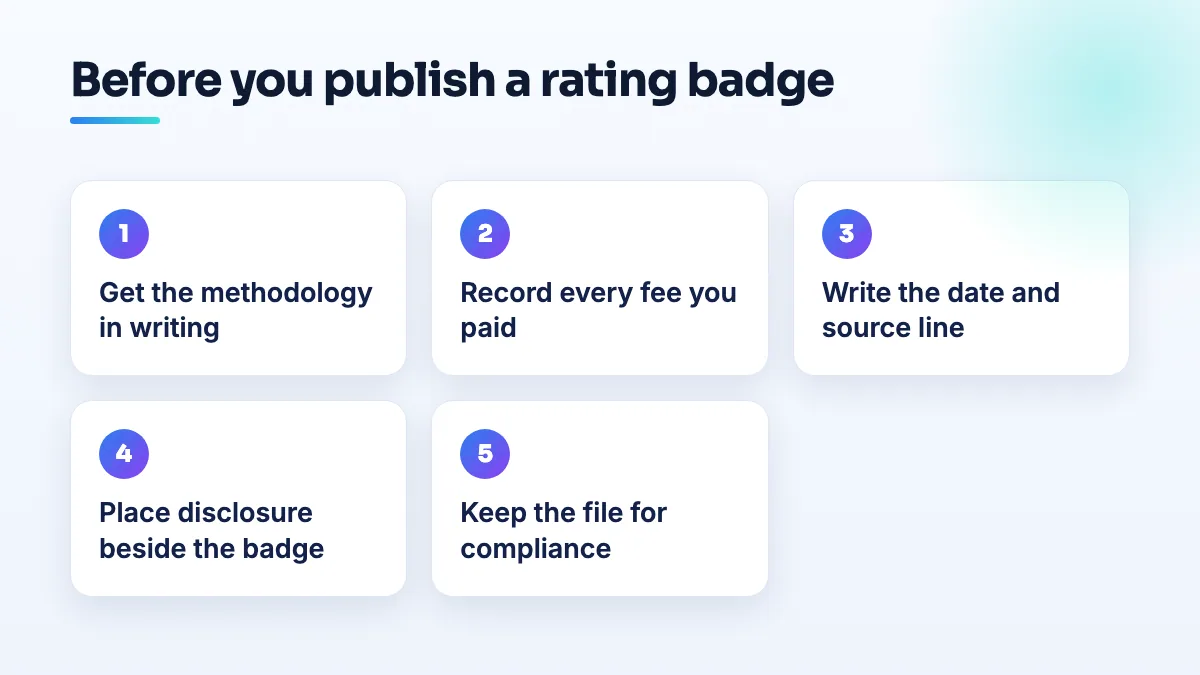
- Get the methodology in writing. Ask the award program how nominees were found, what they or their clients were asked, and how the answers were scored. If they won't tell you, I wouldn't use the badge, because you can't form the reasonable belief the rule asks for without it.
- Add up everything you paid. Nomination fees, the plaque, a logo license, a listing upgrade, an advertising package bundled with the award. My advice is to treat any payment tied to the award or to showing it as compensation you disclose.
- Write the disclosure in one sentence. Something like: "[Award name], awarded [month and year], based on [the period reviewed]. Created by [company]. [Firm] paid a fee to [what the fee was for]." Fill in the brackets from the award letter and your invoice, not from memory.
- Put it right next to the badge. Under the logo, in readable text, on every page and profile where the badge appears. A footnote three clicks away is not what I'd call prominent.
- Date it, retire it, and keep the file. Take down badges once they're stale rather than letting an old year look current. Keep the methodology, the invoice and a screenshot of the page as published, and send the whole package to compliance before it goes live.
If you're registered through a broker-dealer, the badge is also a retail communication that needs principal sign-off, which is why I build it into the FINRA 2210 content approval schedule rather than adding it on the side.
Why an award never goes in your Google Business Profile name
Google's guidelines for representing your business name financial planners as individual practitioners and allow a title or degree certification in the name, such as CFA. An award isn't a certification. "Top Advisor" or "Five Star" added to a profile name is the kind of extra wording Google's naming rules are written to catch, and it would put the rating in front of the public with none of the SEC disclosures attached. If you want to show the award on the profile at all, a photo of the plaque with the disclosure in the caption or post text is the honest version, and it still goes through compliance.
The performance page next to the badge
Ratings and performance usually share a page, and the SEC summary sets tighter limits on performance than on badges:
- No gross performance unless net performance is shown alongside it.
- Prescribed time periods in most cases (one, five and ten years).
- Nothing that implies the Commission approved or reviewed your calculation.
- Related performance has to include all portfolios with substantially similar strategies, not the best ones.
My honest view: if your website doesn't need a performance page to win clients, don't publish one. Most people searching for a local advisor want to know who you are, how you're paid and whether you work with people like them. A badge with a proper disclosure and a clear fee page does more for them than a returns chart.
Edge cases worth checking
- Your Google star rating. Client reviews you show or promote are testimonials under the rule, and they come with their own conditions. I cover those in the guide to SEC Marketing Rule testimonials.
- A rating shown in a press mention. If you share an article that names you on a list, I treat that as putting the rating in your advertising, so it gets the same disclosure.
- Old awards on social profiles. The badge in your LinkedIn banner or email signature is easy to forget. Check them when you update the website.
Getting this right is part of the site work in our financial advisor SEO projects, and if your homepage is due for a rebuild, the disclosures go into the website design from the start instead of being squeezed under the logo later.
People also ask
Can you use a coworking space or virtual office for Google Business Profile?
Only with your own dedicated office there. Google allows a coworking address only if the office has clear signage, receives customers during business hours, and is staffed during those hours by your own staff, not the operator's reception. A virtual office, mailbox, hot desk or day pass doesn't qualify, and profiles listed at them are regularly suspended.
Read the full answer: Can you use a coworking space or virtual office for Google Business Profile? →
Why does only one practitioner at our office show up on Google Maps?
Because Google's local filter usually shows only one of several listings that share an address and a category. It isn't a penalty, and the other listings still exist; they're hidden for that search. Agents, advisors, lawyers and instructors at one office trip it most. Different primary categories, direct phone numbers, genuine suite numbers and each listing's own reviews reduce it.
Read the full answer: Why does only one practitioner at our office show up on Google Maps? →
Should each practitioner in a practice have their own Google Business Profile?
Only the practitioners people search for by name, and only if each is public-facing and reachable at the practice during set hours. Google allows individual profiles for doctors, dentists, lawyers, financial planners and agents, but listings at one address are often filtered, and each needs its own reviews. Give listings to key practitioners, make each distinct with its own category and phone, and keep everyone else on the practice listing.
How should a doctor, lawyer or advisor name their Google Business Profile?
It depends on whether you're the only public-facing practitioner at that location. If you are, Google allows your brand followed by your name, as in its own example "Allstate: Joe Miller". If several practitioners share the office, the title should be only your name, without the firm's name. You can add a title or degree such as Dr., MD, JD, Esq. or CFA, and the name should match your license records.
Read the full answer: How should a doctor, lawyer or advisor name their Google Business Profile? →
Why was my second office flagged as a duplicate or suspended?
Because Google can't see enough that makes the second office different from the first. A lease and a sign prove the office exists, but a listing that shares the main office's phone number, web page and hours, or that isn't staffed during the hours it lists, looks like the same business listed twice. Give it its own staff hours, local number and location page.
Read the full answer: Why was my second office flagged as a duplicate or suspended? →