

For years most advisors were told testimonials were off limits, so their websites have no client voices at all. That changed. SEC marketing rule testimonials are allowed, as long as each one carries the right disclosures about whether the person is a client and whether they were paid, and the firm oversees how they're used. If you're also connected to a broker-dealer, FINRA adds its own disclosures on top.
Below is what each rule actually says, how I'd put testimonials and Google reviews on an advisor's site so they pass compliance review, and what to stay away from. I'm not a lawyer or a compliance officer, so treat this as the marketing side of the job and let your compliance team sign off the final wording.
What the SEC marketing rule says about testimonials
The SEC adopted the amended Marketing Rule, Rule 206(4)-1 under the Advisers Act, in December 2020. The SEC's press release on the amended Marketing Rule says advertisements must "clearly and prominently disclose whether the person giving the testimonial or endorsement (the 'promoter') is a client and whether the promoter is compensated." In practice that means:
- Client status. Every testimonial says whether the person is a current client. An endorsement from someone who isn't a client, such as an accountant who refers business to you, says that instead.
- Compensation. Say whether the person was paid or received anything of value for it, and add the further disclosures about compensation and conflicts of interest the rule requires.
- Written agreements and oversight. Paid promoters need a written agreement, and the firm has to oversee their compliance.
- Disqualified promoters. The SEC's Marketing Rule FAQ sets out the dates: effective May 4, 2021, with a compliance date of November 4, 2022. It also bars compensating someone for a testimonial if they've had a disqualifying event in the prior 10 years.
The same release restricts third-party ratings, which is where "Top Advisor" badges come in. That's a separate question, and I cover it in the answer on the financial advisor third party ratings rule.
The FINRA testimonial disclosure on top
If you're a registered rep or dual registrant, your public communications also fall under FINRA Rule 2210 on communications with the public. For testimonials, it adds three things:
- The $100 rule. If more than $100 in value is paid for a testimonial, that has to be disclosed.
- Two statements with every testimonial. That it may not be representative of the experience of other customers, and that it's no guarantee of future performance or success.
- Principal approval. An appropriately qualified registered principal approves each retail communication before it's used, and new member firms must file public-media retail communications at least 10 business days before first use.
| Requirement | SEC Marketing Rule (advisers) | FINRA Rule 2210 (broker-dealers) |
|---|---|---|
| Client or not | Disclose clearly and prominently | Check with your reviewing principal |
| Payment | Disclose whether compensated, plus conflicts | Disclose if more than $100 in value was paid |
| Not representative | Check with compliance | Statement required |
| Future performance | Strict performance rules, including net of fees | "No guarantee" statement required |
| Approval | Firm oversight, written agreements for paid promoters | Registered principal approval before use |
If both apply to you, write to the stricter version of each line. It's simpler than keeping two sets of testimonials.
How to publish testimonials on your website
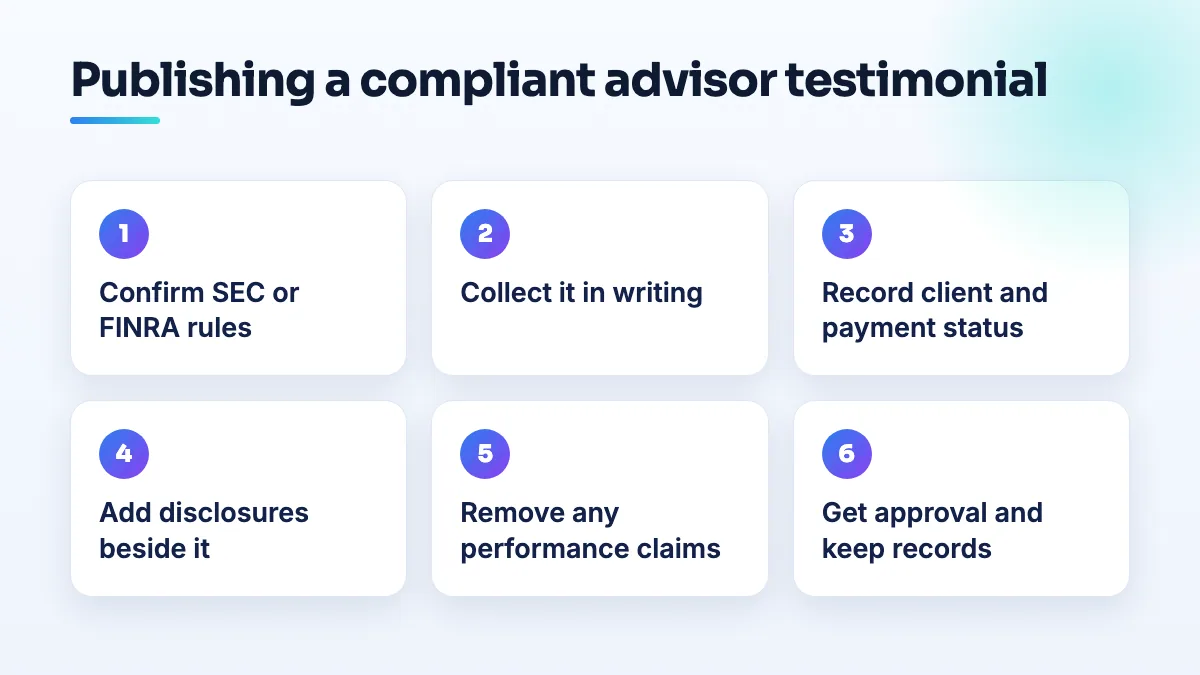
- Confirm which rules apply to you. Ask compliance whether your site is reviewed as an adviser advertisement, a FINRA retail communication, or both. The answer decides which disclosures go on every testimonial.
- Collect the testimonial in writing, with permission to publish. Use a short form that captures the words, the person's consent, the date, whether they're a current client and whether they received anything. Don't edit their words beyond spelling without asking them.
- Write the disclosure right next to the testimonial. Not in the footer and not behind a link. An example to take to your compliance team: "[First name] is a current client of [Firm] and received no compensation for this statement. This testimonial may not be representative of the experience of other clients and is no guarantee of future performance or success."
- Remove anything that sounds like a return. "My portfolio doubled" is a performance claim. The SEC's rule tightly limits how performance is presented, including no gross performance without net. I'd rather publish a testimonial about how clearly you explained a retirement plan than one about numbers.
- Get approval before it goes live, and keep the file. Save the approved version, the signed form and the date it was published. When a testimonial is updated or the client leaves, review it again.
- Put the testimonials where they help the reader decide. A few on the page for each service, such as retirement planning or business owner planning, beat a single "Testimonials" page nobody visits. It's how I structure advisor sites in our SEO content writing work, with compliance review built into the schedule.
That review step is the reason advisor content takes longer than anyone expects. I explain how to plan around it in the post on FINRA 2210 content approval timelines.
Google reviews and advisor compliance
Advisor Google reviews compliance is where firms get most nervous, and there's no rule text in front of me that settles every case. So here's how I approach it, to confirm with your compliance team:
- Reviews that clients post on your Google profile on their own are their words on Google's platform. Asking every client in the same neutral way isn't where I see the risk. Offering anything in return is.
- Once you pick reviews and put them on your website, in ads or on social media, I treat them as testimonials in your marketing and add the same disclosures as any other testimonial.
- Replies to reviews should be short and general. Don't confirm account details or discuss anyone's finances in public.
- Your profile name should follow Google's format. Google's guidelines for representing your business list financial planners as individual practitioners, and a solo advisor at a branded firm uses "[Firm]: [Your name]". Where several advisors share one office, the practitioner profile carries only the advisor's name.
What not to do
- Don't pay for reviews or testimonials without the disclosures. A gift card is compensation, and above $100 FINRA wants it disclosed.
- Don't hide disclosures in the footer. "Clearly and prominently" means next to the words they qualify.
- Don't publish a testimonial about returns. It pulls the whole page into the performance rules.
- Don't use testimonials from promoters you haven't checked. Paid promoters with a disqualifying event in the last 10 years are off limits.
- Don't copy a competitor's disclosure wording without review. Their registration and arrangements may not match yours.
Questions advisors ask
Can I quote a CPA or attorney who refers clients to me?
Yes, as an endorsement. Disclose that they aren't a client and whether they're compensated, including any referral arrangement. If they're paid, you'll need the written agreement too.
Do old testimonials from before the rule need updating?
If they're still on your site, they're still in use. I'd review every one against the current rule and either add disclosures or remove it.
Where to start
Pick five clients who've said something specific and kind about working with you, collect it in writing with the disclosure details, and send the page to compliance. Getting an advisor site found without tripping these rules is what our financial advisor SEO work is built around.
Written by Saifur Rifat, Founder & SEO Lead at SERP Squad.