

Designers decide where a lot of print goes, and many of them send clients to online printers or brokers because that's the option they know won't embarrass them. To become the print shop for designers and agencies in your area, you have to make that decision easy: show your equipment, your proofing, your stocks and your turnaround on pages a designer can check in five minutes, and prove you're the one running the press.
I start here with every print client because the designer is often the person who picks the printer, not the client paying the bill. Lose the designer and you never see the quote request.
Why designers send work somewhere else
In an r/graphic_design discussion about where designers send print, designers describe steering clients to online printers, and local shops lose the job before anyone asks them for a price. My read is that the reasons aren't really about cost. They're about risk.
- Predictability. An online printer publishes its specs, its stocks and its turnaround. The designer knows what the file needs and roughly what will come back.
- No phone call. Many local printers still need a call to answer basic questions about bleed, stock or timing.
- They can't find you. In a graphic design thread criticizing VistaPrint, even the critics assumed a good local shop simply couldn't be found.
A designer's reputation rides on how the print turns out. If your website doesn't show them how you'll protect it, they'll pick the option that feels safer, even if your work is better.
Why brokers win jobs they can't print
The other competitor is the print broker. In an r/CommercialPrinting thread about brokers competing with printers, shop owners describe brokers with no equipment going after the same jobs they quote. When I look at why brokers win, it's usually because they're easy to deal with: a clean website, a quick reply, one contact who handles everything.
My advice is to match the ease and beat them on proof. A broker can't show the press, can't run a press check, and can't promise the job never leaves the building. Those are exactly the things a careful designer wants, so put them front and center.
What a print shop for designers has to show
This is the checklist I'd work through before asking a single agency for work. If a designer can't find these on your site, they'll assume you don't have them.
- Your equipment, by name and purpose. Offset, digital, wide-format, finishing and bindery, with a line on what each is best for. This is the single clearest sign you're a printer, not a broker.
- File specs on one page. Bleed, safe zone, color mode, profiles you print to, how you handle spot colors, fonts and accepted file types.
- Your proofing options. PDF proof, hard proof, and whether you offer press checks, with the turnaround each one adds.
- A stock and finish library. The papers you keep in stock with weights and finishes, and the specialty options you offer, such as foil, spot UV, letterpress or die cutting.
- Turnaround by product. A simple table so a designer can plan a launch date without calling.
- Trade options. Blind shipping, unbranded packaging and a trade account with its own pricing.
- A named contact for designers. One person, a direct line and an email that gets answered the same day.
How to get specified by designers, step by step
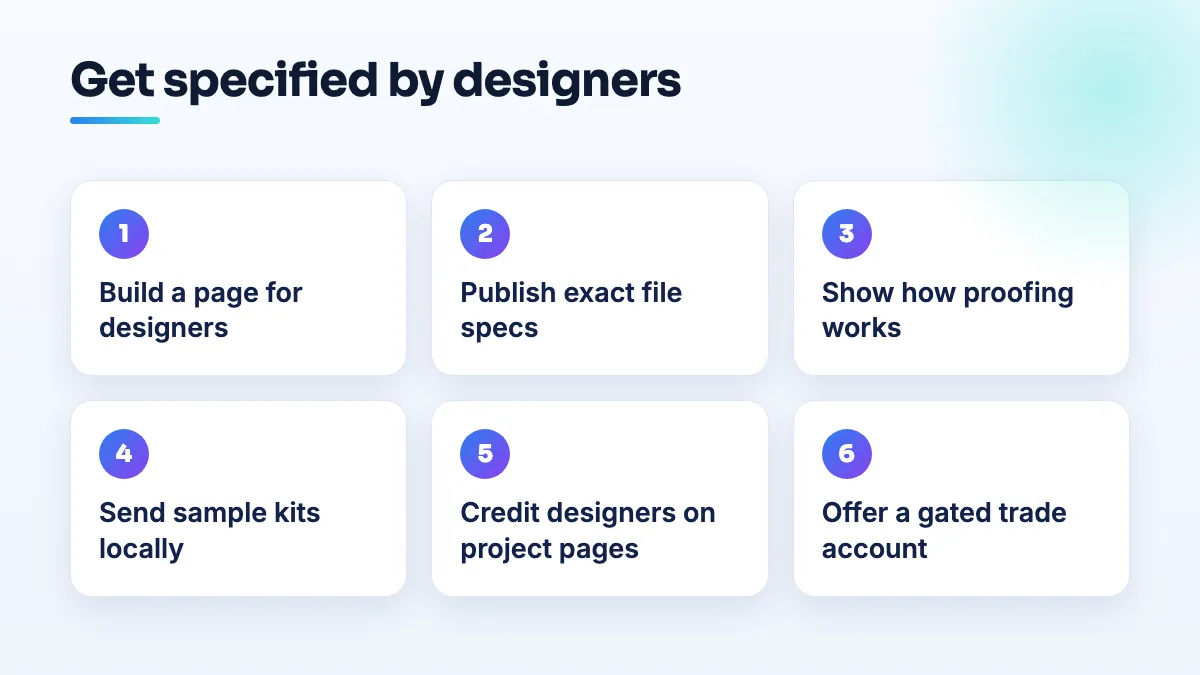
- Build a "For designers and agencies" page. Put the checklist above on it, or link to each part, and make it reachable from the main menu. This is the page you'll send every designer to, so it has to answer their questions without a call.
- Write the file-spec and stock pages properly. Short, exact and printable. These pages also rank for the searches designers make, like "trade printer" or "foil business cards" in your city. It's the kind of detailed service page writing most printers skip.
- Show your proofing, don't just list it. Photos of a hard proof next to the finished piece, a short explanation of how you flag file problems before press, and what happens if a color is off. This is the answer to the designer's real worry.
- Send a sample kit to local designers and agencies. Your stocks, a few finishes and a card with the direct contact. A designer who has held your work is far more likely to specify it than one who has only seen photos.
- Publish project pages that credit the designer. With permission from the designer and the client, show the finished piece, the stock and finish, and name the studio. Designers share work that credits them, and each page gives you something specific to rank for.
- Offer a trade account with gated prices. Designers and agencies who mark up print need prices their clients can't see. How to set that up without undercutting anyone is covered in the answer on gated trade prices.
- Follow up after the first job. Ask how it went, fix anything that went wrong, and ask whether you can show the piece. The second job is where specification actually starts.
How designers search for a printer
In my experience designers rarely search "printing near me". They search for the capability their project needs, often with a city: letterpress, foil stamping, risograph, large-format fabric, short-run packaging, trade printing. Each of those is a page you can own if you actually offer it.
My advice is to build a page for each specialty you're genuinely good at, with photos of real jobs, the stocks it works on, minimum quantities and turnaround. A designer who lands on a page that answers all of that is already halfway to specifying you. This is the part of printing company SEO that pays off most with agency work, because one agency relationship can bring many clients.
Winning against brokers on proof
- Say what you print in-house. On each product page, a line such as "printed and finished in our shop" is a plain fact brokers can't claim.
- Be honest about what you send out. If you outsource a specialty, say so and say who checks it. Designers respect that more than a vague "we do everything".
- Invite press checks. An open invitation to stand at the press for a critical job is something a broker can't offer.
- Answer fast. The broker's real advantage is response time. Match it with a same-day reply to every designer inquiry.
What not to do
- Don't use stock photos of presses. Designers can tell, and it's exactly what a broker's website looks like.
- Don't make designers call for specs. If the file requirements aren't on the site, the online printer wins by default.
- Don't quote the designer's client directly at a lower price. If a client contacts you about a job a designer brought in, send it back through the designer. Undercut them once and you'll never be specified again.
- Don't chase every commodity job. The designers worth winning bring work that needs care. That's where you beat both the online printers and the brokers.
Where to start
If I were starting from nothing, I'd build the designer page first, then send a sample kit to five local studios. I'd measure it simply: how many studios sent a first job within a few months, and how many sent a second. If most of your lost work is going to online printers rather than brokers, read how to compete with VistaPrint next, because the two problems share a fix: show what a person and a press can do that an upload form can't.
Written by Saifur Rifat, Founder & SEO Lead at SERP Squad.